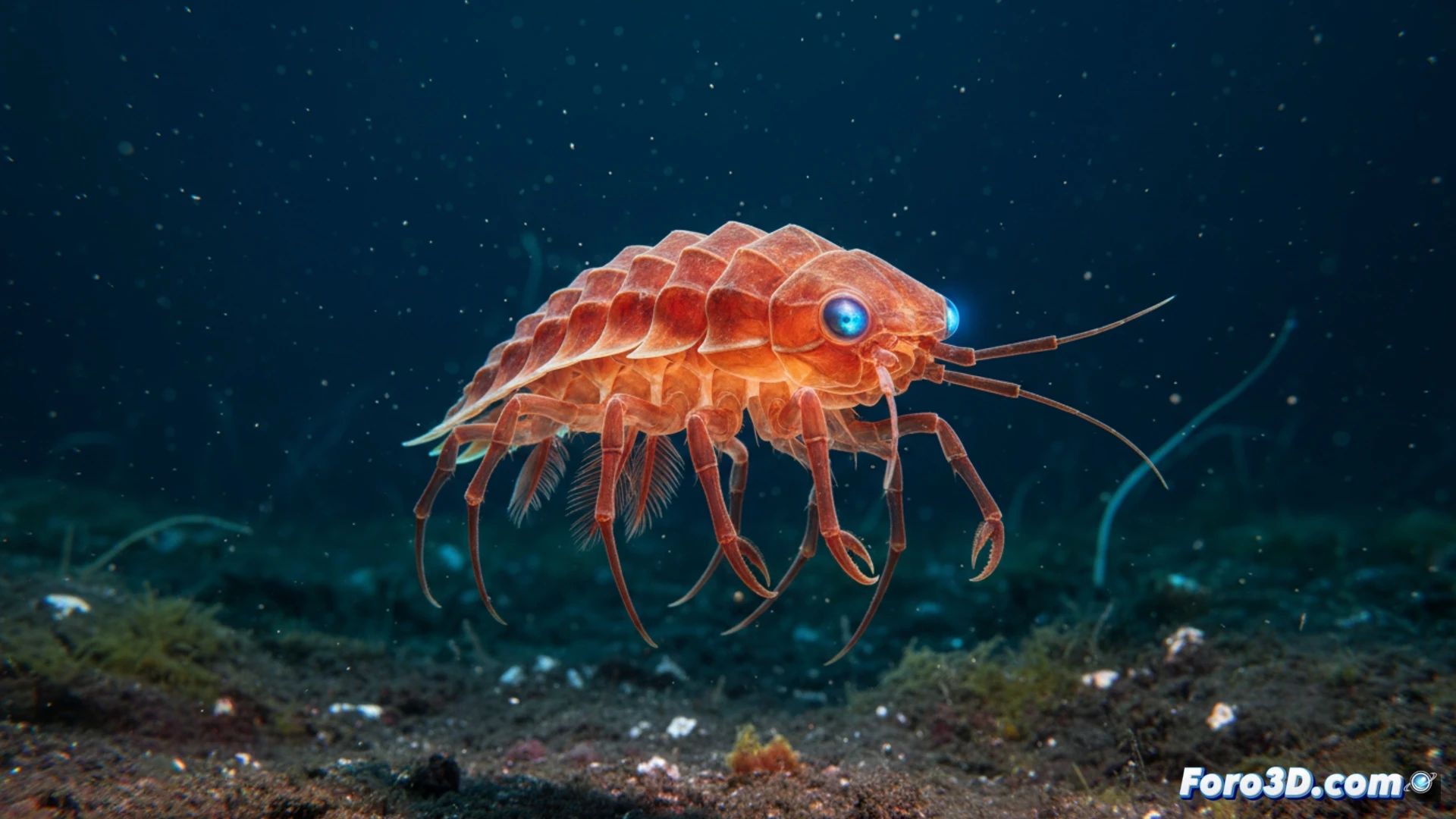
Scientific visualization has taken a qualitative leap with the digital reconstruction of Thrombasia ania, an amphipod species identified in 2024 through advanced taxonomic analysis of samples extracted from ocean trenches. This three-dimensional model, developed from electron microscopy data and genetic sequencing, allows exploring every detail of its morphology adapted to extreme pressure. The result is a key tool for researchers and science communicators seeking to understand life in the deep-sea abyss.
Digitization process and adaptive morphology 🧬
The 3D reconstruction of Thrombasia ania was based on the segmentation of micro-computed tomography images and correlation with data from its chitinous exoskeleton. The model reveals elongated appendages and sensory setae that allow it to detect prey in total darkness, as well as a compact digestive system that optimizes the consumption of organic matter in an environment with scarce resources. The visualization includes an interactive comparison with other abyssal amphipods such as Hirondellea gigas, highlighting differences in the cuticle and the arrangement of locomotor muscles. This digital representation not only facilitates the study of the species' biomechanics but also allows simulating its behavior in a digital twin of the hadal ecosystem.
The value of interactive infographics in hadal exploration 🌊
Beyond anatomy, the 3D model of Thrombasia ania is integrated into an interactive infographic of its habitat in the ocean trench, where conditions of pressure, temperature, and chemosynthesis are recreated. This tool allows users to navigate the water column profile and observe how the species moves between sediment deposits and hydrothermal vents. For the scientific community, it represents an advance in the dissemination of cryptic biodiversity; for the general public, it turns a taxonomic discovery into a visual experience that sparks curiosity about the unknown.
What was the greatest technical challenge in digitally reconstructing the transparent and gelatinous structures of Thrombasia ania to achieve a scientifically accurate 3D visualization?
(PS: modeling manta rays is easy; the hard part is making them not look like floating plastic bags)