NASA has confirmed the launch of the Nancy Grace Roman Space Telescope for September 2026, an instrument that will revolutionize scientific visualization. With a field of view 100 times greater than Hubble and 50 times greater than James Webb, its 18 detectors will capture data from billions of galaxies. For 3D graphics experts, this represents a challenge and an opportunity: transforming that torrent of information into interactive volumetric models of the large-scale universe.
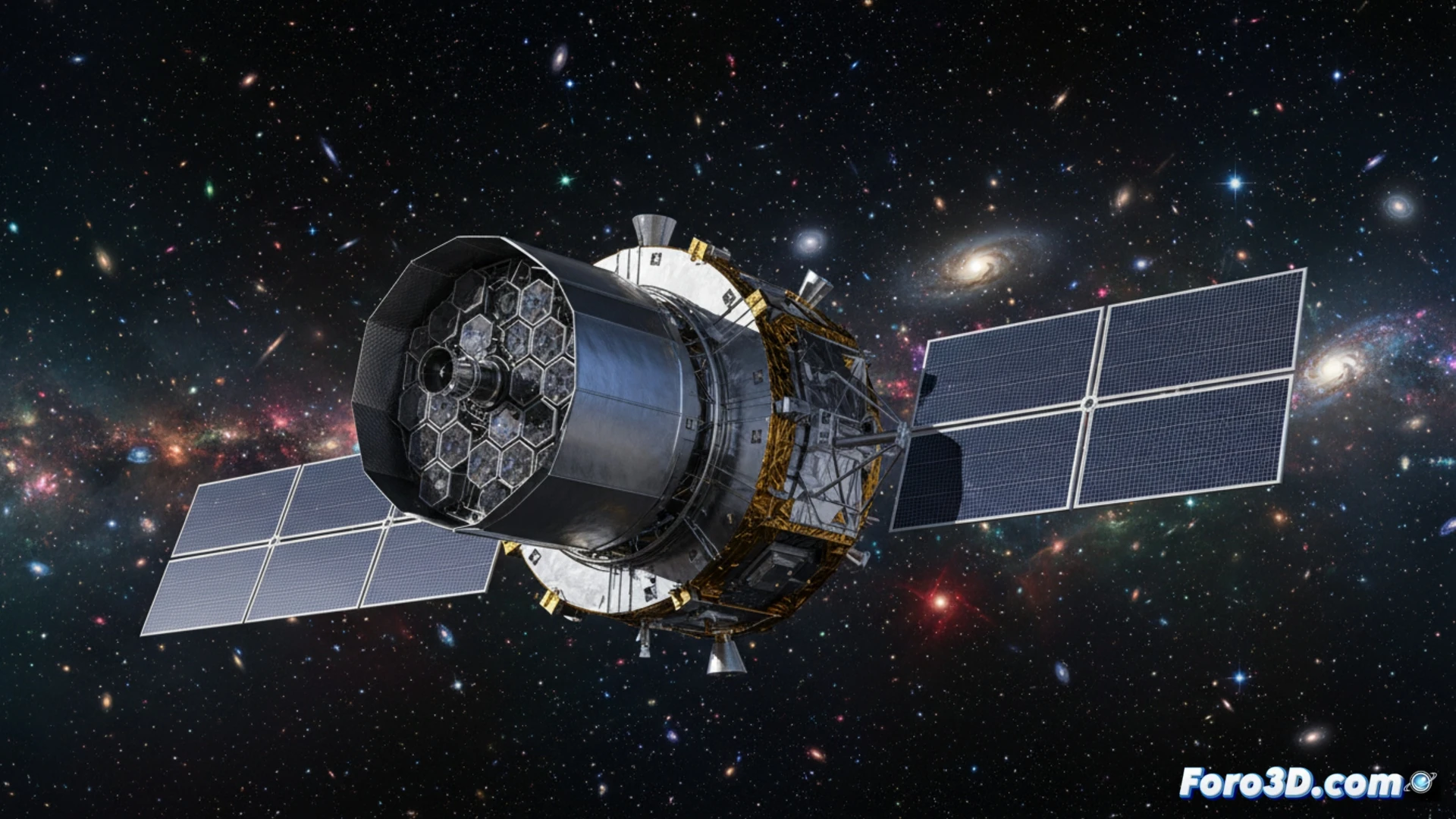
3D Visualization of Massive Data: From Sweep to Detail 🚀
The Roman will operate as a cosmic scanner, sweeping across expanses without a fixed target. In the realm of 3D visualization, this involves working with gravitational microlensing and planetary transit data. Tools like Blender with astronomical add-ons or specialized software such as AstroViz allow mapping the position of tens of thousands of exoplanets in three-dimensional space. The key lies in representing the complementarity with James Webb: while Roman generates a low-resolution galactic density map, Webb applies a high-precision zoom. Rendering pipelines must manage levels of detail (LOD) that alternate between point clouds of billions of galaxies and detailed models of individual supernovae.
Simulating the Invisible: The Art of Cosmic Scale 🌌
The true technical challenge is not just displaying data, but simulating phenomena that the human eye cannot perceive. For example, detecting planets via microlensing requires animating light curves in 3D and warping spacetime around stars. This is achieved using real-time volumetric shaders (such as in Unity or Unreal Engine) that represent gravitational curvature. Roman forces us to think in scales: moving from visualizing a nebula to rendering a 10-gigaparsec cube. The Foro3D community can lead the creation of interactive prototypes showing how Roman's sweep and Webb's zoom complement each other, using simulated NASA data.
How will the three-dimensional data from the Roman Telescope be integrated with existing scientific visualization systems, such as Unity or Blender, to allow researchers to explore the massive structure of the cosmos in real time?
(PS: at Foro3D we know that even manta rays have better social bonds than our polygons)