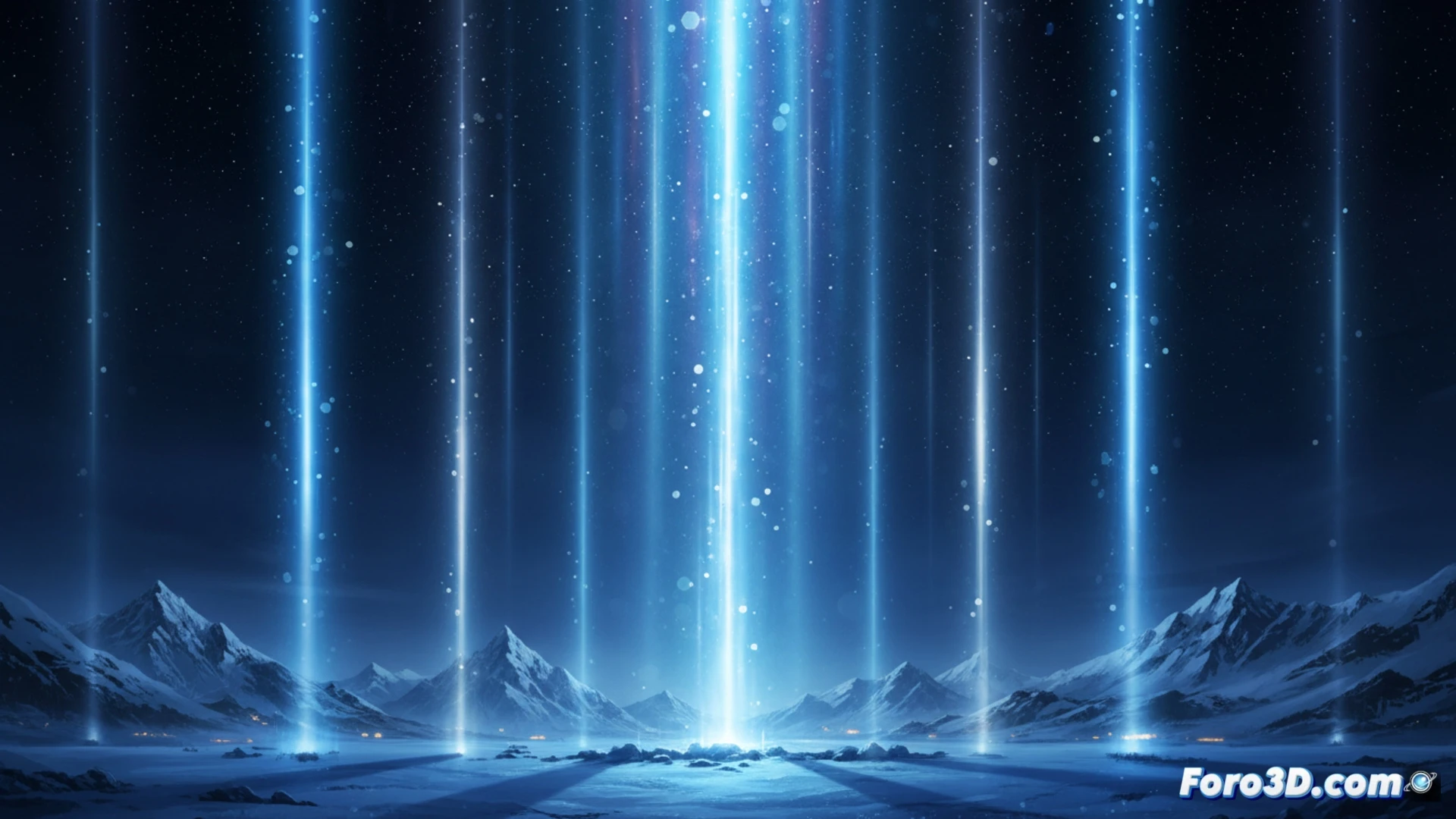
Light pillars are a nocturnal visual spectacle where vertical luminous columns appear to emerge from terrestrial light sources. This phenomenon, purely optical, is not physical light, but the reflection of it in millions of flat, hexagonal ice crystals suspended in a frigid and calm atmosphere. For scientific visualization, recreating this effect in 3D not only allows for its study but also enables the precise and spectacular dissemination of an atmospheric physical principle.
Technical Pipeline for Digital Recreation 🔧
The simulation begins with the modeling or instancing of flat hexagonal ice crystals. Tools like Houdini are ideal for generating thousands of these plates with random, but predominantly horizontal, orientations, simulating their suspension in layers of stable air. The next crucial step is assigning the correct optical properties to the material: a perfect or near-perfect reflection shader, without significant refraction. The light source, preferably an area light or a set of point lights at the position of the real focus, illuminates this cloud of crystals. The final render, with high exposure and possibly slight volumetric effects for the atmosphere, captures the sum of all those micro-reflections, creating the illusion of a solid column of light.
Beyond the Static Image 🎬
The true power of this recreation lies in its ability to go beyond a photograph. An interactive or animated 3D simulation allows for altering parameters in real-time: varying the temperature to change crystal density, modifying their orientation angle, or moving the light source to observe how the pillar deforms. This transforms the visualization into a powerful educational tool, breaking down a complex phenomenon into understandable variables and demonstrating the power of 3D for science.
How can atmospheric light pillars be physically simulated in 3D software using particles and shaders to replicate the scattering of hexagonal ice crystals?
(PS: if your manta ray animation isn't exciting, you can always add some documentary music from La 2)