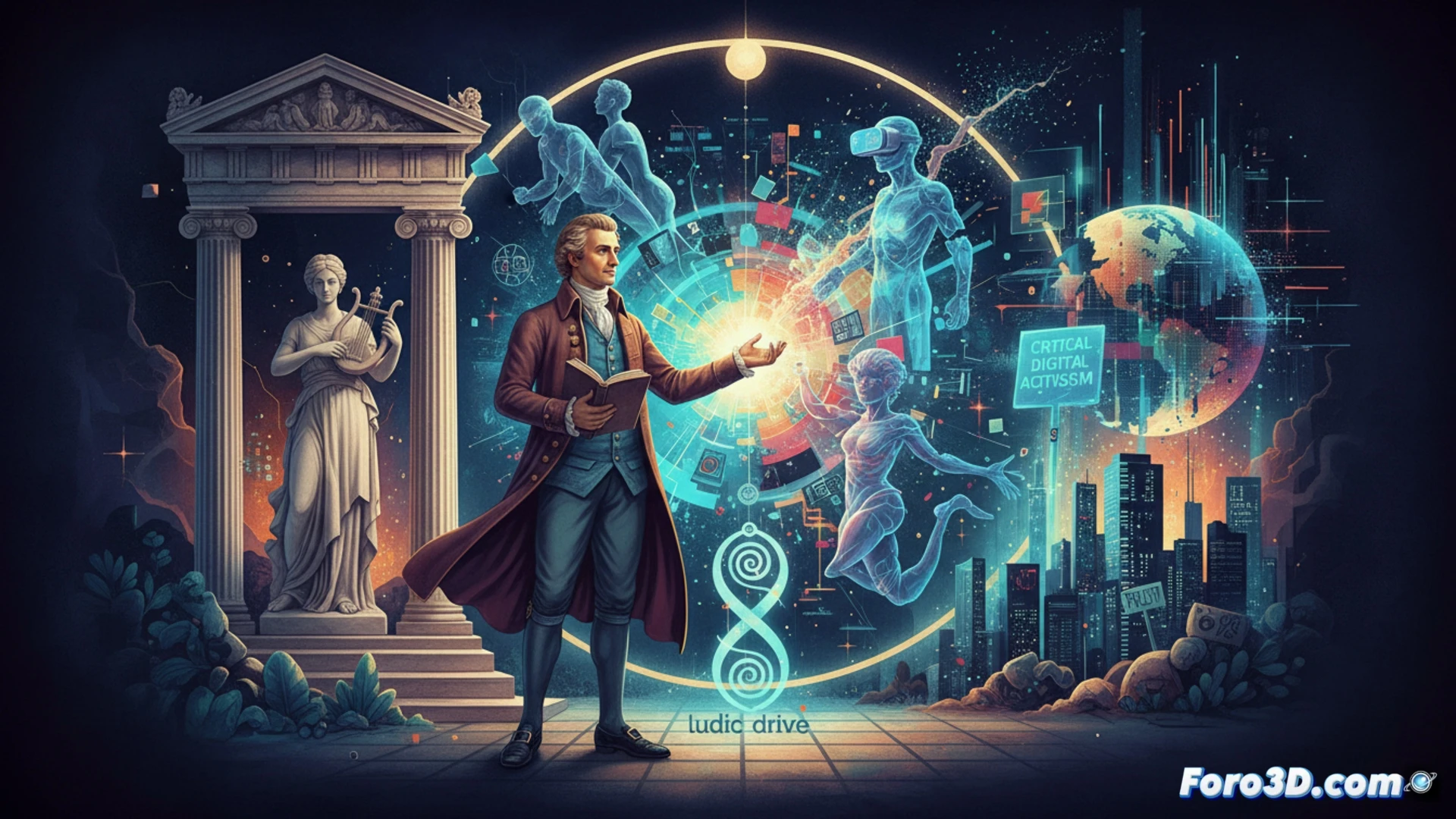
In his Letters on the Aesthetic Education of Man, Friedrich Schiller proposed that art is the essential bridge between our sensible nature and our reason. For him, the aesthetic experience, through the play impulse, makes us free and complete. In the current context of digital art and activism, this philosophy regains surprising relevance. 3D tools, virtual reality, and new media are not just techniques, but spaces where that serious play can question realities and form a critical consciousness, aligning digital creation with a profound social purpose.
The Play Impulse as the Engine for Critical Creation in 3D 🎮
Schiller distinguished between the sensuous impulse (passive, material) and the formal impulse (active, rational). Beauty and art arise from a third: the play impulse, which reconciles both. For the digital creator, this translates into projects that surpass mere technical imitation or purely discursive messaging. An interactive 3D environment that critiques mass surveillance, for example, not only informs (formal impulse) but makes one sensorially experience oppression (sensuous impulse). The play here is the meaningful interaction, the design of a total aesthetic experience that, by moving and making one think simultaneously, educates perception and promotes an inner freedom in the face of the systems it criticizes.
Beyond the Render: The Social Function of Digital Art 🤔
The ultimate goal of aesthetic education in Schiller was the formation of free individuals and, by extension, a free society. This ethical horizon is crucial for digital activism. It's not just about mastering software or producing striking images, but about asking: does this work contribute to an aesthetic education of the viewer? Does it foster free reflection or impose a dogma? Committed 3D art, from immersive installations to online activism, finds in Schiller a framework to aspire to something greater than ephemeral provocation: the creation of symbolic spaces where one can exercise, in a playful and profound way, the freedom of thought.
How can today's digital art tools materialize Schiller's play impulse to create aesthetic experiences that foster a critical and active consciousness in the viewer?
(PS: Pixels have rights too... or at least that's what my last render says) 🎨