Counterfeit medication is a global threat requiring advanced forensic techniques for traceability. Researchers have developed a method that uses the surface roughness of tablets as a unique fingerprint. Using a micrometric 3D scanner, they capture the texture left by the tablet press, successfully linking seized drugs to specific presses in clandestine laboratories, even when no batch documentation exists.
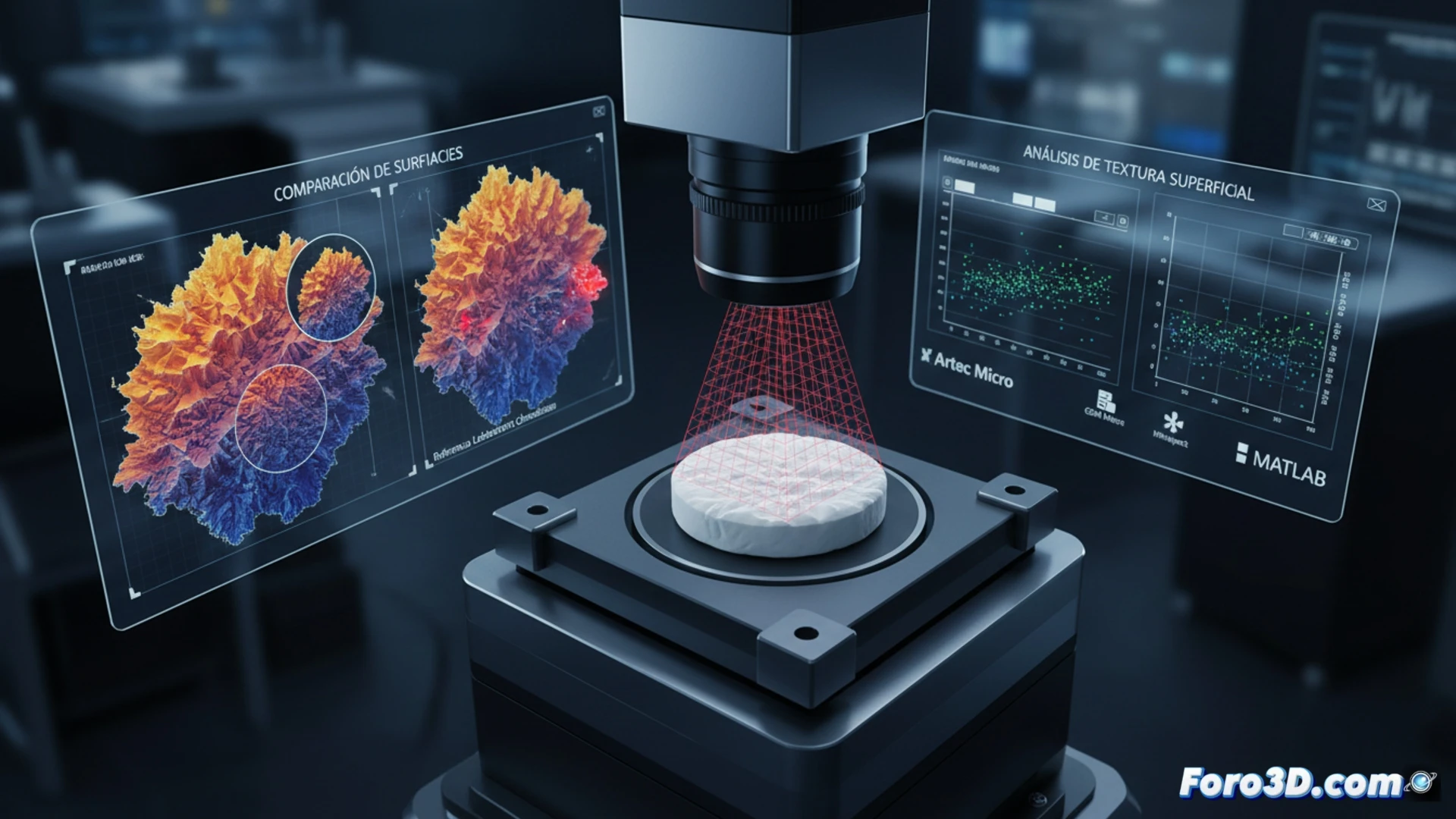
Forensic workflow: Capture, alignment, and expert validation 🔬
The process begins with high-precision scanning using an Artec Micro, capturing the tablet's surface topography with micrometric resolution. This model is exported to GOM Inspect, where a surface comparison is performed against the die of the seized press. Best-fit alignment allows for calculating geometric deviations and extracting the roughness pattern. Subsequently, MATLAB analyzes the surface texture using parameters such as Sa (arithmetic mean deviation) and Ssk (skewness), generating a unique statistical signature. This workflow, documented step by step, complies with chain of custody standards to be presented as expert evidence in a court of law.
The value of imperceptible detail as irrefutable evidence 🧬
The fascinating aspect of this technique is that it leverages a manufacturing defect as a forensic advantage. Micro-imperfections on the die, invisible to the human eye, are transferred to each tablet like a mechanical watermark. This not only allows identifying the exact press but also differentiates batches produced on the same machine. In a context where counterfeiters copy logos and colors, 3D scanning demonstrates that surface texture is the most difficult link to forge, turning the microscopic into definitive proof.
How can surface roughness detected by 3D scanning reliably differentiate between an original pharmaceutical tablet and a counterfeit one when both have similar coatings?
(PS: In the forensic pipeline, the most important thing is not to mix the evidence with the reference models... or you'll end up with a ghost at the scene.)