In a long-range attack scenario, the projectile must pass through two inclined tempered glass windows before reaching its target. The deviation caused by refraction, although minimal in each pane, accumulates and can shift the impact by several centimeters at 800 meters. To solve this problem, a 3D pipeline was implemented integrating Faro Zone 3D, Rhino 3D, LS-DYNA, and Blender, allowing the line of fire to be corrected and the shooter's nest to be located with millimeter precision.
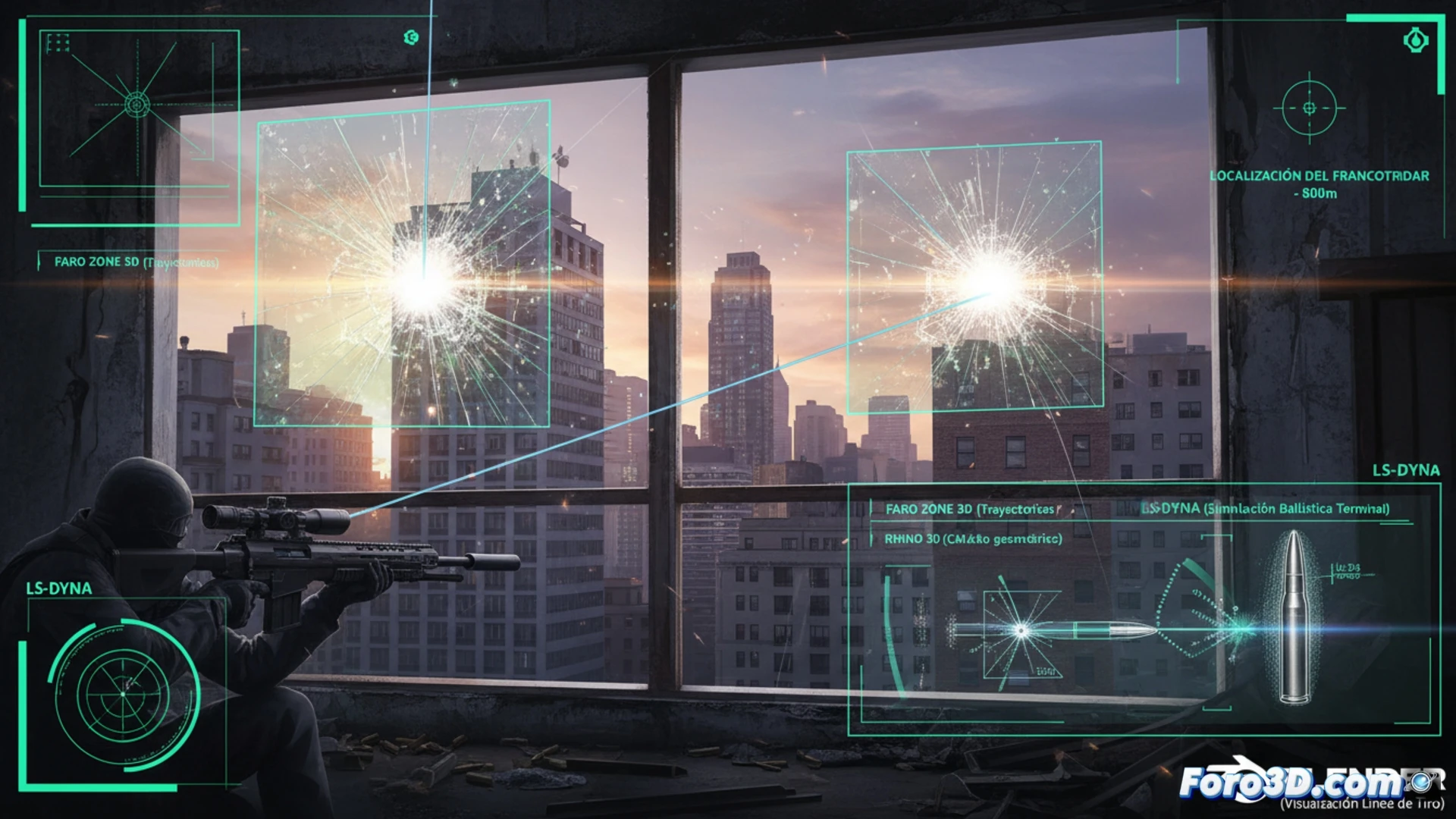
Technical pipeline: from laser scene to impact simulation 🎯
The process begins with Faro Zone 3D, which captures the geometry of the building and windows through laser scanning, generating a point cloud with the exact inclination of each pane. This information is exported to Rhino 3D, where Snell's law is applied to calculate the angular deviation of the projectile when changing medium. The tempered glass is modeled with a refractive index of 1.52 and the incident ray is traced. The corrected trajectory is input into LS-DYNA to simulate terminal ballistics, evaluating projectile deformation and glass fragmentation. Finally, Blender visualizes the complete line of fire, overlaying the original and corrected paths to validate the calculation.
The hidden physics behind the glass: precision at the threshold of error 🔬
The key to success lies in understanding that refraction is not a linear phenomenon. Each tempered glass pane acts as a thin prism that deflects the projectile according to the angle of incidence and the thickness of the material. At distances greater than 500 meters, ignoring this effect can mean the difference between a lethal impact and a total miss. This pipeline demonstrates that 3D simulation not only reconstructs scenes but corrects physical reality, transforming an optical error into a forensic location tool.
Which physics engine do you prefer for precise simulations?