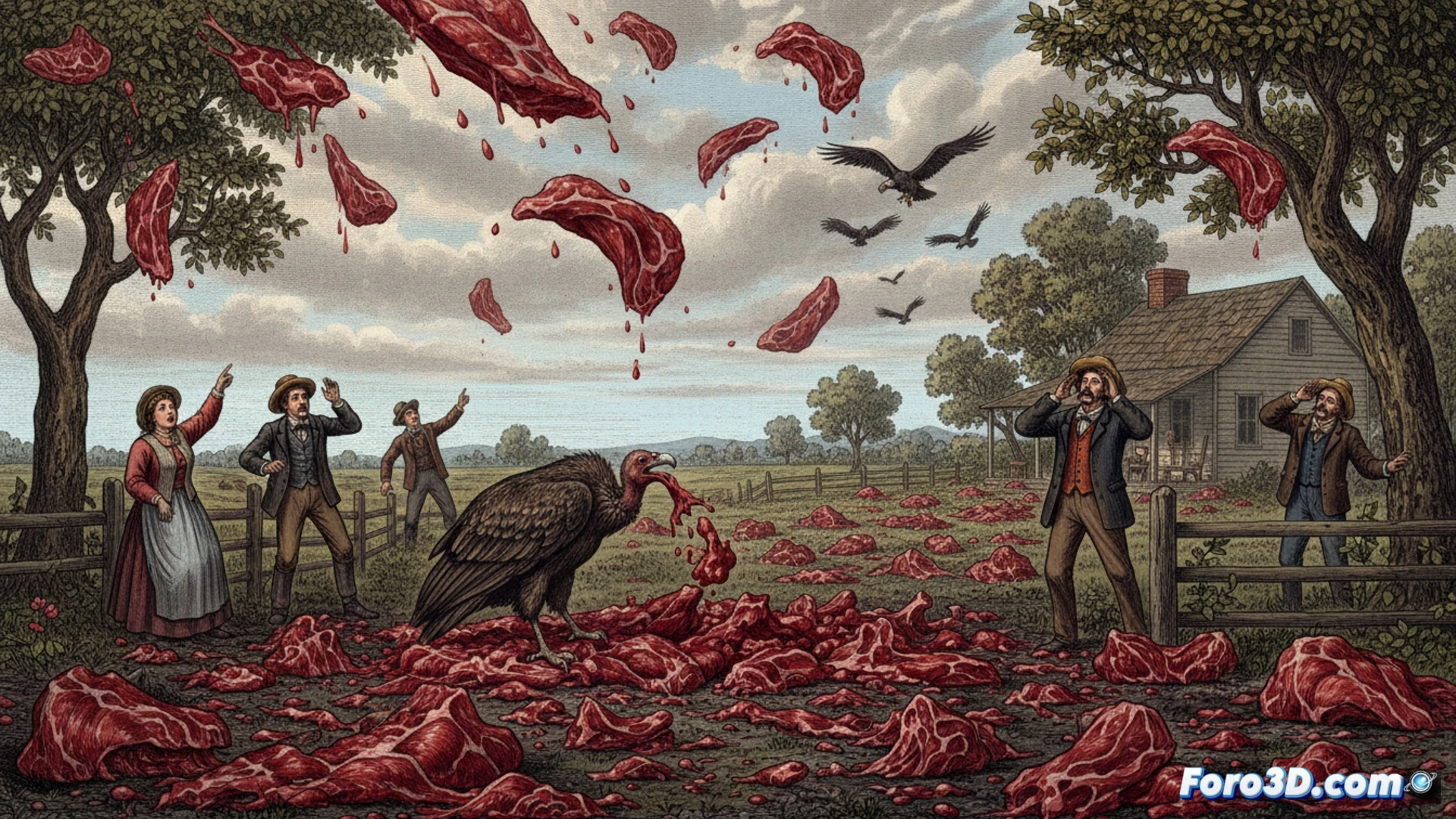
In 1876, an unusual event astonished Bath County, Kentucky: for several minutes, pieces of red meat fell from the sky over a 90-meter area. This event, with no definitive explanation, is a perfect case for scientific visualization. Through 3D modeling, we can reconstruct the scene, analyze the distribution of the fragments, and evaluate the theories, transforming a historical account into an interactive and accessible object of study.
Methodology for Modeling a Historical Phenomenon 🧩
The reconstruction begins with geolocation and modeling of the affected terrain. On this, instances of meat fragments are distributed, based on historical descriptions of size and density. A particle system can simulate the fall. In parallel, the main hypothesis is modeled: a group of vultures regurgitating in flight. The comparative visualization of this theory against others, such as aggregations of airborne bacteria, allows the user to evaluate probabilities based on the spatial arrangement and the real scale of the event.
Visualization as a Tool for Critical Thinking 💡
Beyond recreating a mystery, this project underscores the value of 3D visualization for scientific outreach. By materializing hypotheses in a virtual space, objective evaluation is fostered. The user not only reads about vultures but sees their trajectory and the resulting dispersion simulated. Thus, 3D technology becomes a bridge between historical curiosity and methodological analysis, inviting a well-founded reflection on extraordinary phenomena.
How can modern 3D scientific visualization techniques be applied to analyze and represent hypotheses about the origin and fall dynamics of an anomalous atmospheric event like the Kentucky meat shower?
(PS: modeling manta rays is easy, the hard part is making them not look like floating plastic bags)