In the early hours of Monday, a 25-year-old driver under the influence of alcohol struck a pedestrian in the Coll d'en Rabassa neighborhood of Palma. He was driving at high speed, lost control on a sharp turn, mounted the sidewalk, and crashed into a metal bollard. The victim was thrown against the windshield. This incident is an ideal case for applying a complete 3D forensic pipeline, from scene capture to impact simulation. 🚗💥
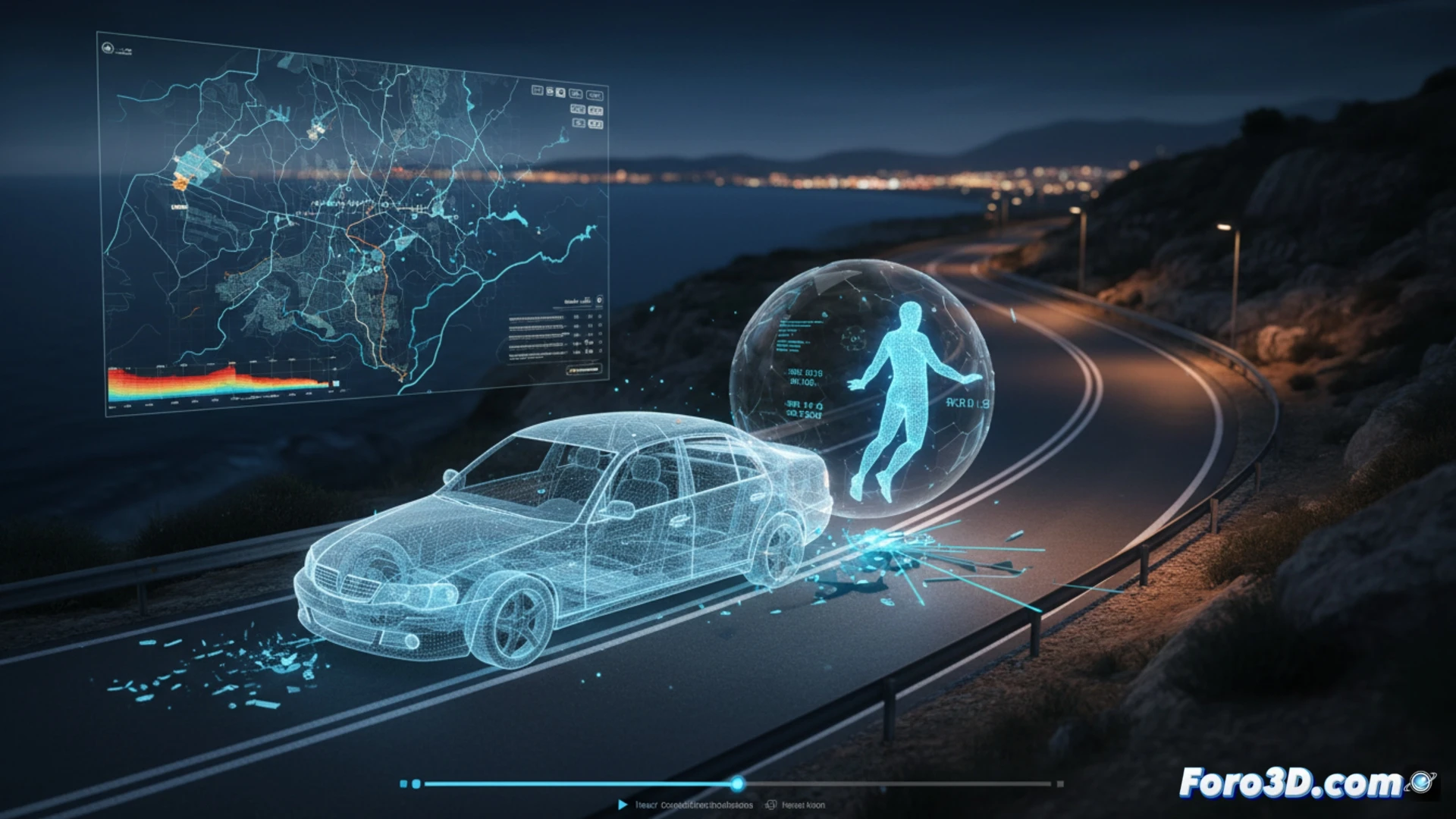
Workflow for the virtual reconstruction of the incident 🛠️
The first step would be to document the scene using terrestrial laser scanning or aerial photogrammetry with a drone, obtaining a high-precision point cloud of the roadway, sidewalk, and metal bollard. Using software like FARO Scene or RealityCapture, the involved vehicle would be modeled and its post-impact position adjusted. The driver's trajectory would be recreated in a 3D environment using PC-Crash or Virtual CRASH, where variables such as the estimated initial speed (calculated from skid marks and the bollard's projection distance) and the steering angle would be input. The dynamic simulation would allow calculating the collision force against the pedestrian, reproducing their backward projection and head impact against the windshield, thus validating the accident mechanics.
The importance of forensic data against reckless driving ⚖️
This case highlights how the combination of alcohol and high speed triggers preventable tragedies, but also demonstrates that 3D forensic technology is key to clarifying responsibility. Without an accurate model of the scene, the defense could question the vehicle's trajectory or speed. The virtual recreation, with objective data such as the bollard's deformation and the victim's final position, provides judges and experts with an irrefutable visual representation, raising the standard of justice in road incidents.
How the dynamics of a nighttime hit-and-run in Coll d'en Rabassa are modeled and validated when vehicle speed and trajectory data come solely from testimonies and partial skid marks.
(PS: don't forget to calibrate the laser scanner before documenting the scene... or you could be modeling a ghost) 👻