The recent fatal electrocution at Castellbisbal station, where a person died after coming into contact with a high-voltage cable, opens a technical debate on the documentation of railway accidents. For Forensic Pipeline specialists, this case represents an ideal scenario to apply 3D capture workflows that can clarify the accident dynamics, from the exact position of the victim to the actual distance from the electrical infrastructure.
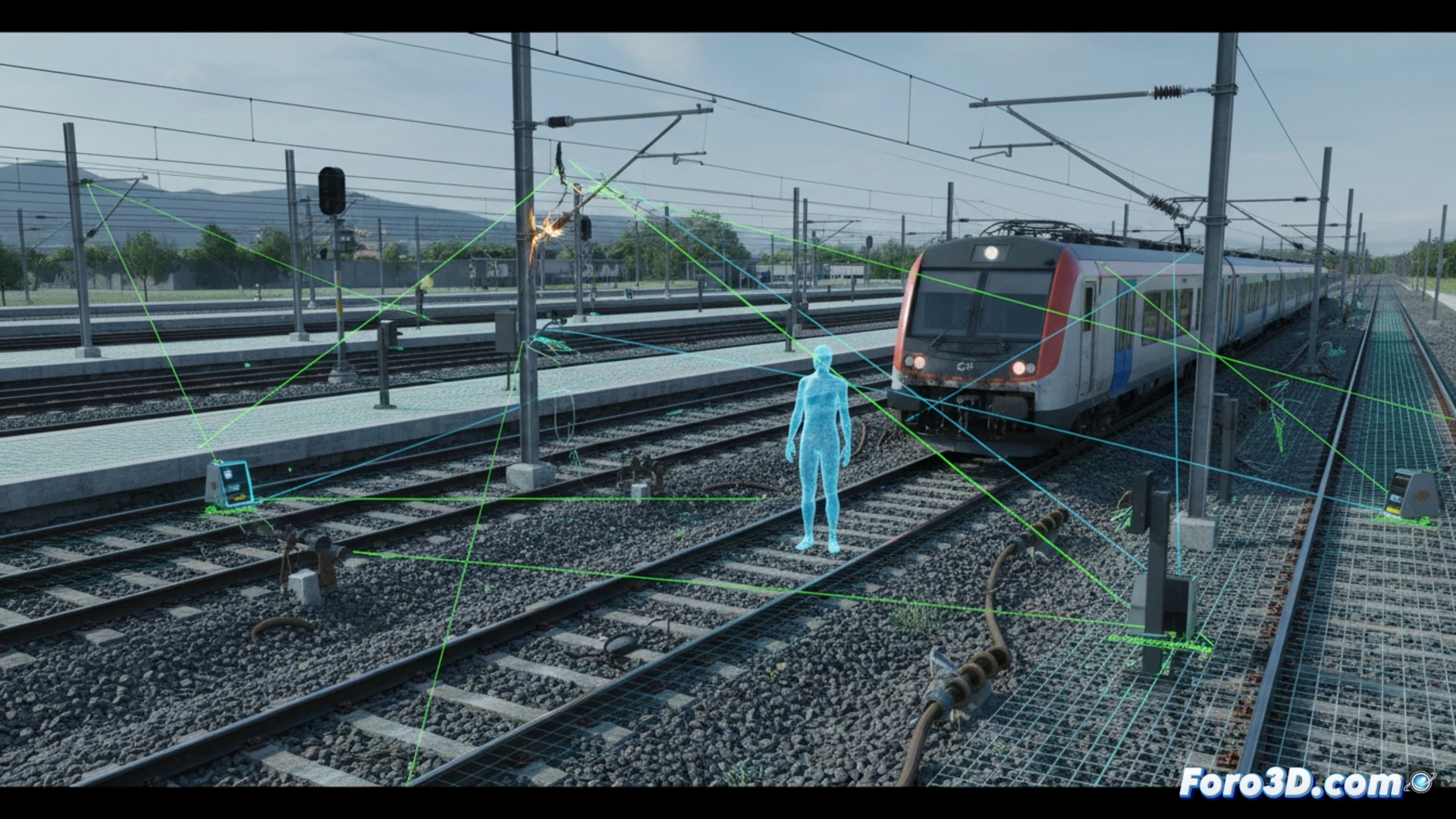
Workflow: Photogrammetry and laser scanning in railway scenes 🚆
The action protocol for this type of incident should begin with a terrestrial laser scanner (TLS) sweep to capture the complete geometry of the track area, including the catenary and high-voltage poles. Subsequently, short-range photogrammetry allows documenting the point of contact and ground marks with millimeter detail. With this data, a point cloud is generated and processed in reconstruction software such as RealityCapture or Agisoft Metashape. The result is a textured 3D model that allows experts to measure exact distances between the cable and the body, simulate fall trajectories, and analyze environmental factors such as humidity or track slope, crucial data for determining responsibilities.
From virtual evidence to railway prevention 🛡️
Beyond the judicial investigation, the resulting 3D model becomes an invaluable educational tool. By allowing the accident to be recreated from any angle, Renfe engineers can identify safety blind spots or deficiencies in cable insulation. Simulating the electric arc in virtual environments helps visualize the lethality radius, facilitating the implementation of physical barriers or proximity sensors. Ultimately, 3D forensic technology not only seeks procedural truth but also offers a tangible path to ensure tragedies like the one in Castellbisbal are not repeated.
Would you use a laser scanner or photogrammetry to document this case? 🔍