In a recent case of a shooting against an armored vehicle, the projectile failed to penetrate the curved laminated windshield, instead bouncing off. This event, seemingly a dead end without analysis, became the key piece to locate the shooter. Through a technical forensic workflow integrating 3D scanning, geometric calculation, and simulation, it was possible to reverse the physics of the impact. The static evidence, a cavity in the glass, dynamically revealed the exact angle of incidence and, with it, the point of origin of the shot.
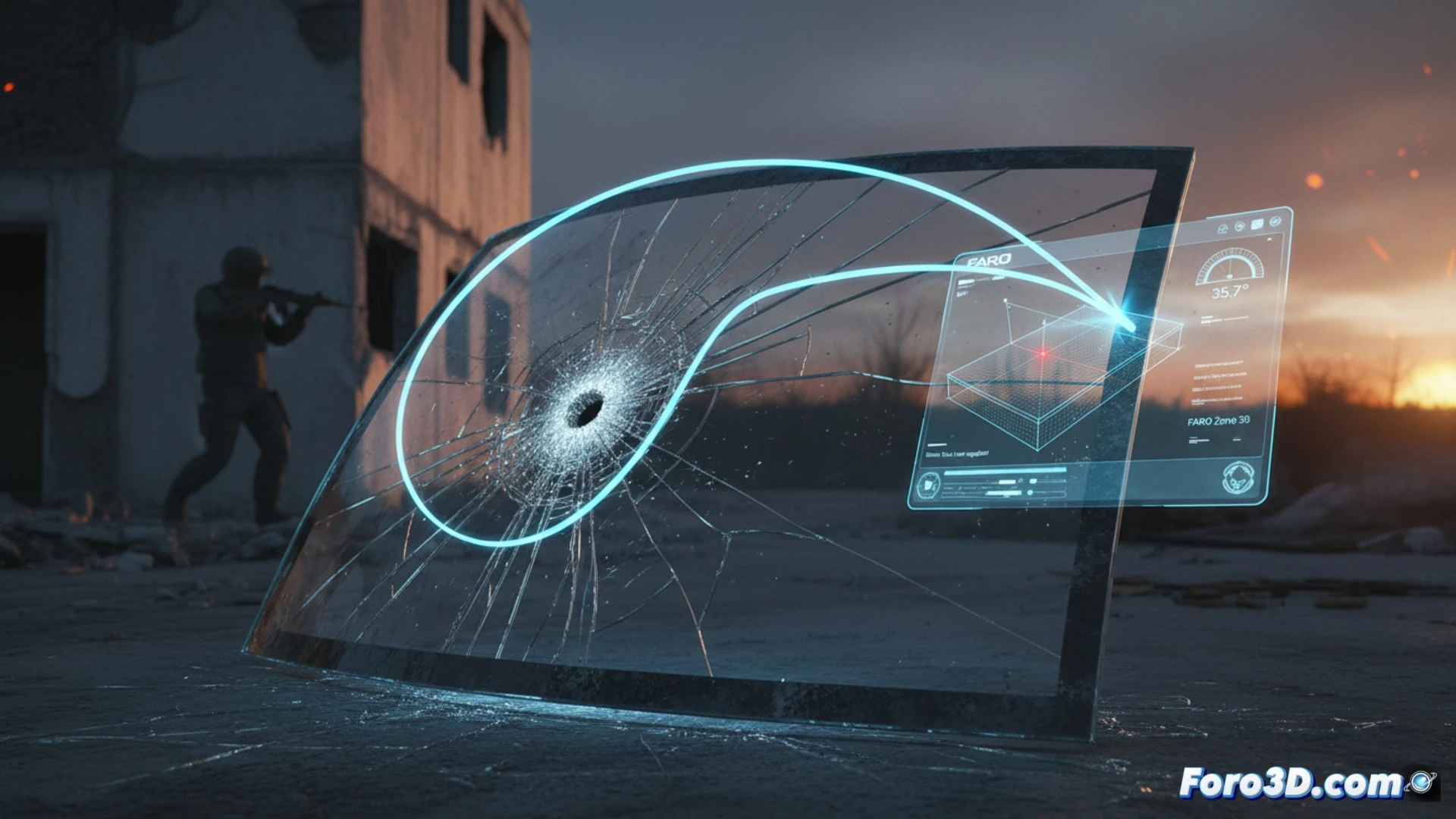
Technical Workflow: From Scanning to Simulation 🔬
The process began with the precise capture of the impact cavity in the curved glass using a Faro Freestyle 3D scanner, generating a high-fidelity point cloud. This model was imported into Rhino 3D, where Snell's law for refraction in laminated media was applied. By calculating the bounce vector from the impact geometry and material properties, the reverse trajectory was traced. To validate the hypothesis, LS-DYNA was used to simulate the impact, contrasting the virtual damage with the real one. Finally, in FARO Zone 3D, the calculated trajectory was extrapolated into the 3D environment of the scene, pinpointing the point of origin behind a corner.
The Static Evidence as a Dynamic Witness 🕵️
This case underscores a crucial forensic principle: a physical piece of evidence is not just an object, but a coded record of a dynamic event. The described methodology transforms a simple impact into a quantitative testimony. The integration of engineering tools, like LS-DYNA, with forensic documentation software, like Zone 3D, closes the loop between physical theory and investigative application, offering objective and defensible conclusions in a judicial environment.
How can the three-dimensional ballistic trajectory of a projectile that impacts and bounces off a curved laminated windshield be precisely reconstructed, considering the non-linear deformations of the glass and the possible alteration of the physical evidence?
(PS: In scene analysis, every scale witness is a small anonymous hero.)