The manipulation of payment QR codes, known as physical quishing, has evolved towards superimposition techniques that are almost undetectable to the naked eye. In a recent case, a parking network fell victim to this fraud when fake stickers were adhered over the original codes. The key to proving the manipulation lay not in the image, but in the surface topography, analyzed through a 3D forensic workflow that revealed the relief differences between the original ink and the added adhesive.
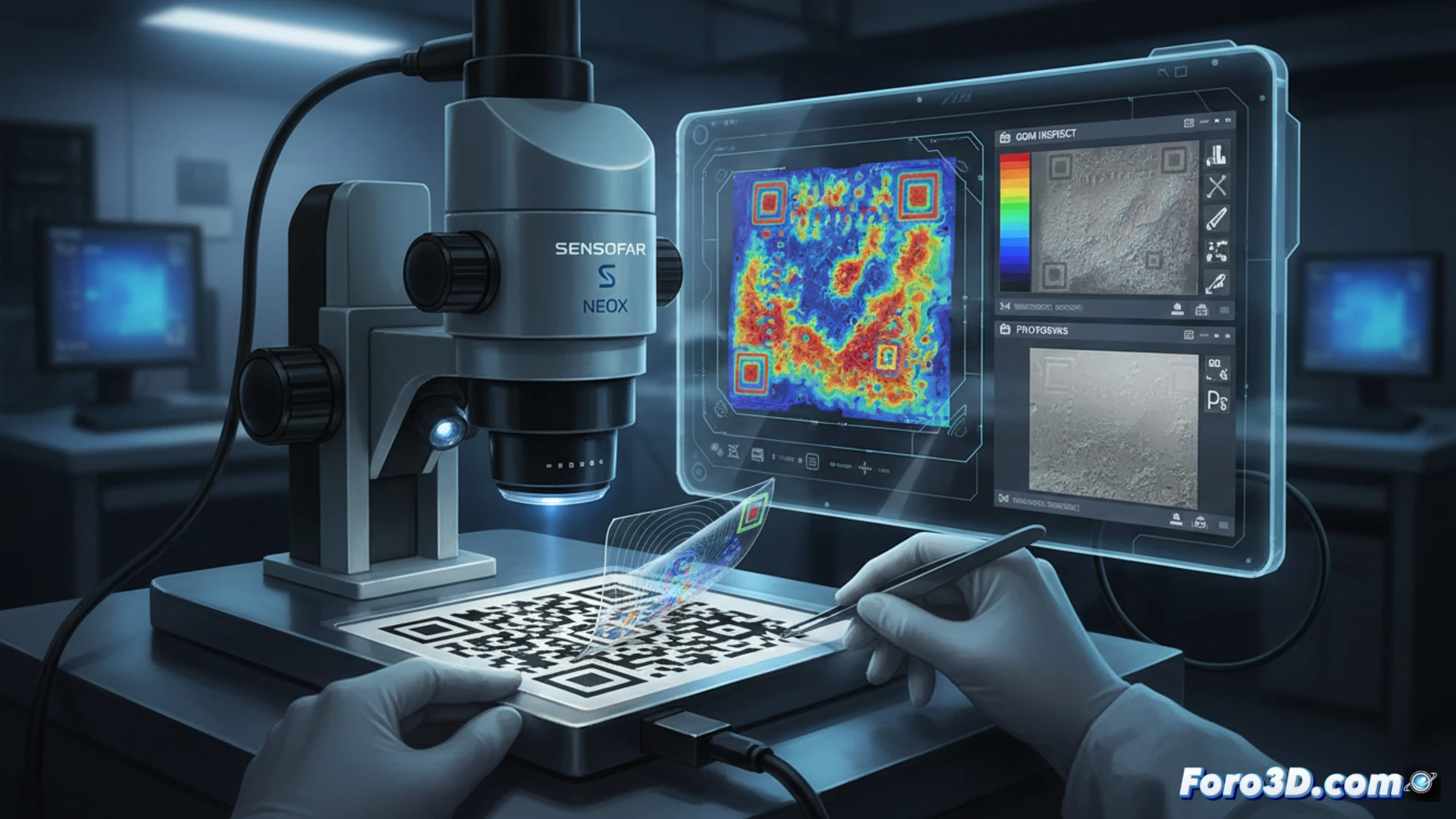
Workflow: Topographic capture and relief analysis 🔬
The process begins with the Sensofar S neox 3D microscope, which performs a non-contact scan of the suspicious area. This equipment captures the microgeometry of the surface, generating a point cloud that measures heights with nanometric precision. The data is exported to GOM Inspect, where it is aligned with a reference model of the original signage. By activating the deviation inspection, the software colors the areas where the relief exceeds the thickness of a standard ink layer. The areas with a fake sticker show an abrupt step of between 80 and 120 microns, corresponding to the adhesive and the overlaid vinyl. Finally, the height map is visualized in Photoshop as a relief channel, allowing the expert to mark the exact edges of the superimposition and demonstrate that the extra layer is not part of the original plate printing.
Forensic implications: From the microscope to the courtroom ⚖️
This methodology establishes a replicable standard for any case of physical quishing. By focusing on topography and not on the QR image, the possibility of the forger claiming a simple printing error is eliminated. The micron difference between the original ink and the additional adhesive is an irrefutable physical proof. For the forensic pipeline, this workflow demonstrates how 3D profilometry bridges the gap between digital crime and material evidence, offering courts a clear visual representation of the manipulation that transcends visual inspection.
How can 3D profiling of the roughness and relief of a QR sticker reveal fraudulent superimposition even when the human eye detects no differences in the printed design?
(PS: don't forget to calibrate the laser scanner before documenting the scene... or you might be modeling a ghost)