A recent paleontological discovery has revealed the existence of a 19-meter-long octopus that dominated the seas during the Cretaceous period. This invertebrate, comparable in ecological range to the great white shark, challenges our understanding of the ancient food chain. Its fossil remains indicate superior intelligence and a robust build, positioning it as the largest invertebrate predator ever recorded, a finding that redefines the evolutionary potential of cephalopods. 🐙
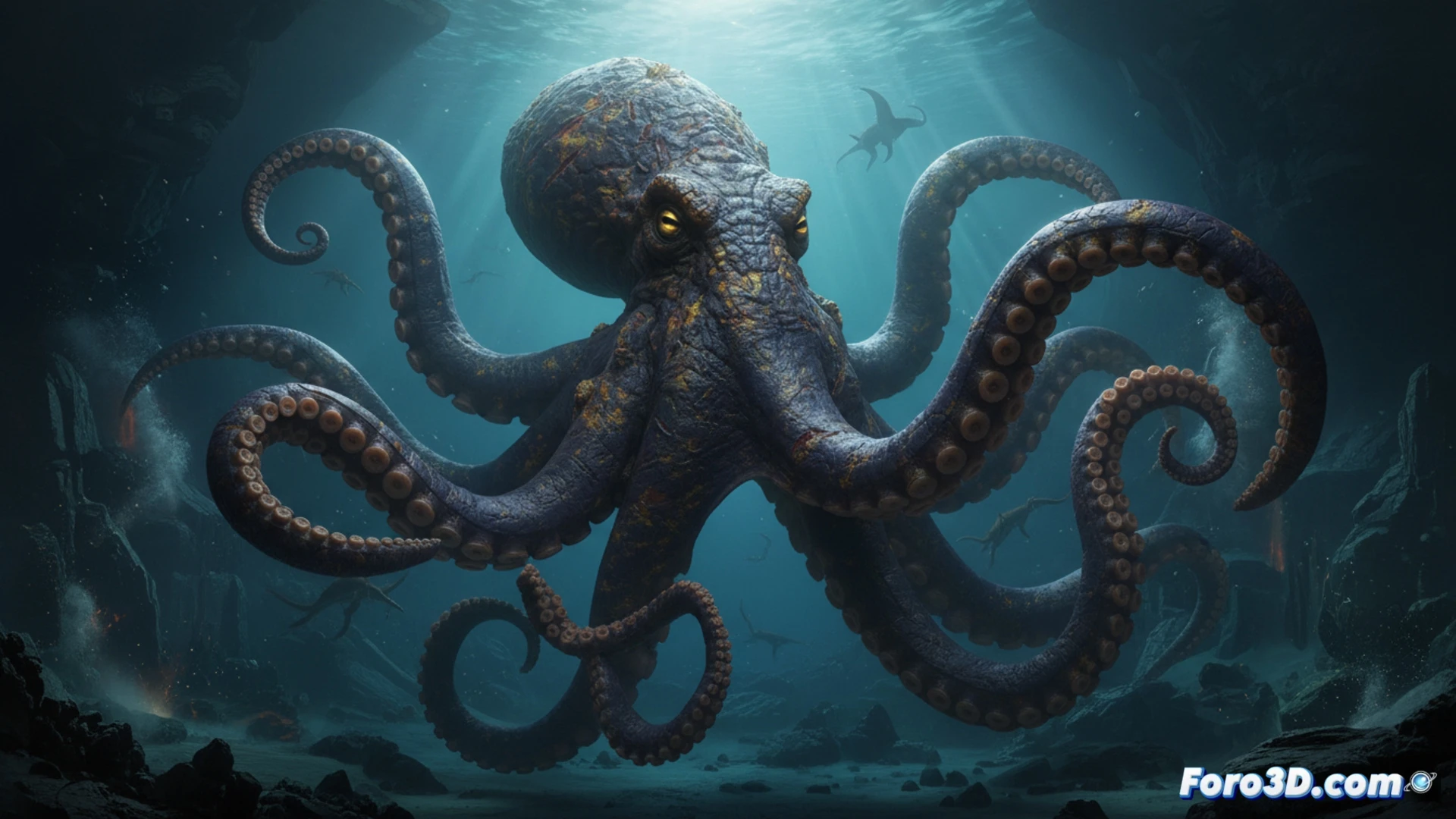
Photorealistic reconstruction and biomechanical animation 🎥
For the scientific visualization project, a 3D model with complex rigging is proposed to simulate the hydrostatic locomotion of a massive-scale octopus. The mesh must integrate high-resolution textures based on the morphology of modern octopuses, but scaling up the arm thickness and mantle capacity to sustain an active hunter's metabolism. The key animation will include an ambush sequence, showing how the animal used its suckers and chromatic camouflage to stalk prey the size of a reptile fish. The visual comparison will be made using a digital great white shark rigged at the same scale, allowing the user to toggle between both silhouettes to appreciate the differences in mass and hunting strategy.
Implications for digital paleoecology 🦴
Modeling this octopus is not just an exercise in realism; it is a tool for testing hypotheses about invertebrate dominance. By creating an interactive environment where the user can measure the animal's span against a diver or a mosasaur, access to science is democratized. This educational approach demonstrates that evolution did not always favor vertebrates, and that intelligence and size in cephalopods have much deeper roots than traditional models suggested.
What texturing and soft tissue simulation techniques were used to model the movement and realistic appearance of a colossal 19-meter octopus in a Cretaceous marine environment.
(PS: if your manta ray animation doesn't excite, you can always add documentary music from channel 2)