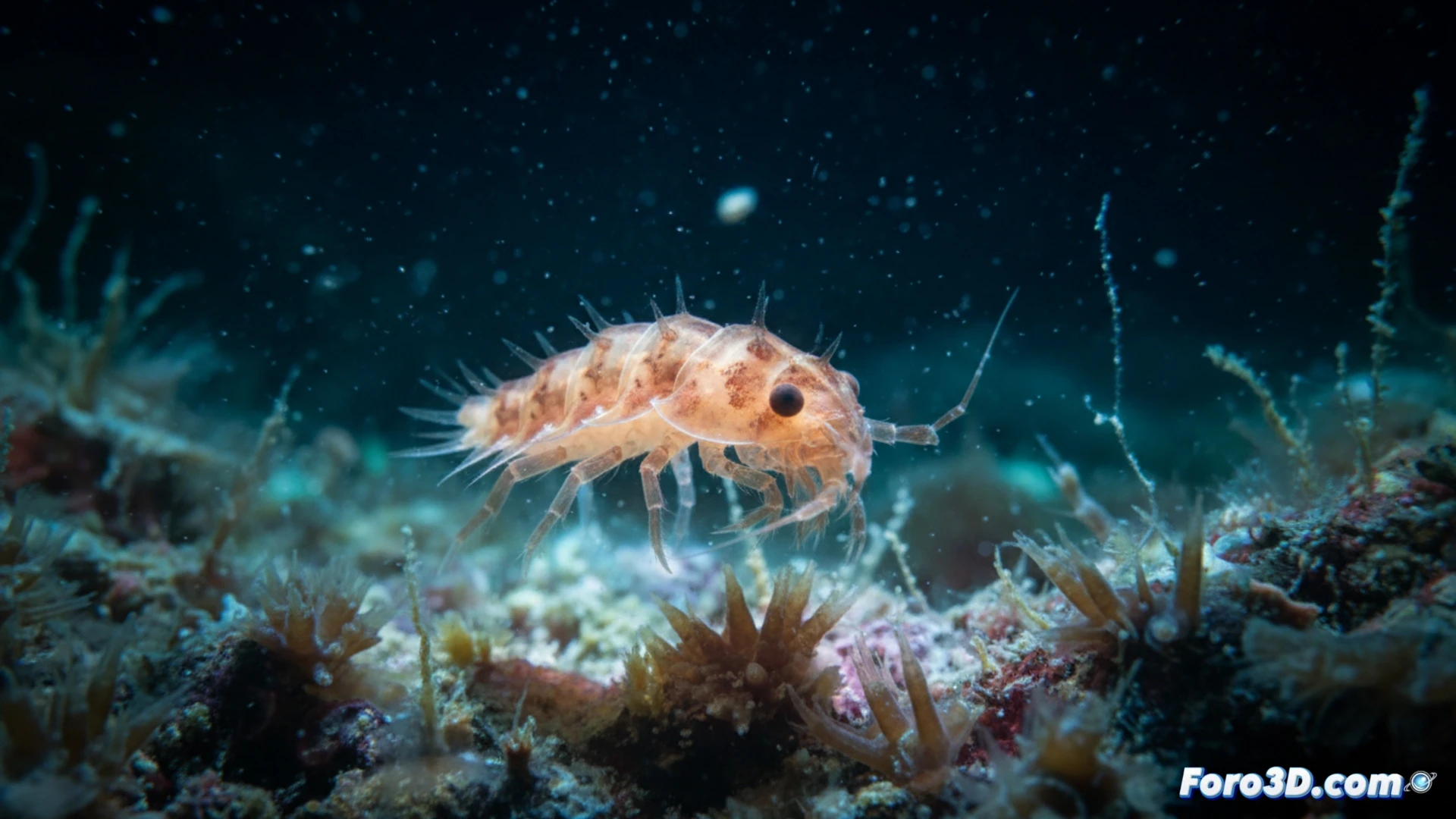
The amphipod Pseudolepechinella apricity has been named with a term meaning winter sun warmth, a biological irony that contrasts with its real home: the abyssal trenches. It inhabits an environment where sunlight never penetrates, temperatures hover near freezing, and atmospheric pressure exceeds 400 atmospheres. This crustacean, only a few centimeters in size, represents a fascinating challenge for scientific visualization, as its translucent morphology and appendages adapted to extreme pressure require high-precision 3D modeling techniques to be faithfully represented.
Digital reconstruction through photogrammetry and pressure simulation 🌊
To generate a reliable 3D model of Pseudolepechinella apricity, the workflow begins with photogrammetry of specimens preserved in ethanol, capturing between 80 and 120 images with cross-polarized lighting to avoid reflections on its semi-transparent cuticle. Reconstruction software (such as Agisoft Metashape or RealityCapture) generates a polygonal mesh that must then be retopologized to simulate its flexible exoskeleton. The real technical challenge lies in simulating the ecosystem: modelers must recreate the hydrostatic pressure and water viscosity at 4000 meters depth, adjusting fluid dynamics parameters in engines like Houdini or Blender so that the movement of the amphipod's appendages reflects the resistance of the abyssal environment.
Etymological irony and visual rigor 🔍
The name apricity evokes an impossible warmth in the perpetual darkness of the ocean floor. This contradiction offers a unique narrative opportunity in scientific visualization: we can represent the amphipod in an interactive 3D gallery where the user explores its anatomy with a subsurface scattering shader that mimics its translucency, while a simulated particle background represents the marine snow that constitutes its food. The irony of the name thus becomes a visual hook that educates about extreme adaptations, demonstrating that 3D modeling not only documents form but also tells the story of the most hostile place on the planet.
As a researcher or 3D artist, what specific technical challenges did you face when modeling the transparent and bioluminescent structures of Pseudolepechinella apricity to convey its visual paradox of warmth in an abyssal environment?
(PS: fluid physics for simulating the ocean is like the sea: unpredictable and you always run out of RAM)