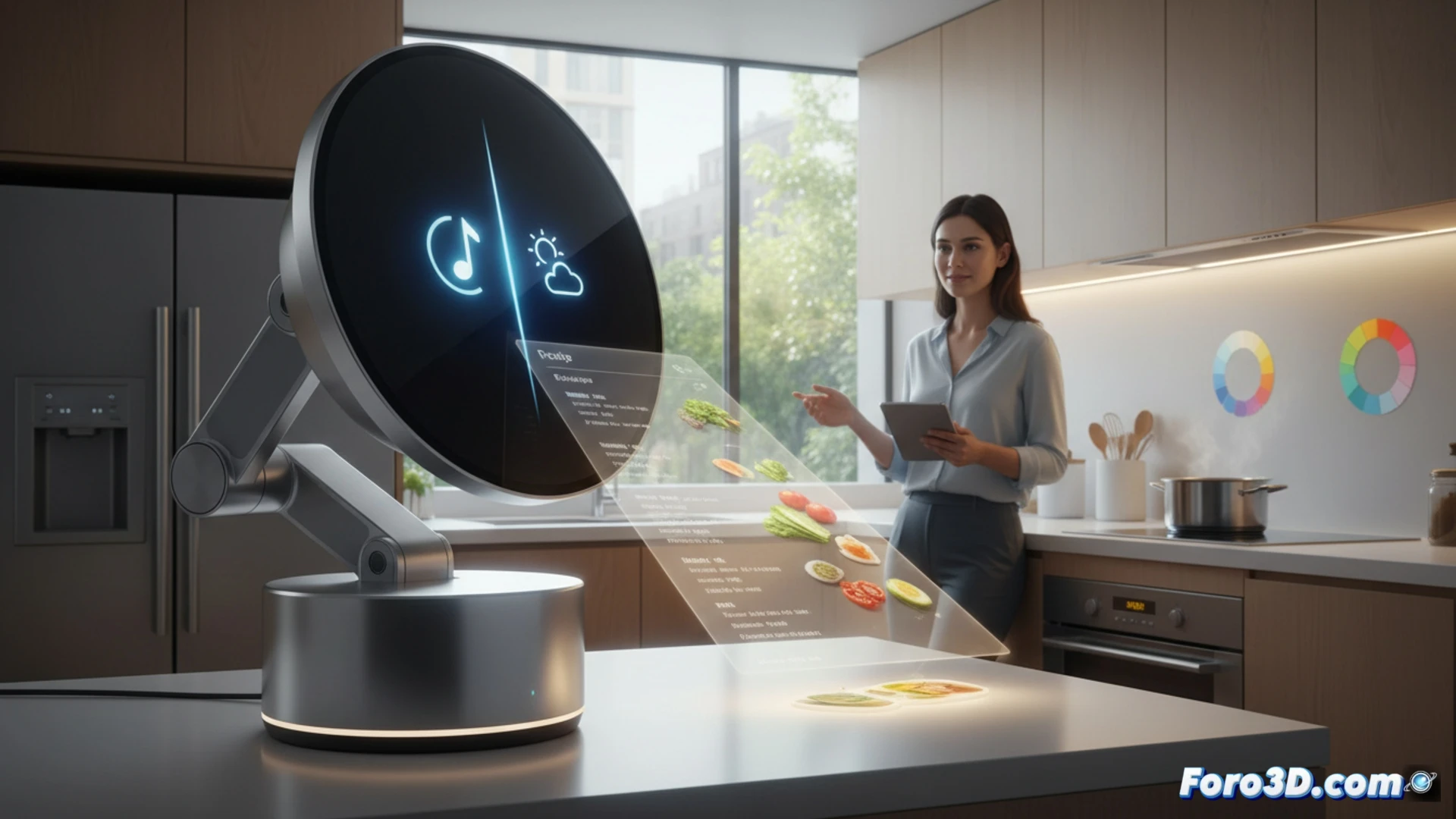
Samsung has unveiled Project Luna, a concept that aims to revolutionize home interaction. It's not just another speaker, but a desktop device with a circular screen that physically moves to orient itself towards the user. This prototype, designed for spaces like the kitchen, combines voice assistance, home control, and information projection. Its goal is not to hit stores tomorrow, but to explore a future where AI abandons its passivity to gain physical presence and a dynamic, reactive interface.
From Passive Assistant to Entity with Physical Presence 🤖
Project Luna, along with rumors of a similar concept at Apple, marks a technical turning point. The evolution is no longer just in the software, but in the hardware that supports it. A motorized head that rotates and a moving screen aim to create an illusion of attention and reciprocity, mimicking basic social interactions. This transcends the vocal command to a static speaker; it's about a device that looks at and addresses the user, integrating gestures and shared space. Information is no longer just heard, it's projected onto surfaces, making AI an environmental control center rather than a simple auditory oracle.
A Robotic Companion or an Intruder in Privacy? 👁️
This personification of technology in intimate space raises profound dilemmas. On one hand, it promises more natural and efficient interactions. On the other, it normalizes constant surveillance and the collection of sensitive data in an environment that should be a refuge. Do we really want a device with a moving head and cameras observing our most everyday habits? The challenge will not only be technical, but ethical: finding the balance between utility and privacy, between a useful assistant and a companion that, literally, never takes its eye off us.
To what extent does the integration of AI assistants with visual tracking capabilities, like Samsung's Project Luna, redefine the boundaries between domestic convenience and intimate surveillance in digital society?
(PS: technological nicknames are like children: you name them, but the community decides what to call them) 😄