The authentication of historical objects has found an unexpected ally in 3D laser profilometry. In the recent analysis of a violin suspected of being a copy, researchers used a Lucida 3D scanner to capture the surface microgeometry. Under the varnish, gouge marks revealed inconsistencies with Stradivari's documented techniques, demonstrating that the forensic workflow can be applied beyond the crime scene. 🔍
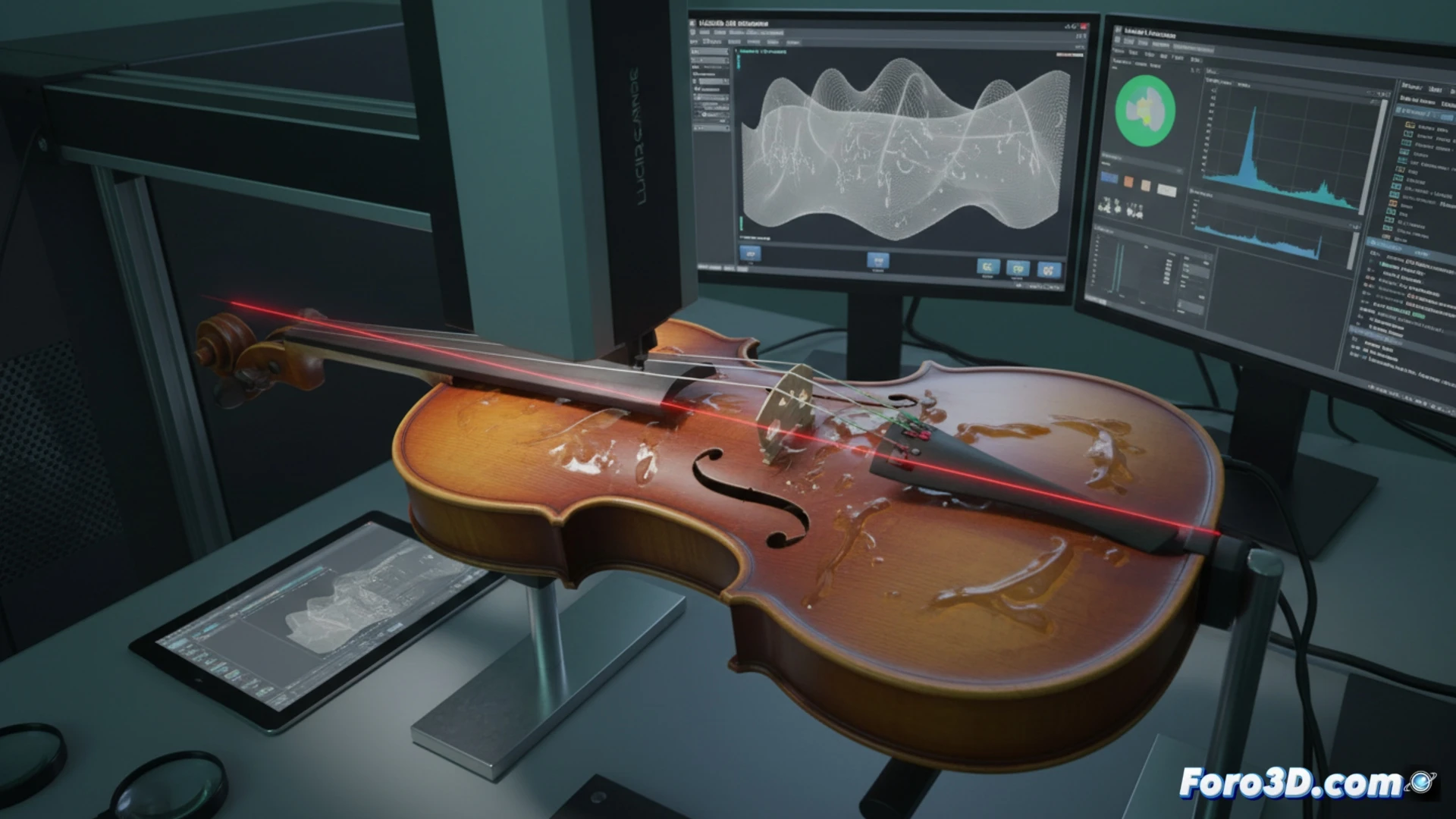
Forensic workflow: from scanning to hidden evidence 🛠️
The process began with high-resolution scanning using the Lucida 3D Scanner, capable of detecting micrometric variations in the wood. The data was processed in Amira to segment and visualize the tool marks that the varnish layer concealed from the naked eye. Subsequently, MATLAB allowed for the analysis of the frequencies and patterns of the incisions, comparing them with databases of historical techniques. This method is directly analogous to documenting a crime scene, where a 3D scanner captures the geometry of a location, and scientific visualization software reveals evidence such as footprints or projectile trajectories that the human eye cannot perceive.
Microgeometry as the artisan's fingerprint 🎻
The true secret of the varnish was not in its chemical composition, but in what it concealed. Each gouge leaves a unique signature on the wood, a pattern of striations and depths that acts as the artisan's fingerprint. In the analyzed violin, the marks did not match the typical angle or pressure of Stradivari. 3D profilometry not only unmasked the copy but also set a precedent: any object with a worked surface can be subjected to this same forensic scrutiny, transforming authentication into a science of hidden evidence.
What specific parameters of surface roughness and microgeometry detected by 3D profilometry allow for the conclusive differentiation of an authentic Stradivarius from a modern forgery?
(PS: In scene analysis, every scale witness is a small anonymous hero.)