A recent study from Ben-Gurion University of the Negev reveals that plants do not only feed through their roots. Published in New Phytologist, the work demonstrates that leaves can absorb nutrients directly from the dust deposited on them. This finding, which quantifies iron and phosphorus inputs in global ecosystems, opens a new frontier for 3D scientific visualization.
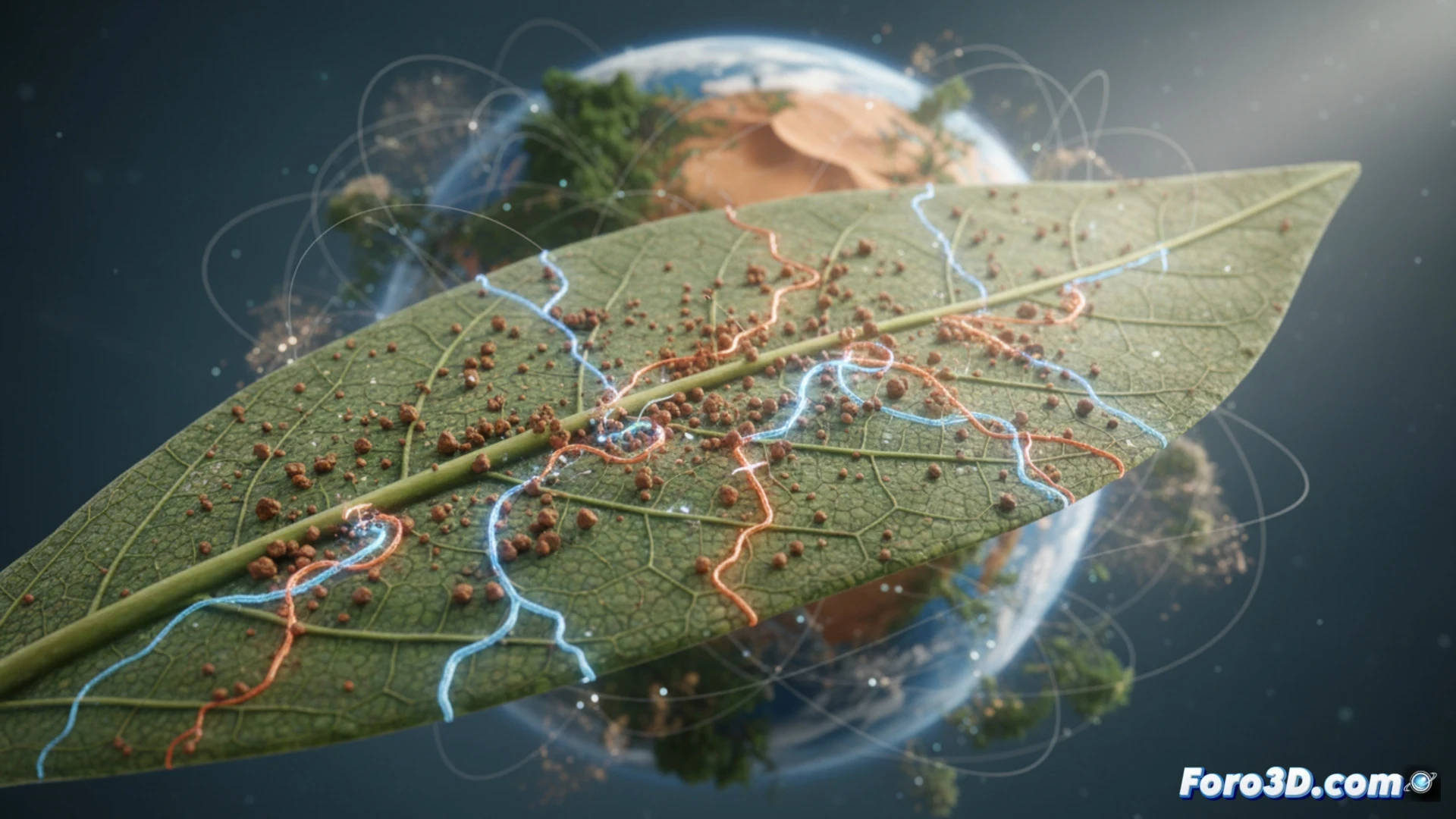
Animation of the process: From particle to metabolism 🌿
To represent this phenomenon, we propose a 3D animation that begins with a macro shot of a leaf covered in volcanic dust. A progressive zoom will reveal the cuticle and trichomes. The visual key will be the secretion of organic acids, represented as a semi-transparent mist surrounding the particles. Using a particle system, micronutrients (iron, nickel, manganese) will dissolve and cross the epidermis, lighting up in specific colors as they are absorbed. A counter-shot will show the soil, where particles remain inert, surrounded by microorganisms and minerals that block their absorption, explaining why the foliar pathway is more efficient in certain environments.
3D maps and data: Visualizing the global impact 🌍
The animation will include three-dimensional maps of the Sahara, the western United States, and the eastern Amazon. On these terrains, animated bar charts will compare foliar versus soil input. For example, in the western U.S. region, a bar will grow to 17% for foliar iron, while the soil bar remains static. In the Amazon, foliar phosphorus will reach 12%. This visual contrast, combined with a timeline simulating a dust storm, will allow the viewer to understand how atmospheric dust can match or exceed soil nutrients in arid or degraded ecosystems.
What specific technical challenges did you face when modeling in 3D the dynamics of dust particles and their interaction with the leaf surface to simulate absorption at a microscopic level?
(PS: if your manta ray animation doesn't excite, you can always add documentary music from the 2nd one)