The discovery of Tometes camunani in Brazil has rewritten the biology of Amazonian fish. Weighing up to 4 kg, this herbivorous piranha defies the carnivorous stereotype of the group. For scientific visualization, it represents an exceptional case of evolutionary adaptation. Modeling its anatomy in 3D allows exploring key morphological differences, such as teeth specialized for crushing seeds and an elongated digestive system, ideal for breaking down plant cellulose instead of animal protein.
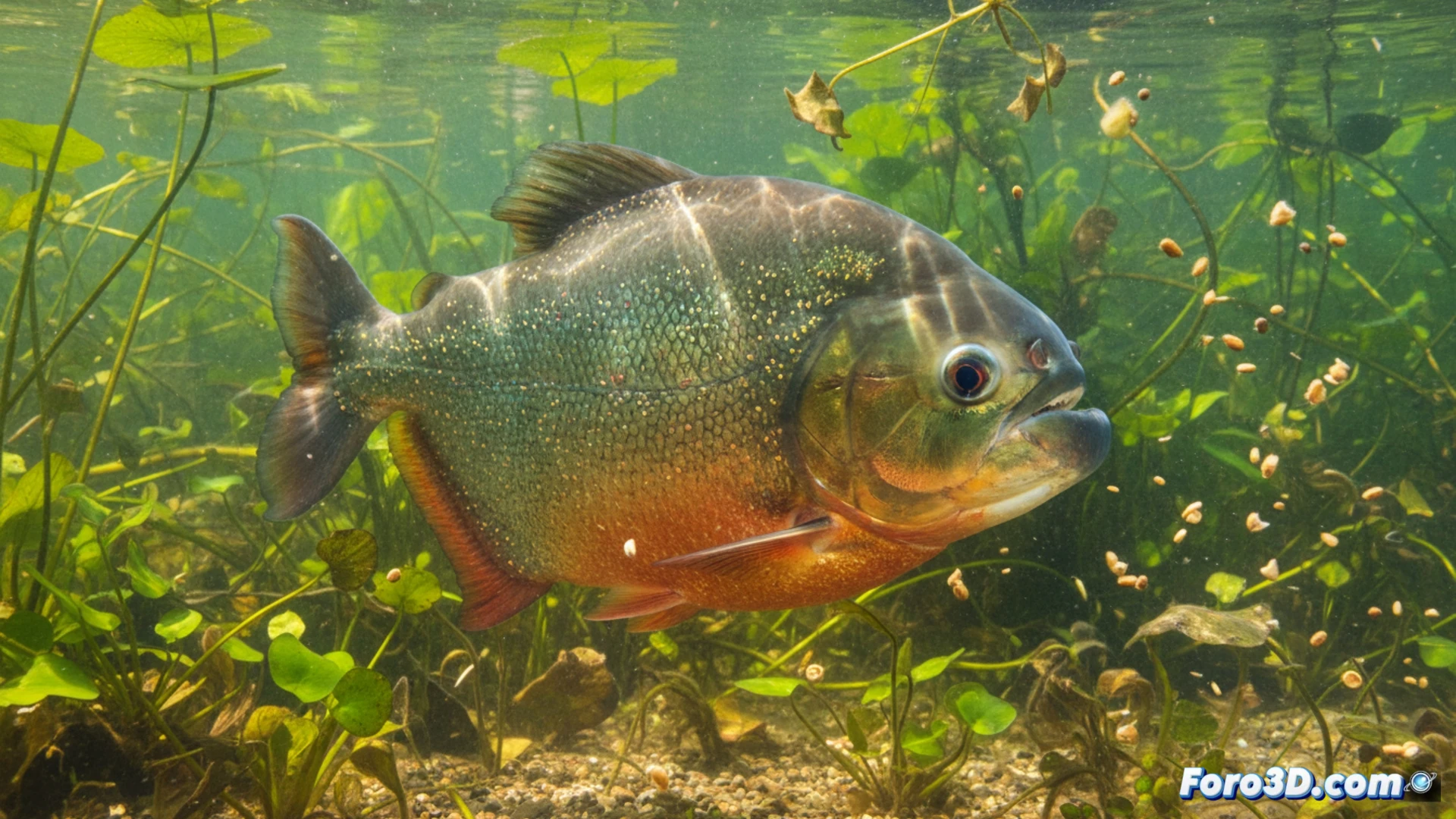
Anatomical reconstruction and habitat simulation 🐟
The technical project focuses on three phases. First, the polygonal reconstruction of the skull and jaw, highlighting the molariform teeth adapted to the abrasion of aquatic plants. Second, the modeling of the digestive tract: a larger stomach and a coiled intestine, directly compared to that of a carnivorous piranha like Pygocentrus nattereri. Third, an interactive simulation of the habitat in Brazilian waters, with submerged vegetation and gentle currents. The photorealistic renders, generated with global illumination engines, show the fish feeding on fruits and leaves, while particle animations reveal the seed filtration process.
Scientific outreach and educational applications 🌿
This 3D model not only satisfies scientific curiosity but also becomes a pedagogical tool for natural history museums. By visually comparing the two species side by side, visitors understand ecological specialization without the need for real dissections. For educational documentaries, animations of feeding behavior, such as browsing aquatic plants, offer a window into a little-known niche. The vegetarian piranha demonstrates that 3D technology is the best bridge between a biological discovery and its public understanding.
What technical challenges does the 3D modeling of a fish with the unique morphology of Tometes camunani present for accurate scientific visualization of its anatomy and herbivorous behavior?
(PS: if your manta ray animation doesn't excite, you can always add documentary music from channel 2)