The discovery in 2023 of a new variety of ghost orchid in the deep jungles of Madagascar has redefined the boundaries of botany. This species completely lacks leaves and chlorophyll, surviving solely through an obligate symbiosis with mycorrhizal fungi. For scientific visualization, this organism represents a fascinating challenge: modeling a plant structure reduced to its minimum expression, where the stem and flower are the only visible elements of a biological cycle hidden underground.
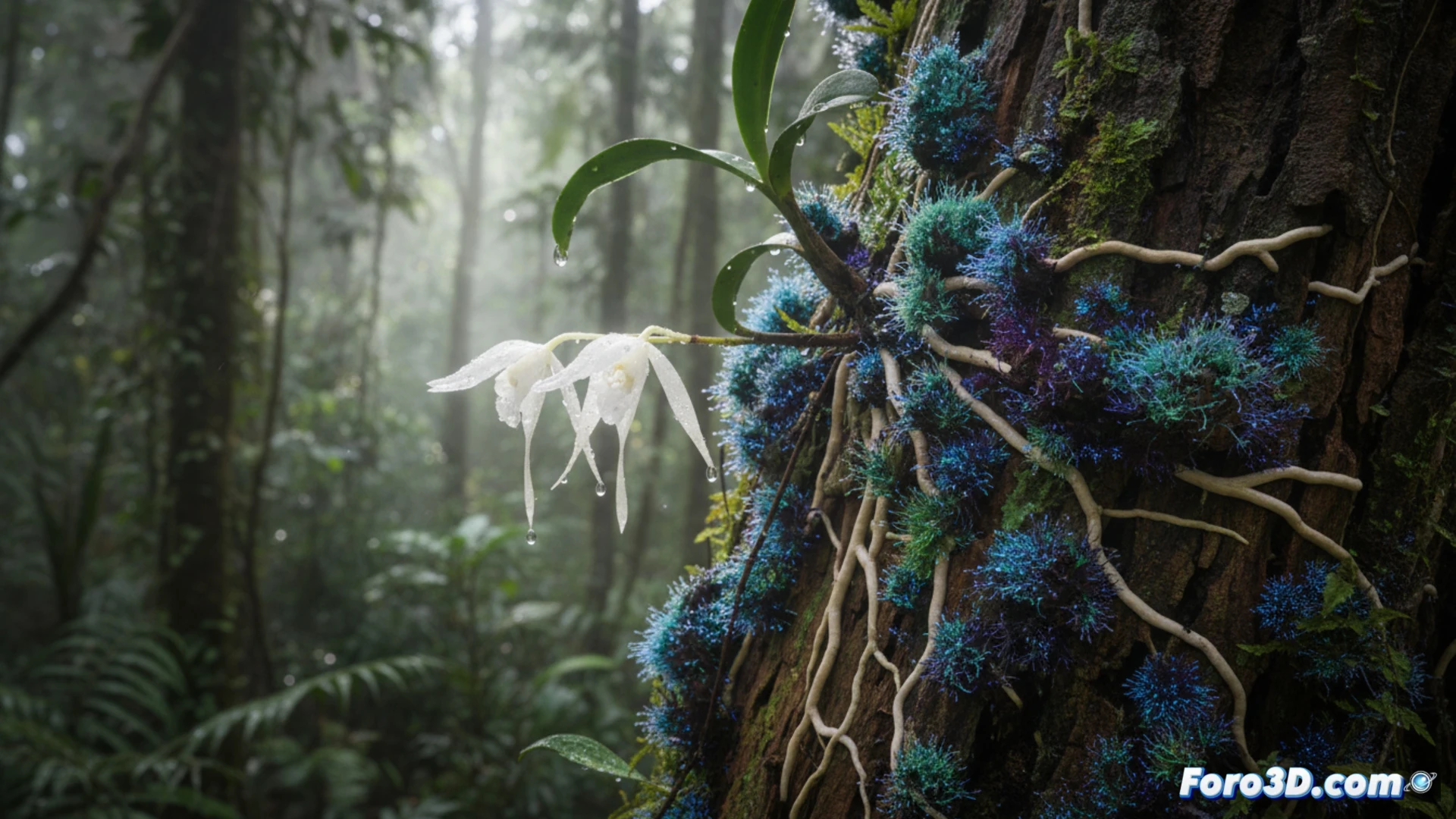
Modeling mycorrhizal structures and reduced floral anatomy 🌿
The 3D model of this orchid must prioritize transparency and anatomical precision. The absence of leaves forces the polygonal detail to focus on the underground stem (rhizome) and the coral-like roots that envelop the fungal hyphae. For scientific visualization, a micro-CT scan of the root system combined with high-resolution photogrammetry of the flower, which is typically white and ethereal, is recommended. The life cycle animation should include a time-lapse sequence showing how the fungus provides carbon and water to the plant, a process invisible to the naked eye that modeling must make tangible through particles and translucent shaders.
The challenge of visualizing the invisible: hidden ecosystems 🔬
This case demonstrates that scientific visualization not only represents what we see but must infer and construct what is not seen. When modeling this ghost orchid, the scientific artist acts as a detective, reconstructing an underground ecosystem of chemical exchange and fungal networks. For biologists and science communicators, this type of 3D model is an essential educational tool, as it allows exploring the paradox of a plant that blooms without photosynthesis, a reminder that life in the deep jungles of Madagascar still holds secrets that only technology can reveal.
As a 3D modeler, what volumetric scanning techniques and plant biomechanics simulations do you recommend to faithfully represent the extreme symbiotic interaction between the new variety of ghost orchid from Madagascar and its arboreal host in an immersive virtual reality environment?
(PS: if your manta ray animation doesn't excite, you can always add documentary music from channel 2)