A new study proposes using multiband gravitational wave observations to reduce uncertainty in the Hubble constant (H₀). By combining signals from primordial black holes, both induced and from mergers, researchers estimate that precision could improve significantly by cross-referencing predicted data from the Square Kilometre Array and the Einstein Telescope.
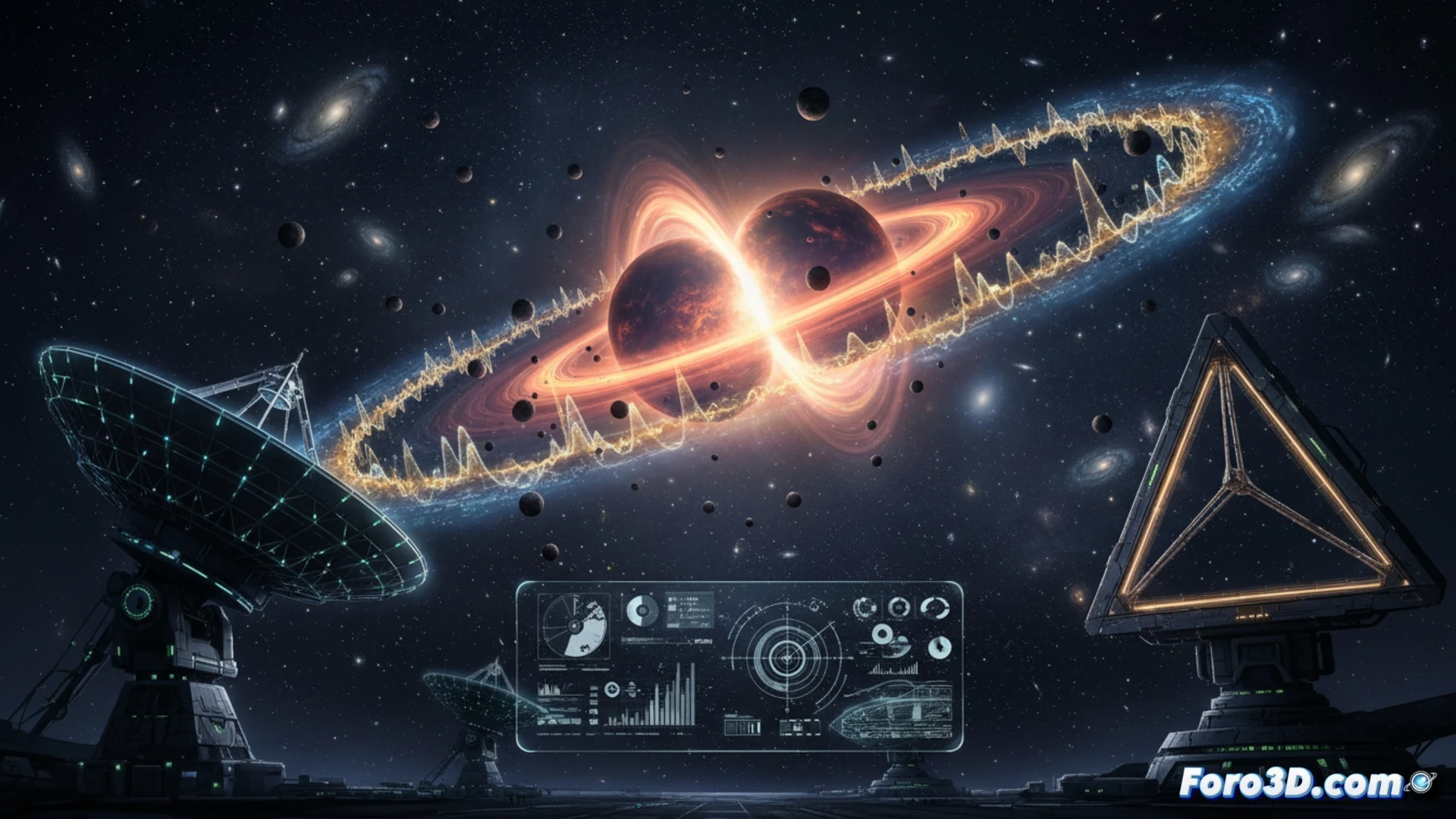
How combining signals and future detectors tightens the margin of error 🎯
The key lies in pairing gravitational waves generated by primordial black hole mergers with signals induced by their density fluctuations. By analyzing both types within the same framework, degeneracies affecting distance and redshift can be broken. With data from SKA and ET, the authors achieve error margins below 2% in optimistic scenarios, offering an independent way to measure cosmic expansion without relying on supernovae or the cosmic microwave background.
Hubble, black holes, and the day the Einstein Telescope saves us 🛸
Of course, all of this depends on primordial black holes existing, which is no small feat. They are like that relative everyone talks about but no one has seen in person. Furthermore, the detectors are not yet operational, so for now we measure the Hubble constant with the precision of a map drawn on a napkin. But hey, if it works, it will be the first time theoretical black holes help astronomers reach a consensus.