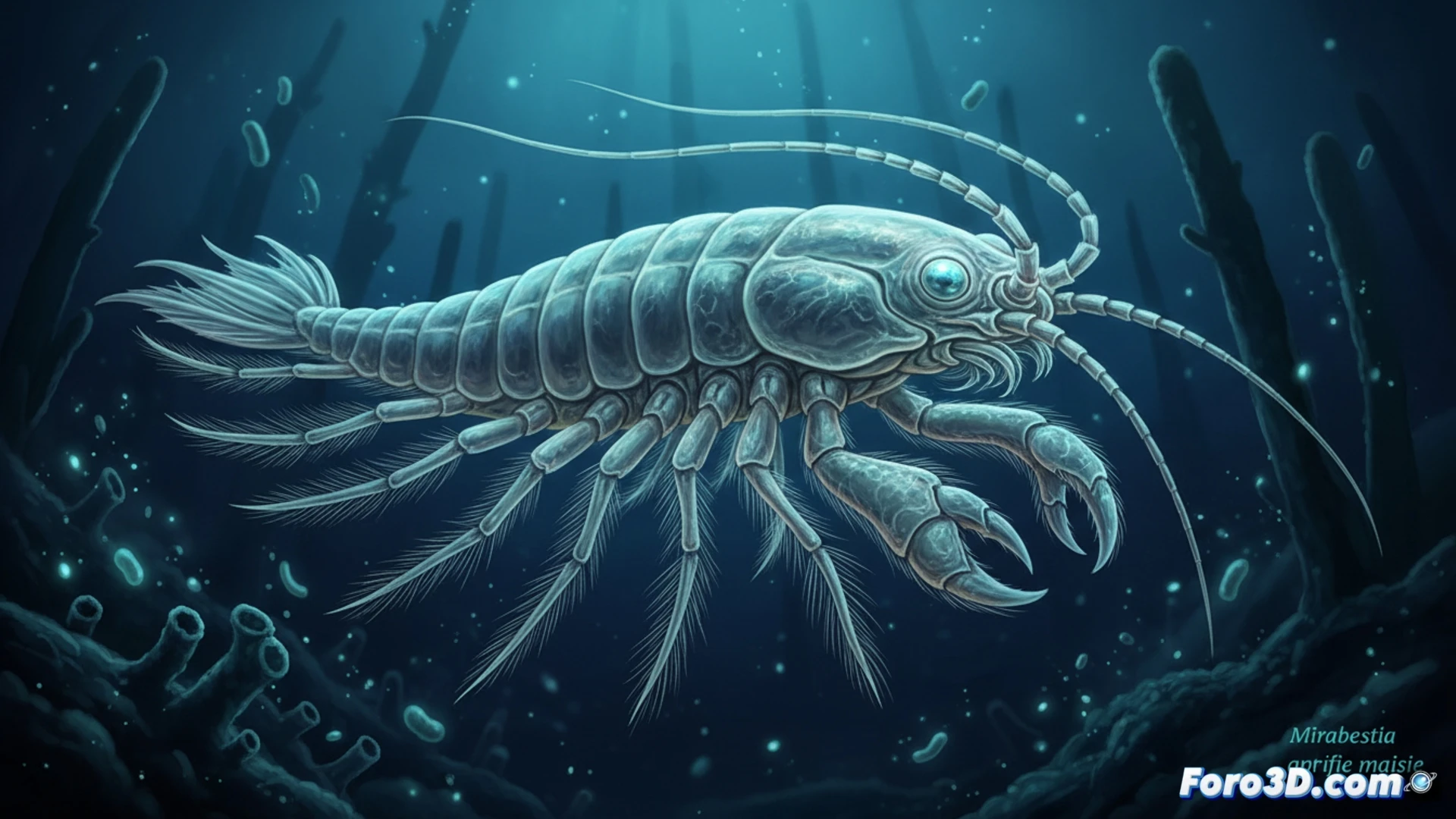
A team of marine biologists has identified Mirabestia maisie, an amphipod found in the depths of the Pacific Ocean. This crustacean is not just a new species; it represents a completely unknown family and superfamily until now. The discovery, published in a scientific journal, expands our understanding of biodiversity in abyssal zones and suggests that much remains to be discovered in the oceans.
Genetic and morphological keys to a hidden lineage 🧬
The morphological and genetic analysis of Mirabestia maisie revealed unique characteristics in its appendages and digestive system that did not fit into any existing classification. The researchers used DNA sequencing and micro-CT tomography to compare the specimen with other amphipods. The results confirmed that it is an independent evolutionary branch. This discovery forces a revision of current phylogenies and opens a new line of study on adaptation in ocean trenches.
Mirabestia maisie: the distant relative nobody invited to dinner 🦐
Imagine going to a crustacean family reunion and discovering you have a cousin so strange that they don't even appear on the family tree. That's Mirabestia maisie, a critter that arrived so late to evolution that it had to invent its own family. While other amphipods fight over leftovers, this newcomer probably sits at the adults' table without really knowing how it got there. Science, once again, proving that the ocean is the neighbor we never know anything about.