The discovery of a new variety of glass sponge from the genus Janulum sp. has captured the attention of the biological community. What makes this specimen unique is its intricate skeleton composed of silica, a glassy structure that challenges the limits of natural morphology. For scientific visualization experts, this finding represents a technical challenge and an opportunity to apply advanced digitization techniques.
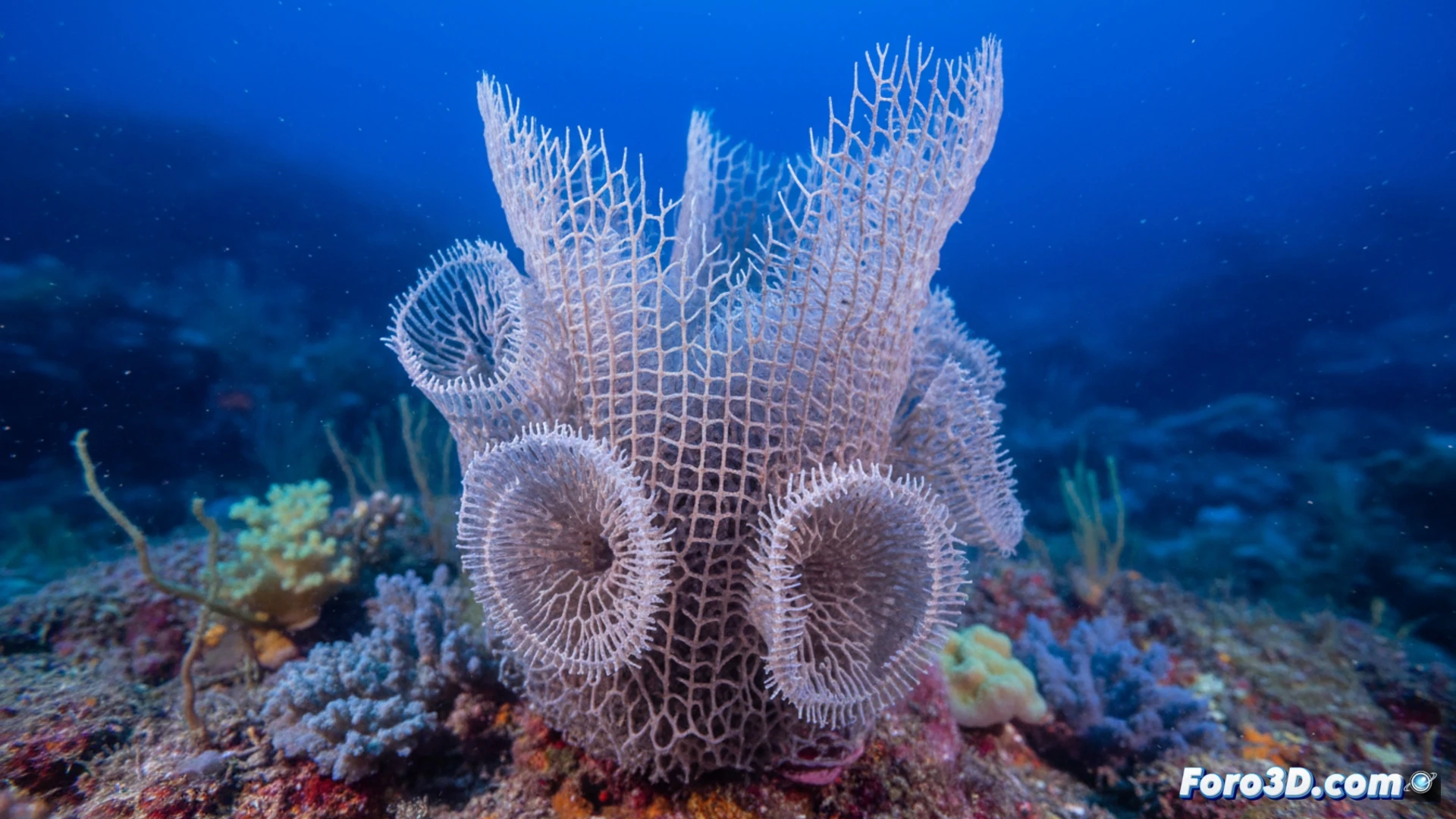
Micro-CT and photogrammetry for the reconstruction of the glassy skeleton 🧬
The fragility of these silica structures prevents direct manipulation without risk of fracture. Therefore, research teams turn to micro-computed tomography (micro-CT) to obtain high-resolution cross-sections of the specimen. This process generates a point cloud that, after being processed with volumetric reconstruction algorithms, allows for 3D modeling of each spicule and biogenic glass fiber. Photogrammetry, in turn, complements the model by capturing the surface texture and reflections of the material, achieving a faithful digital representation that can be rotated and analyzed from any angle without physical contact.
Visualization as a non-invasive study tool 🔬
Beyond aesthetics, these 3D reconstructions allow biologists to study the mechanical function of the glassy skeleton. By simulating loads and stresses on the digital model, it is possible to understand how the sponge resists ocean currents. Scientific visualization transforms a unique specimen into a reusable dataset for research and outreach, preserving its physical integrity while exploring its structural secrets.
How can the 3D modeling of the silica skeleton of the new glass sponge Janulum sp. be optimized to capture its structural complexity and facilitate its analysis in scientific visualization?
(PS: modeling manta rays is easy, the hard part is making them not look like floating plastic bags)