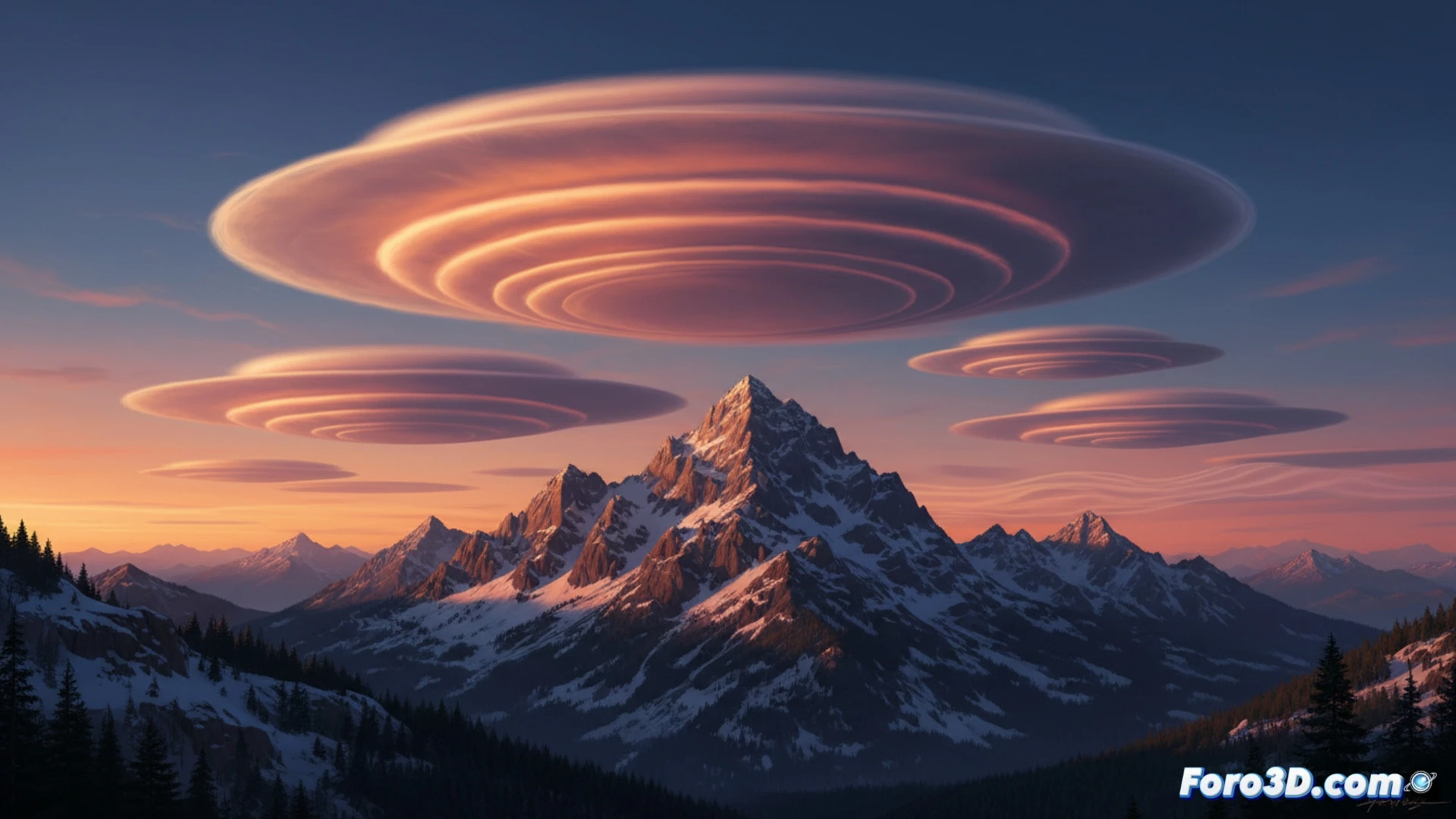
At mountain peaks, it's common to see saucer-shaped clouds, perfectly static despite the wind. These are lenticular clouds, a meteorological phenomenon so spectacular that it is often reported as an unidentified object. Their true explanation lies in the physics of gravity waves, a concept that can be visualized exceptionally well through 3D models and renders to understand their formation and structure.
Gravity Waves and 3D Modeling of Atmospheric Flow 🌪️
The key is the stable wind flowing over a mountain barrier. In doing so, it generates gravity waves in the atmosphere, vertical oscillations similar to waves in the sea. When the air rises at the crest of these waves, it cools and the water vapor condenses, forming the cloud. As it descends, it warms and the cloud evaporates. A 3D model allows this process to be broken down: the mountain profile, the moving air layers, and the precise condensation zone that shapes the stationary lenticular cloud can be visualized, showing why it does not move with the wind.
From Appearance to Visual Explanation 👁️
Scientific 3D visualization transforms a phenomenon that invites speculation into a clear lesson in atmospheric physics. By rendering cross-sections and animating the flow, the optical illusion of a solid object is dispelled, revealing the dynamic natural process behind that perfect shape. This tool not only debunks myths but also educates by showing the elegant interaction between terrain, wind, and humidity that paints these ephemeral sculptures in the sky.
What level of anatomical detail would you need to faithfully represent this species?