The discovery of Stanley's dwarf shrew in the Afroalpine grasslands of the Congo Basin in 2025 has redefined the limits of miniaturization in mammals. With a body mass barely exceeding a few grams, this species represents a milestone for scientific visualization. At Foro3D, we analyze how the digital reconstruction of its anatomy allows us to study its extreme adaptations to cold and altitude, offering an invaluable resource for biologists and science communicators. 🐭
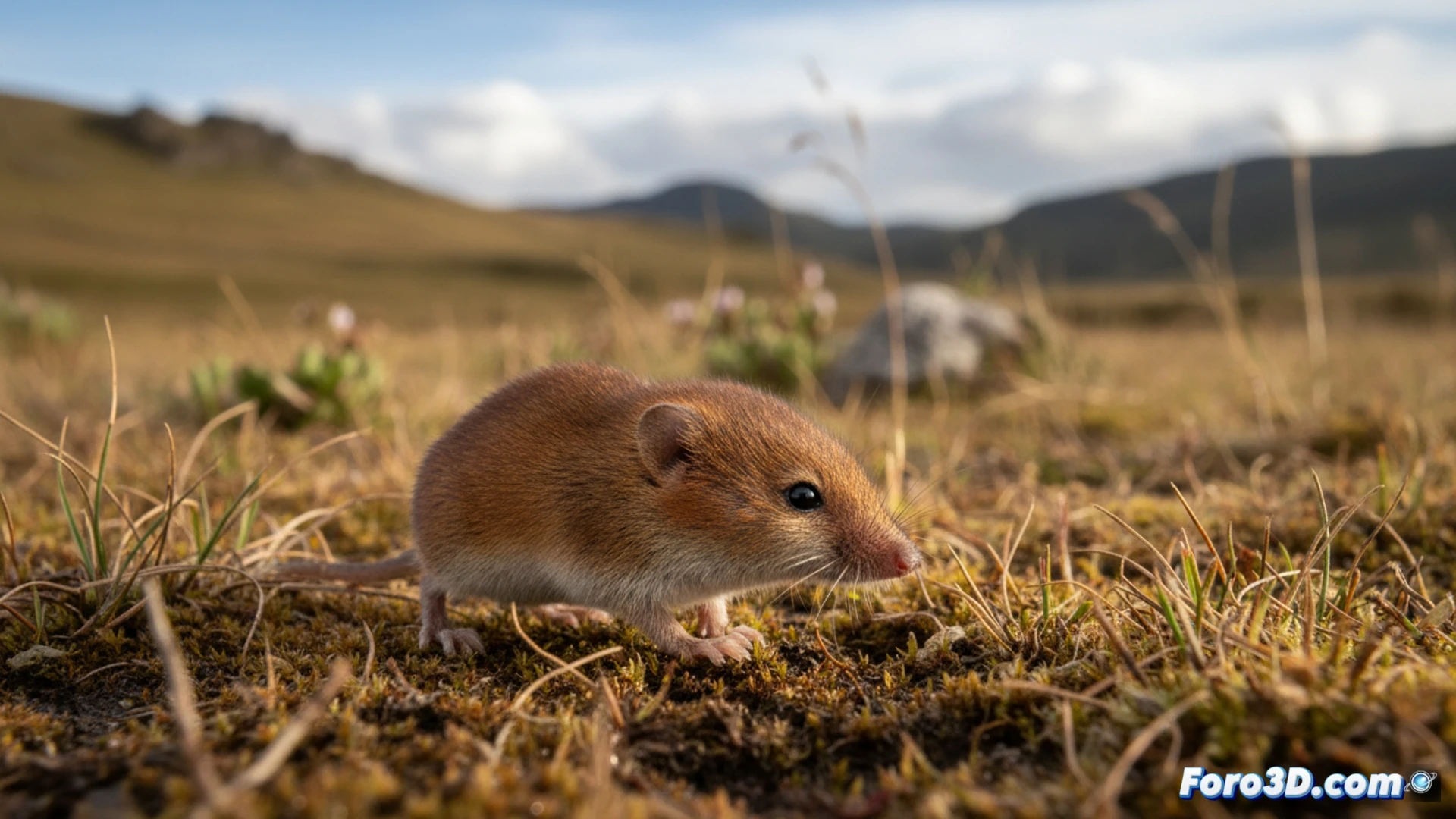
Anatomical Reconstruction and Comparative Scale in 3D Environments 🦴
To accurately model Stanley's dwarf shrew, it is essential to work with micrometric references. The 3D asset must include rigging that simulates its muscle tremors, a key feature for maintaining body temperature in páramo habitats. Implementing PBR textures for its dense, short fur, along with a digital skeleton showing the skull-to-body ratio, helps illustrate why it is smaller than a ten-cent coin. Tools like Blender or ZBrush are optimal for scaling these details, while volumetric lighting recreates the dense fog of its ecosystem.
The Challenge of Visualizing the Invisible in Extreme Ecosystems 🔬
The true power of 3D modeling in this case is not just aesthetic, but functional. By creating an interactive infographic that places this shrew alongside the bumblebee bat or the pygmy jerboa, the viewer intuitively understands the size hierarchy. This approach transforms cold scientific data into an immersive experience, where the Afroalpine grassland comes to life and biological miniaturism ceases to be an abstraction, becoming a tactile and visual object of study.
What technical challenges does the 3D modeling of a mammal weighing just a few grams, like Stanley's dwarf shrew, pose for accurately representing its morphology and anatomical details at a microscopic scale in a scientific visualization environment?
(PS: if your manta ray animation doesn't excite, you can always add some documentary music from channel 2)