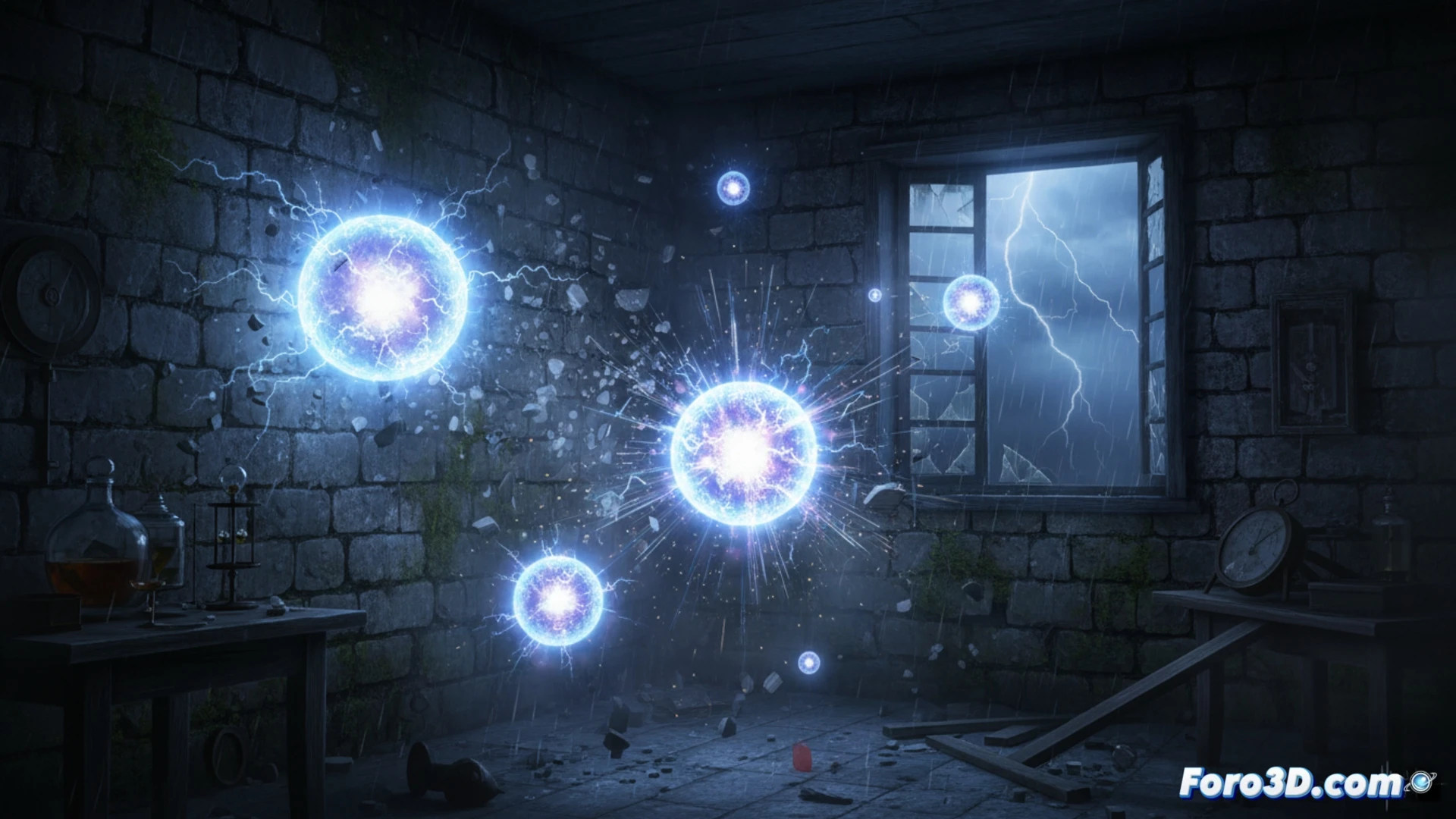
For centuries, accounts of floating luminous spheres during storms, capable of passing through walls and disappearing in silent explosions, have defied scientific explanation. Ball lightning, a phenomenon as fascinating as it is elusive, represents the perfect challenge for scientific visualization. In this article, we explore how 3D modeling and simulation tools allow us to materialize hypotheses, giving visual shape to abstract theories and helping to unravel the physics behind this natural enigma.
From Theory to 3D Model: Visualized Hypotheses 🔬
3D visualization acts as a bridge between speculative theory and tangible understanding. For ball lightning, we can build contrasted models based on the main hypotheses. One model would represent a plasma core confined by self-generated magnetic fields, showing its possible stability. Another would simulate a sphere of incandescent silicon vapor, resulting from soil vaporization by a common lightning strike, with particles slowly recombining and emitting light. A third approach would model a trapped spherical microwave cavity, visualizing the resonance of electromagnetic energy. These reconstructions allow for the visual analysis of reported behaviors, such as interaction with solid surfaces or the dynamics of its disintegration.
The Power of Visualizing the Unknown 💡
Beyond simple illustration, this 3D visualization exercise is fundamental for research. By forcing a geometric and behavioral definition for each theory, inconsistencies are identified and new questions are generated. How does a confined plasma model interact with a windowpane? What would the decomposition of a silicon cloud look like? This methodology does not solve the mystery, but it transforms qualitative debates into quantifiable analysis, directing scientific inquiry and offering a powerful tool for the dissemination of one of the most intriguing atmospheric phenomena.
How can the seemingly contradictory properties of ball lightning, such as its stability, movement, and ability to pass through materials, be simulated and validated in a 3D environment using current scientific data and physical hypotheses?
(PS: if your manta ray animation isn't exciting, you can always add documentary music from channel 2)