The discovery in 2024 of a new semi-aquatic rodent in the mountain streams of Alto Mayo, Peru, has captured the attention of the scientific community and digital artists. This animal, a true amphibious mouse, exhibits extreme anatomical adaptations for swimming, with its webbed feet being the most distinctive feature. For scientific visualization, this specimen offers a perfect case study on convergent evolution and aquatic biomechanics in small mammals.
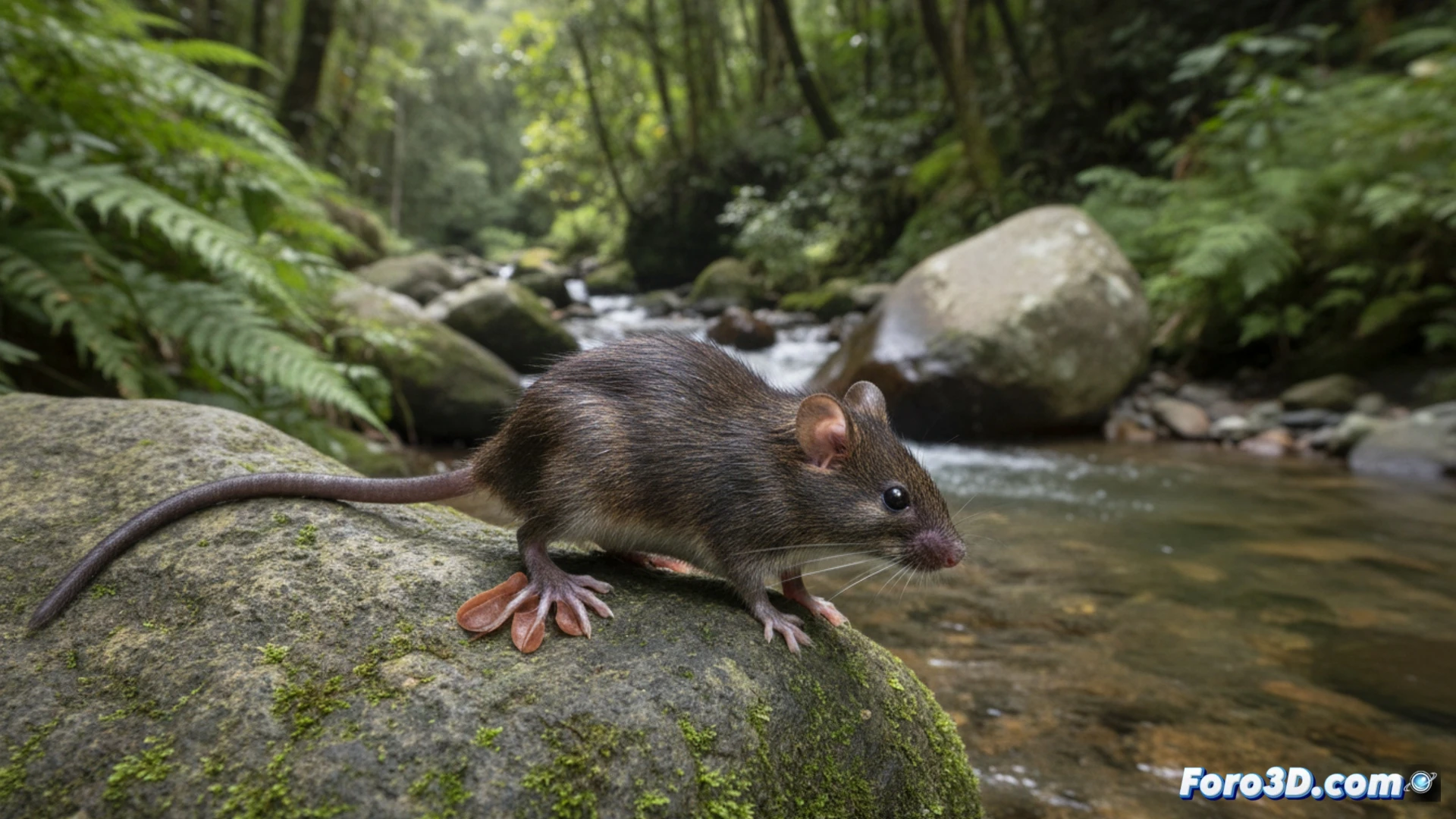
Anatomical reconstruction and simulation of aquatic locomotion 🐭
The 3D model of this rodent should prioritize the accuracy of the hind limbs, where the interdigital membrane extends beyond the base of the toes, forming an efficient paddle. The tail, slightly flattened and muscular, acts as a rudder. For simulation, a skeleton with inverse kinematics is recommended to reproduce the stroke cycle: a powerful, synchronized kick from both hind legs, followed by a glide. The dense, waterproof fur can be represented using hair guides with a darker color gradient on the back and lighter on the belly, a typical countershading pattern of surface-dwelling animals.
The value of visualization in the conservation of cryptic habitats 🌿
Beyond anatomical modeling, digitally recreating the Alto Mayo habitat is an act of conservation. The mountain streams with clear waters and dense riparian vegetation are fragile ecosystems. By generating a photorealistic 3D environment showing the amphibious mouse moving among rocks and submerged roots, we not only educate about its biology but also create a visual tool to raise awareness about protecting these microhabitats from deforestation.
As a 3D modeler specialized in scientific visualization, what technical and methodological challenges did you face in digitally reconstructing the anatomy and semi-aquatic behavior of the webbed-foot amphibious mouse from Alto Mayo based on field data from the 2024 discovery?
(PS: modeling manta rays is easy; the hard part is making them not look like floating plastic bags)