The discovery of the blobfish (Curimata sp.) in the Peruvian Amazon during 2024 has captured the attention of the scientific community due to its bulging and protruding cranial structure. Far from being a simple evolutionary oddity, this species represents a technical challenge for scientific visualization. Creating a three-dimensional model of its skull allows biologists to study internal morphology without needing to dissect specimens, a crucial advance for preserving fragile and rare specimens.
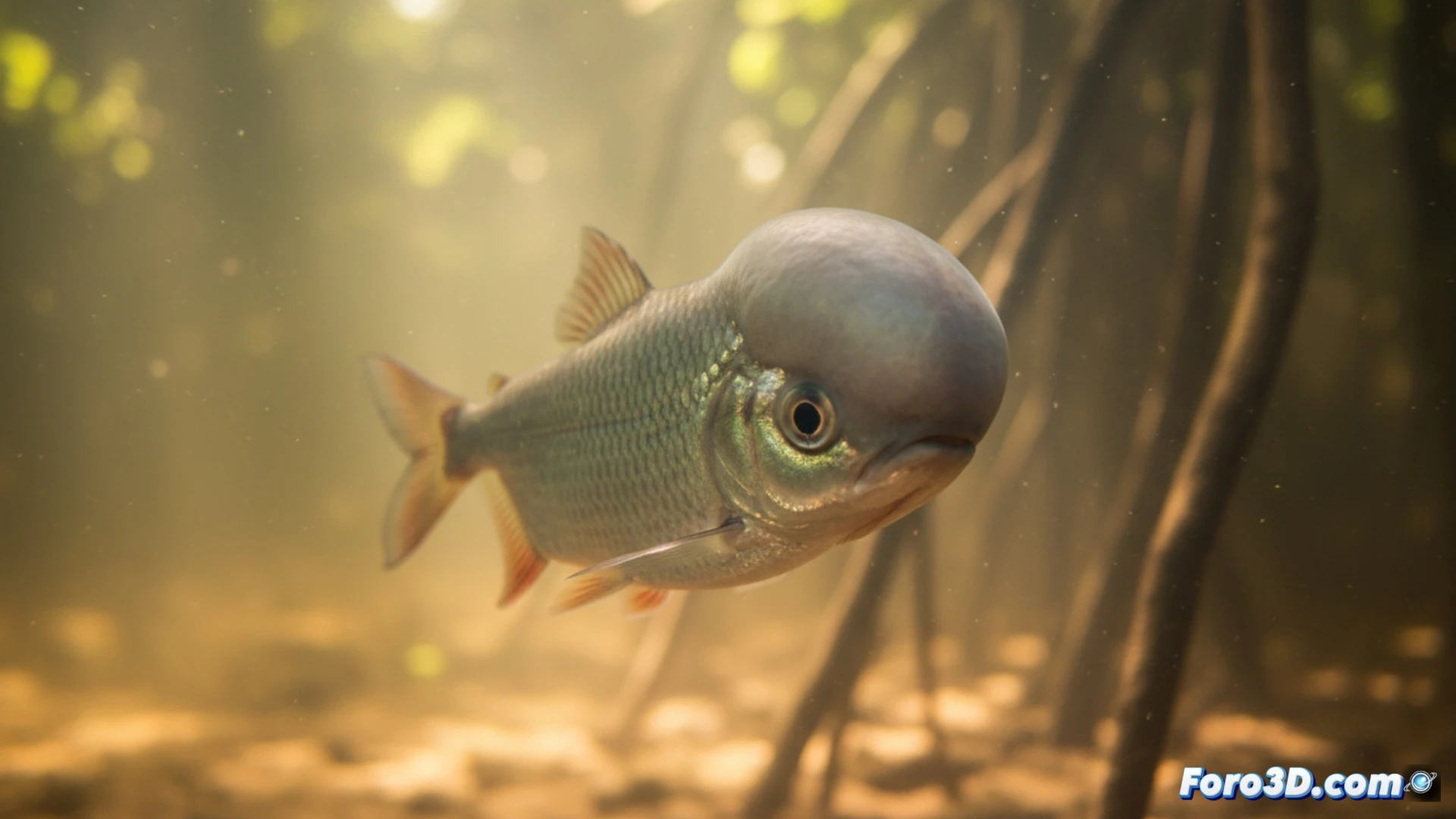
Workflow for digital skull reconstruction 🧠
The process begins with capturing high-resolution computed tomography scans of the holotype, generating a stack of DICOM slices. This data is imported into segmentation software such as 3D Slicer or Dragonfly, where bone structures are isolated from soft tissues through thresholding. The resulting point cloud is converted into a polygonal mesh in Blender or ZBrush, refining the topology to preserve the frontal protuberances. Finally, a PBR texture based on macro photographs of the specimen is applied, achieving a submillimeter level of detail that allows measuring angles and volumes with surgical precision for comparison with other species of the genus Curimata.
Interactive visualization as a dissemination tool 🌐
Beyond the laboratory, the 3D model is deployed on web platforms such as Sketchfab or Unity, allowing any researcher or enthusiast to rotate the skull and explore its internal cavities. This accessibility transforms scientific dissemination, as a biology student in Lima can compare the morphology of the blobfish with that of a common sunfish in real time. The ability to annotate reference points directly on the mesh turns the model into an interactive atlas, democratizing access to data that previously required years of specialization in comparative anatomy.
How the 3D reconstruction of the blobfish skull was achieved from computed tomography data and what implications this model has for understanding its anatomy and evolution in the Amazonian ecosystem
(PS: if your manta ray animation doesn't excite, you can always add documentary music from channel 2)