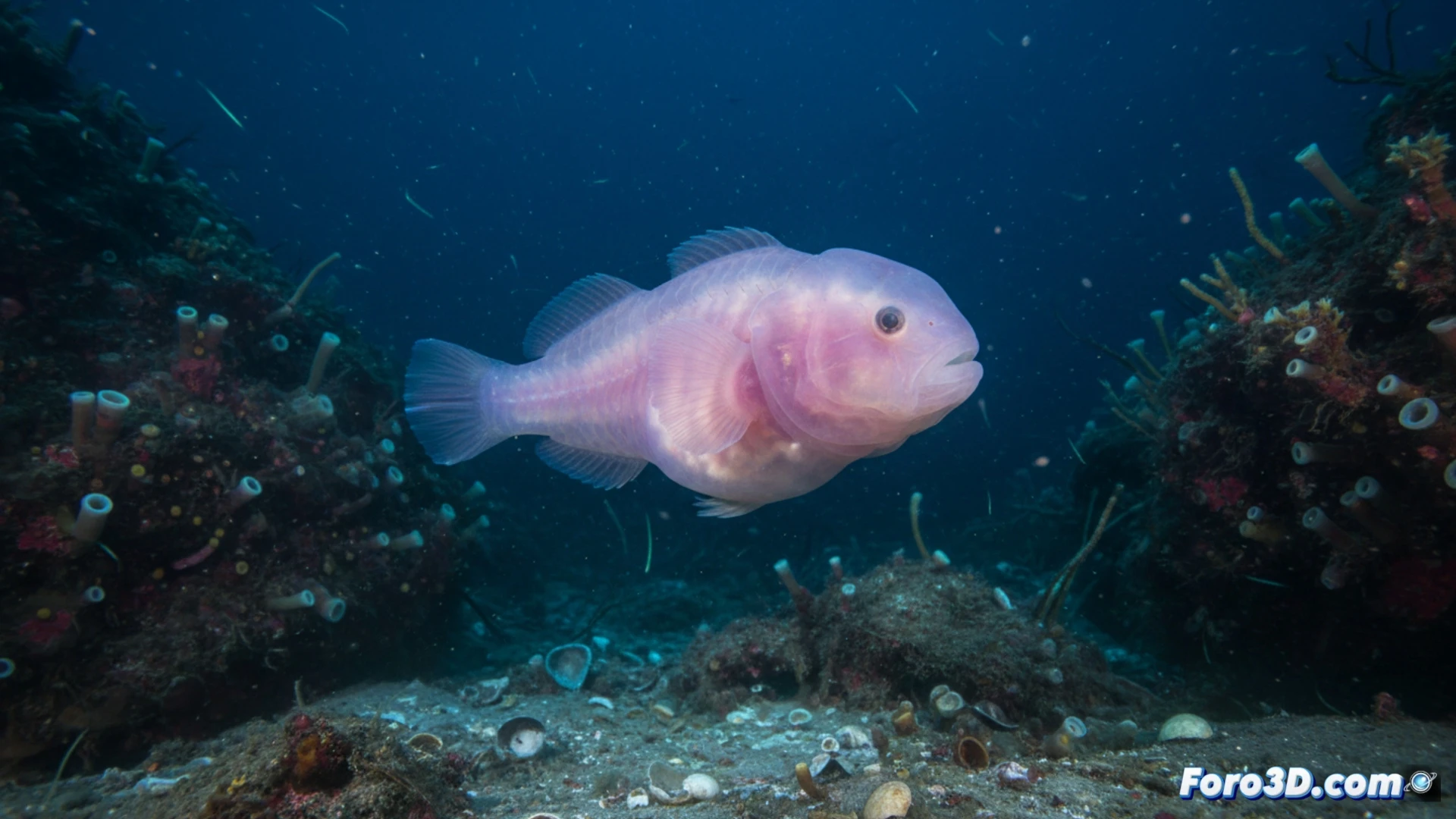
A team of New Zealand researchers has captured images of an unknown species of abyssal fish in the Bounty Trench. With a gelatinous and semi-transparent body, this organism lives at a depth of 2,762 meters, withstanding crushing pressures and temperatures near freezing. For the scientific visualization community, this discovery represents a technical challenge: reconstructing its soft anatomy and extreme ecosystem through precise 3D graphics.
Volumetric reconstruction and tissue simulation 🧬
The absence of a rigid skeleton in this fish forces the use of modeling techniques based on fluid physics. Bathymetric data from the Bounty Trench and expedition photographs allow generating a base mesh with low-density topology. To emulate its gelatinous appearance, it is recommended to use a subsurface scattering (SSS) shader with variable roughness maps. The key is to simulate light refraction through its translucent skin, adjusting the refractive index to values close to seawater. Additionally, a particle simulation can recreate the viscous currents that deform its body during slow swimming.
Habitat visualization and evolutionary adaptations 🌊
The environment of the Bounty Trench requires representing pressure gradients and total darkness. A lighting setup with a single deep blue light point (wavelength 470 nm) mimics ambient bioluminescence. For animation, it is crucial to show the absence of a swim bladder: the fish must float effortlessly, with minimal undulating movements. This 3D model not only serves for outreach but also allows marine biologists to study the evolution of body gelatin as an adaptation to the lack of nutrients in the abyss.
What are the main technical challenges when 3D modeling an abyssal fish from images captured at 2,762 meters depth, and how do these affect the accuracy of scientific visualization?
(PS: at Foro3D we know that even manta rays have better social connections than our polygons)