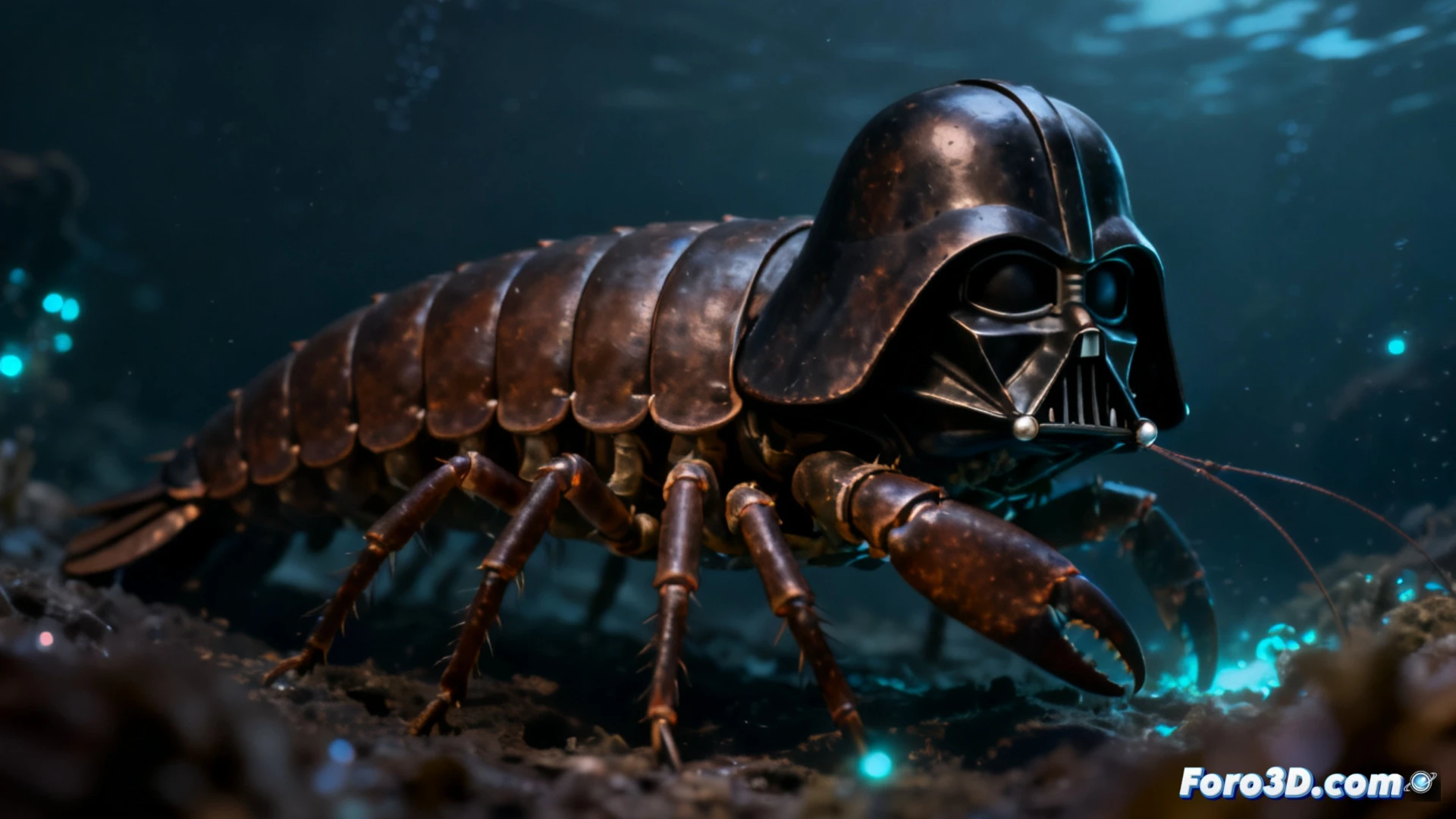
The discovery of Bathynomus vaderi in 2025 off the coast of Vietnam has captured the imagination of biologists and science fiction enthusiasts alike. This giant crustacean, belonging to the isopod group, features a cephalic carapace whose morphology unmistakably evokes the helmet of the iconic Star Wars villain. For the scientific visualization community, this species represents a fascinating challenge: translating a real biological curiosity into an anatomically accurate and visually striking 3D model.
Anatomical Reconstruction and Retopology of the Carapace 🦞
The modeling process for Bathynomus vaderi must begin with a rigorous analysis of collected specimens. The most distinctive feature is the frontal projection of the carapace, forming an angular structure similar to the visor of Darth Vader's helmet. When performing retopology, it is crucial to preserve bilateral symmetry and the subtle curves that differentiate this species from its relatives like Bathynomus giganteus. The use of high-resolution photogrammetric scanning is recommended to capture the rough texture and segmented plates of the exoskeleton. The color palette should prioritize the brown and dark gray tones of marine sediment, avoiding pure black to maintain scientific credibility. The legs and uropods require smooth rigging to allow for locomotion simulations on the ocean floor.
Interactive Outreach in Virtual Environments 🌊
A 3D model of Bathynomus vaderi has enormous potential in virtual museums and outreach platforms. By integrating this crustacean into a recreation of its natural habitat, the trenches of the South China Sea at depths over 800 meters, the public can be educated about adaptation to extreme pressure and chemosynthesis. The interactive comparison with Darth Vader's helmet, far from being a mere gimmick, serves as a pedagogical hook to explain the convergent evolution of protective forms in nature. This approach transforms a pop culture anecdote into a solid lesson in marine biology.
What 3D modeling techniques based on photogrammetric scanning or computed tomography can be employed to accurately reconstruct the segmented anatomy and articulated appendages of Bathynomus vaderi, ensuring the model's viability for biomechanical simulations or educational visualizations in interactive environments?
(PS: fluid physics for simulating the ocean is like the sea: unpredictable and you always run out of RAM)