The discovery of the leaf pygmy chameleon in the forest fragments of Madagascar offers us a unique opportunity for scientific visualization. This reptile, whose size does not exceed that of a matchstick, is an evolutionary marvel of camouflage. As editors of Foro3D, we propose a photorealistic modeling project that captures its essence: from the microscopic texture of its scales to the simulation of its integration into the leaf litter. The goal is to create a 3D asset that serves both for public outreach and biomechanical analysis.
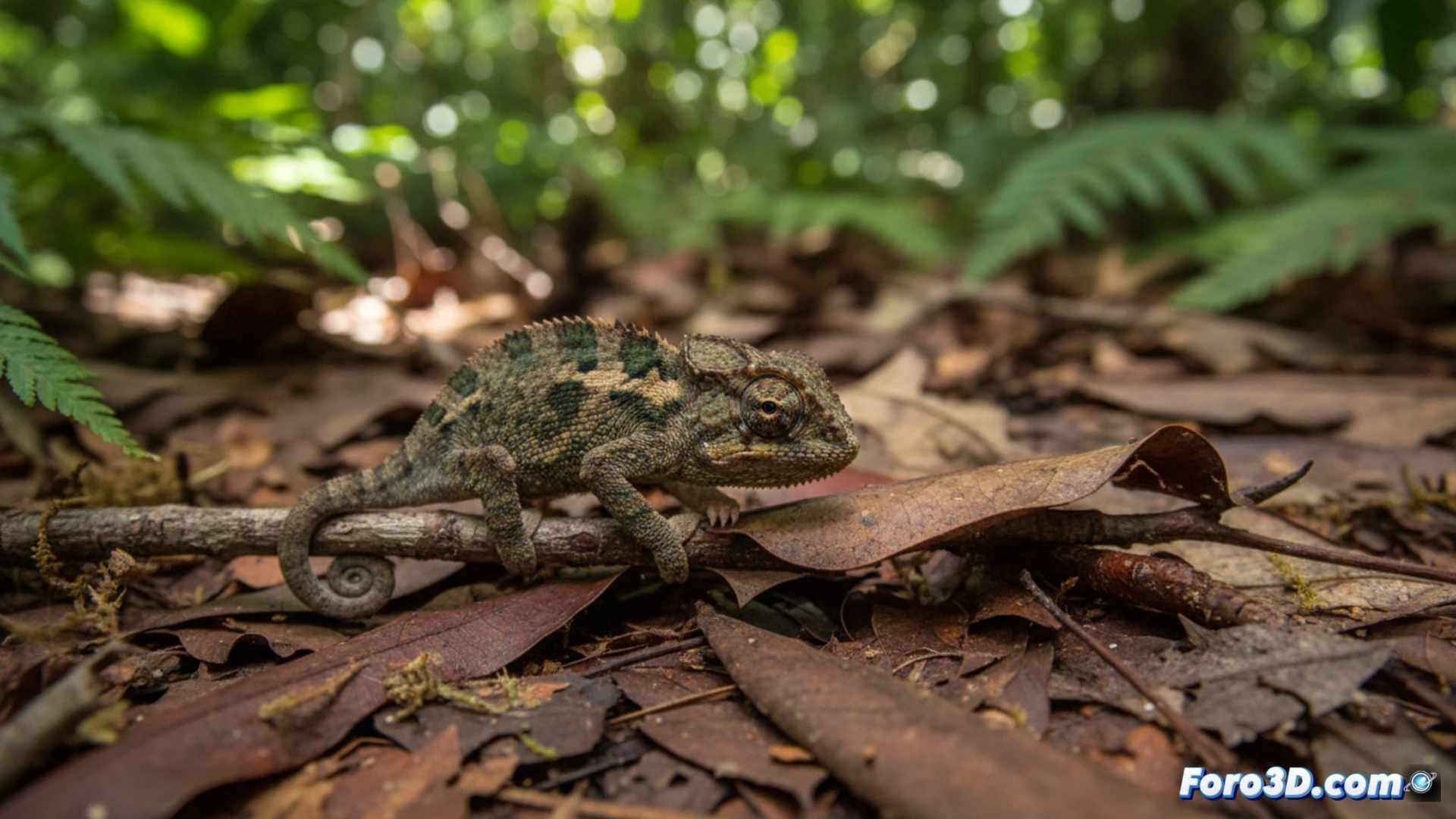
Modeling pipeline: Scales, coloration, and environment 🦎
The modeling phase should begin with a reference photogrammetric scan (if possible) or with polygonal modeling based on high-resolution images. The key lies in shading: we must recreate the animal's cryptic coloration, using procedural textures that mimic lichen and bark markings. For animation, we will implement a particle system that simulates the movement of leaf litter as the chameleon passes, while advanced rigging will allow independent eye movement and the typical body undulation of these reptiles. Additionally, it is crucial to add a displacement map for the keeled scales, giving them the realistic volume required for scientific visualization.
The 3D map of the lost sanctuary 🌍
The animal alone is not enough; the geographical context is vital. We must generate a 3D map of the fragmented forests of Madagascar, using satellite elevation data and vegetation textures. The final animation should show a transition: from a satellite view of the landscape, zooming into a microhabitat of leaf litter where the chameleon, nearly invisible, slowly reveals itself. This approach not only educates about the species but also visualizes the urgency of its conservation, demonstrating how 3D can be a tool for science and awareness.
What specific technical challenges in the 3D modeling of biological microstructures, such as the scales and camouflage system of the pygmy chameleon, allow for improving the accuracy of scientific simulations to study their interaction with light and the environment in the tropical leaf litter?
(PS: at Foro3D we know that even manta rays have better social connections than our polygons)