The discovery of Byblis hortonae in the abyssal plains of the central Pacific offers a unique opportunity for scientific visualization. This amphipod crustacean, formally described as a specialized scavenger, exhibits extreme adaptations to pressure and perpetual darkness. Its morphology, featuring elongated sensory appendages and a semi-transparent exoskeleton, is ideal for 3D reconstruction. Modeling this species allows marine biologists to study its anatomy without the need for physical specimens, facilitating the dissemination of deep-sea ecosystems.
Anatomical reconstruction and abyssal adaptations 🦐
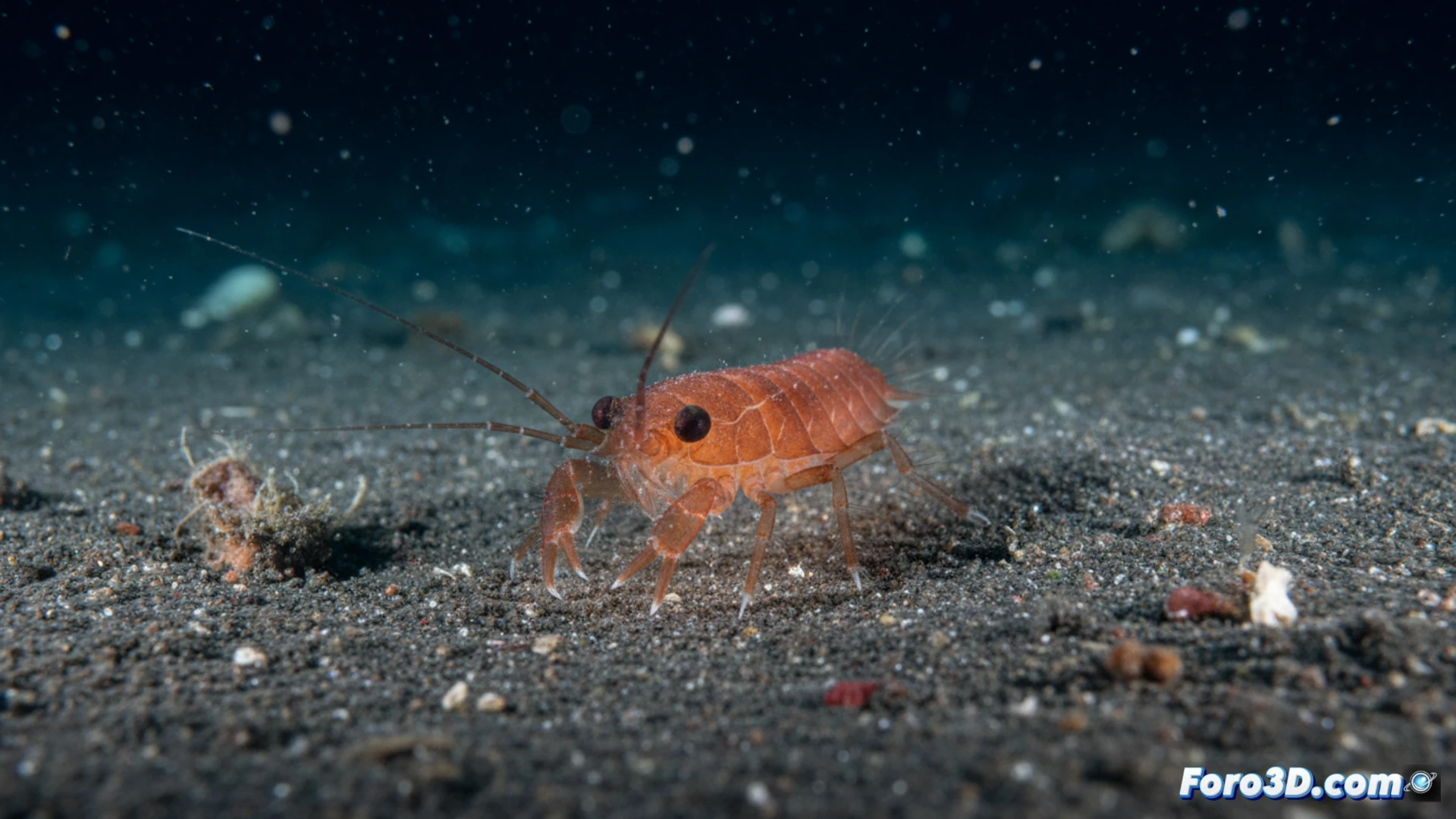
For the 3D model, it is crucial to capture the detailed morphology described in the taxonomic literature. Byblis hortonae has an elongated and laterally compressed body, with flagellated antennae that exceed the length of the cephalothorax. The pereiopods are adapted for locomotion on soft sediments, while the gnathopods have fine chelae for tearing organic matter. The absence of ocular pigmentation and the thin cuticle are evolutionary responses to the aphotic zone. It is recommended to model the cuticle with translucency maps and add sensory setae on the appendages to simulate chemoreception. The scale of the model should be submillimetric, with a level of detail that allows observation of segmentation.
Visualizing an ecosystem on the abyssal plain 🌊
The representation of the habitat is as important as the organism. The abyssal plain of the central Pacific is characterized by fine pelagic sediments and extremely low nutrient density. In the 3D scene, a sediment layer with irregular texture and dim lighting simulating background bioluminescence should be included. Comparing Byblis hortonae with other scavengers such as giant isopods or amphipods of the genus Hirondellea highlights differences in mandibular morphology and feeding strategies. This visual comparison helps to understand adaptive radiation in ocean trenches.
What are the main technical challenges when 3D modeling an abyssal organism like Byblis hortonae, considering its translucent anatomy and the lack of direct visual references from its natural environment?
(PS: if your manta ray animation doesn't excite, you can always add documentary-style music from channel 2)