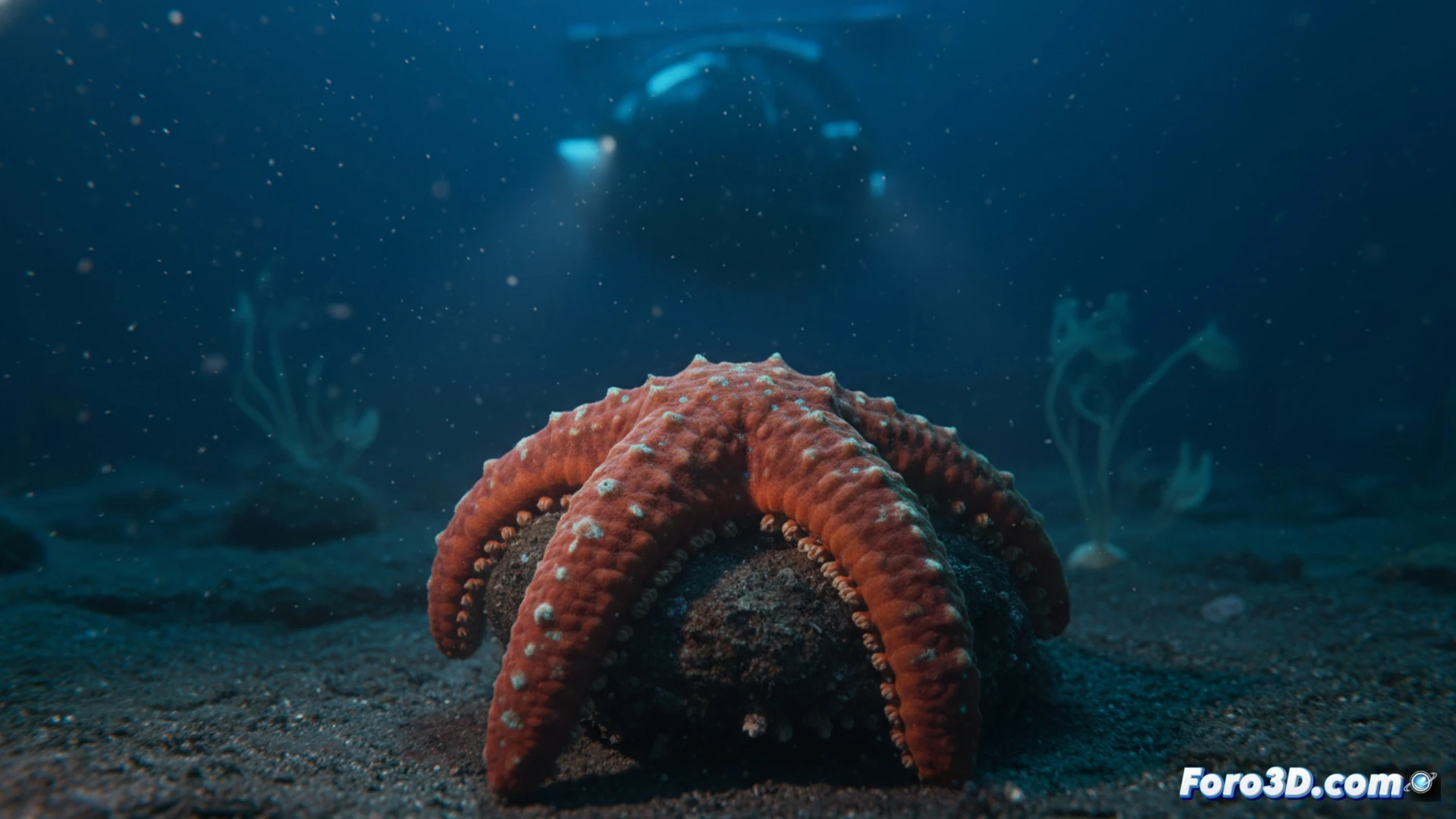
The discovery of a new species of asteroid, Tylaster sp., in abyssal trenches during recent oceanographic surveys opens a unique window for scientific visualization. This purely biological finding challenges us to digitally represent its extreme adaptations. The Foro3D community has the opportunity to reconstruct not only the anatomy of the specimen but also the ecosystem it inhabits, using scanning and photogrammetry tools.
Photogrammetry and scanning of abyssal specimens 🌊
The fragility of the tissues of Tylaster sp., adapted to pressures of over 3000 meters, prevents constant handling. This is where high-resolution photogrammetry and structured light 3D scanning become essential protocols. We can generate a detailed polygonal mesh of its arms and calcareous plates, preserving the texture of its gelatinous epidermis. This digital model allows marine biologists to study structural deformations without risking damage to the holotype. The technical challenge lies in capturing the translucency of its exoskeleton and simulating neutral buoyancy in a virtual environment.
Reconstructing the habitat for outreach 🐚
Beyond anatomy, the true educational value lies in reconstructing the habitat. By integrating bathymetric data from the surveys, we can recreate the topography of the ocean floor where the Tylaster sp. was collected. Visualizing this asteroid alongside cold-water corals and foraminifera in an interactive 3D environment allows us to explain its adaptations to total darkness and high pressure. This approach transforms biological data into an immersive experience for the global scientific community, demonstrating that digital art is an indispensable tool for modern taxonomy.
What specific challenges does the digital reconstruction of the delicate skeletal structures of Tylaster sp. present, based on low-clarity images captured under extreme pressure and total darkness in abyssal trenches, and how can these be overcome using advanced 3D modeling techniques and photogrammetry adapted to the deep environment?
(PS: fluid physics for simulating the ocean is like the sea: unpredictable and you always run out of RAM)