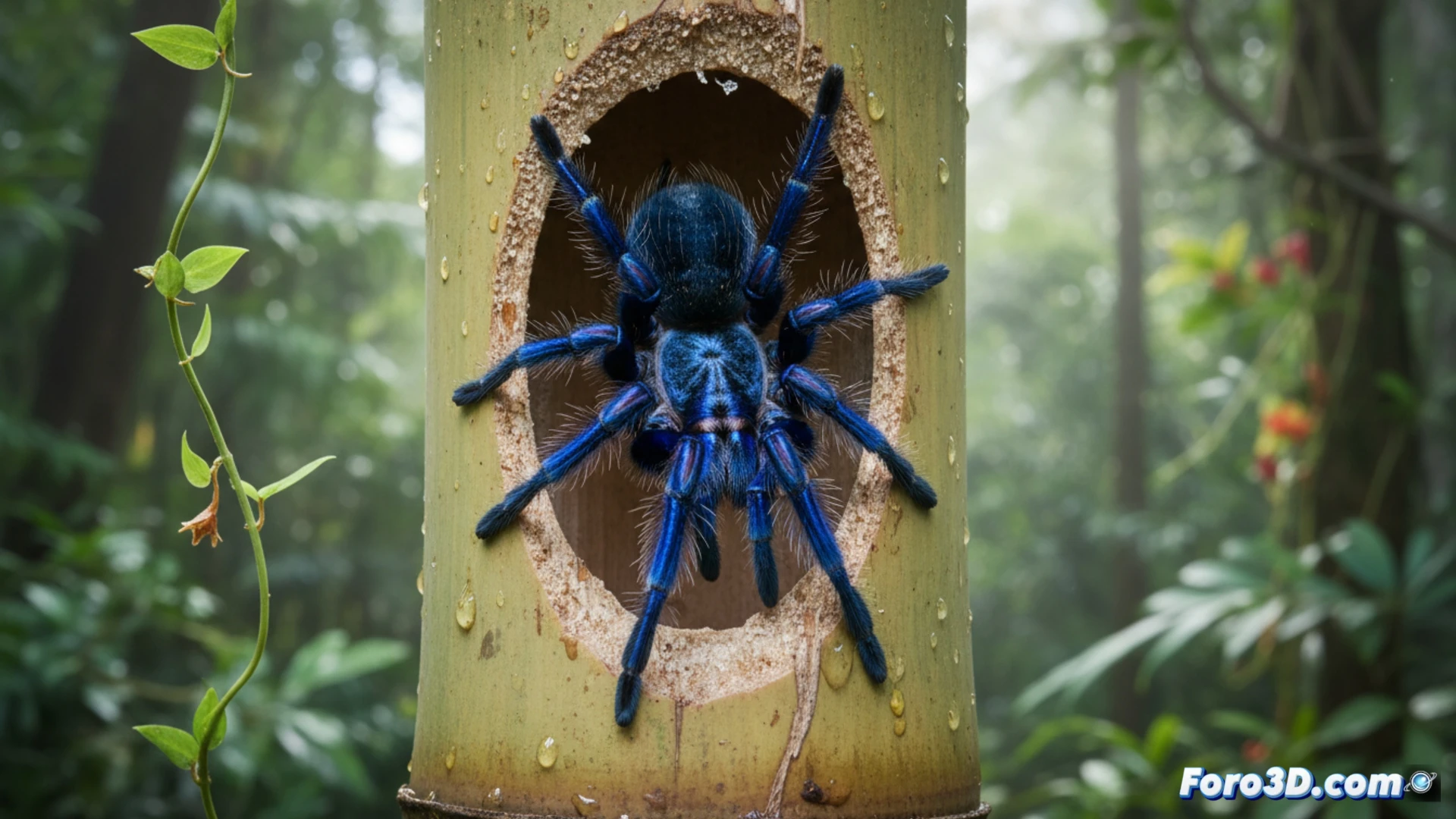
The discovery of a new species of tarantula with vibrant metallic coloration in the jungles of Thailand represents a milestone for zoology and a technical challenge for scientific visualization. This arachnid, which inhabits hollows in bamboo trees, has an exoskeleton with electric blue reflections that requires advanced rendering techniques to capture its natural iridescence. In this article, we will explore the process of creating a photorealistic 3D model, from capturing reference data to implementing PBR materials that replicate the structure of the arthropod's cuticle.
Technical workflow for modeling the metallic exoskeleton 🕷️
To achieve a reliable result, the process begins with the analysis of macro photographs and field studies of the specimen in its natural habitat. The base geometry is built in Blender using subdivisions that respect the real anatomical segmentation: prosoma, opisthosoma, and chelicerae. The greatest challenge is simulating the metallic effect, which depends on nanostructures in the cuticle that interact with light. A multi-layer shader is used in Substance Painter, combining a variable roughness map with a cyan-blue color gradient and touches of purple. Lighting is configured with an HDRI system that emulates the filtered light of the jungle canopy, and a subsurface scattering effect is added for the more translucent areas of the legs. The interactive animation, exported to Unity, allows the user to rotate the model and activate a visual comparison mode with other tarantulas such as Chilobrachys natanicharum.
Implications of the model for scientific outreach 🔬
This 3D model transcends mere aesthetic representation by serving as an educational tool. The interactive animation includes a behavior cycle where the tarantula emerges from its bamboo refuge, displaying stalking and defensive movements based on real ethological observations. For the Scientific Visualization niche, the project demonstrates how computer graphics technology can help researchers study coloration patterns without needing to manipulate live specimens. Additionally, the model has been optimized for use in virtual reality environments, allowing biology students to examine the arachnid's anatomy at a virtual microscopic scale, fostering immersive learning about Southeast Asian biodiversity.
What specific technical challenges does reproducing the iridescent metallic coloration effect of the electric blue tarantula in a 3D model intended for scientific visualization present, and how can they be overcome through texturing and shading techniques?
(PS: modeling manta rays is easy, the hard part is making them not look like floating plastic bags)