The discovery of Dendrelaphis nigromaculatus in the islands of Milne Bay represents a milestone for herpetology in 2025. For scientific visualization, this finding offers a unique opportunity to digitally recreate a newly described species. Creating a photorealistic 3D model not only documents its morphology but also allows for its study without the need to manipulate live specimens, a critical factor in the conservation of endemic species.
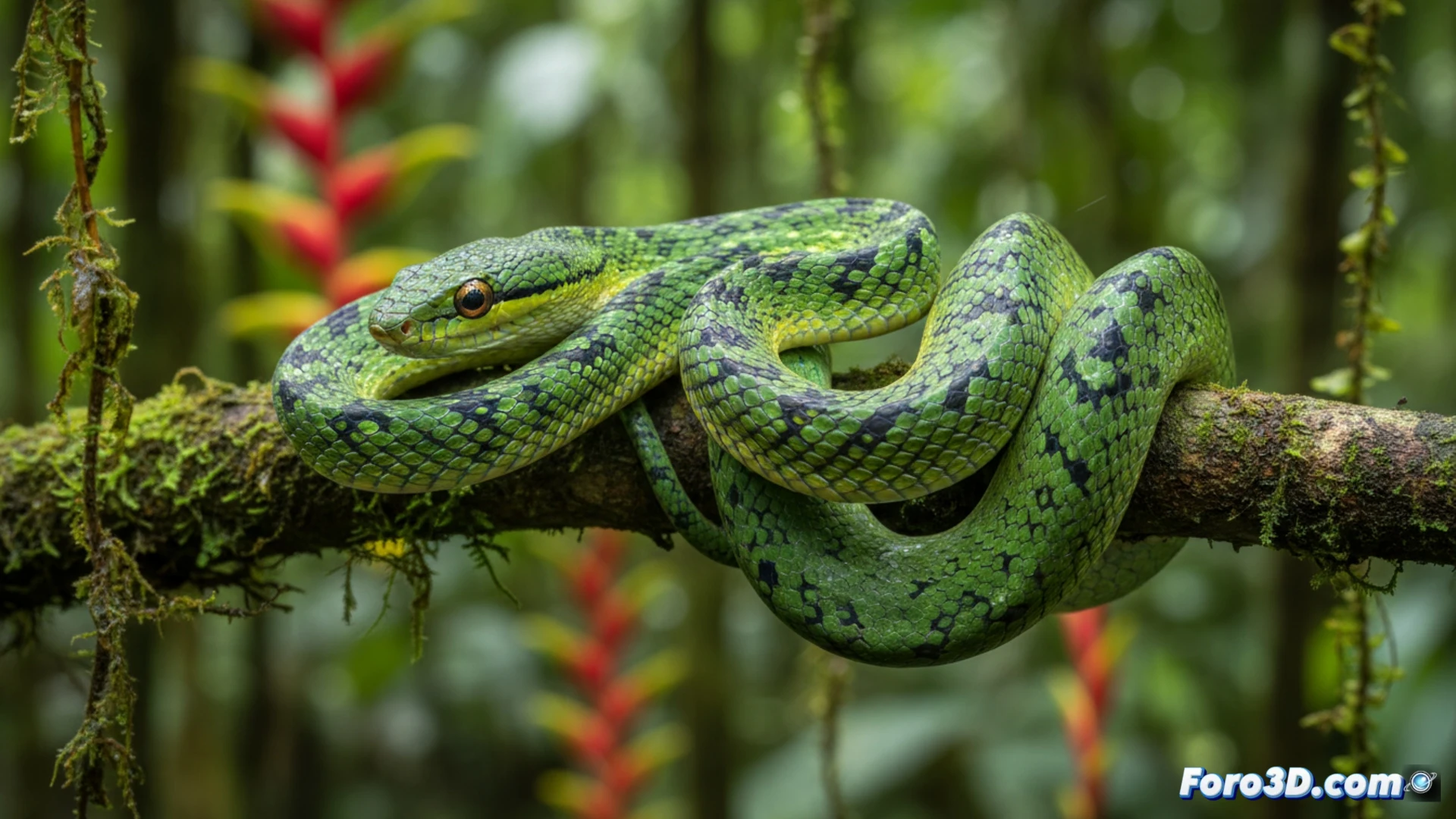
Digital Reconstruction and Morphometric Analysis 🐍
The modeling process begins with micro-CT scanning of a preserved holotype, capturing the arrangement of dorsal scales and the characteristic vertebral keel of the genus. Texturing is based on high-resolution photographs of the animal in life, where the pattern of black spots on an olive-green background stands out. The animation of arboreal locomotion is achieved through rigging based on inverse kinematics, replicating the lateral S-shaped movement these snakes use to move between branches. The 3D comparison with Dendrelaphis punctulatus reveals differences in prehensile tail length and snout angle, data visualized through geometric heat maps.
Implications for Science Communication 🔬
Beyond taxonomy, this 3D model allows biologists to simulate the species' interaction with its island ecosystem. The digital representation of camouflage patterns against bark and foliage backgrounds helps understand its hunting strategy. For the general public, an interactive visualization on virtual reality platforms can bring the biodiversity of Papua New Guinea to global audiences, fostering interest in the conservation of habitats threatened by deforestation.
How the morphology of Dendrelaphis nigromaculatus can be accurately modeled in 3D from limited field data for scientific visualization in herpetology
(PS: fluid physics for simulating the ocean is like the sea: unpredictable and you always run out of RAM)