The discovery of Coffea rizetiana in the mountain forests of Cameroon represents a milestone for botany and agriculture. This new species, identified by its resistance to pests and extreme shade conditions, expands the genetic map of the genus Coffea. For scientific visualization, this poses a fascinating challenge: reconstructing its unique morphology in 3D, from the arrangement of its leathery leaves to the structure of its fruits, which are smaller and more pigmented than those of Arabica coffee.
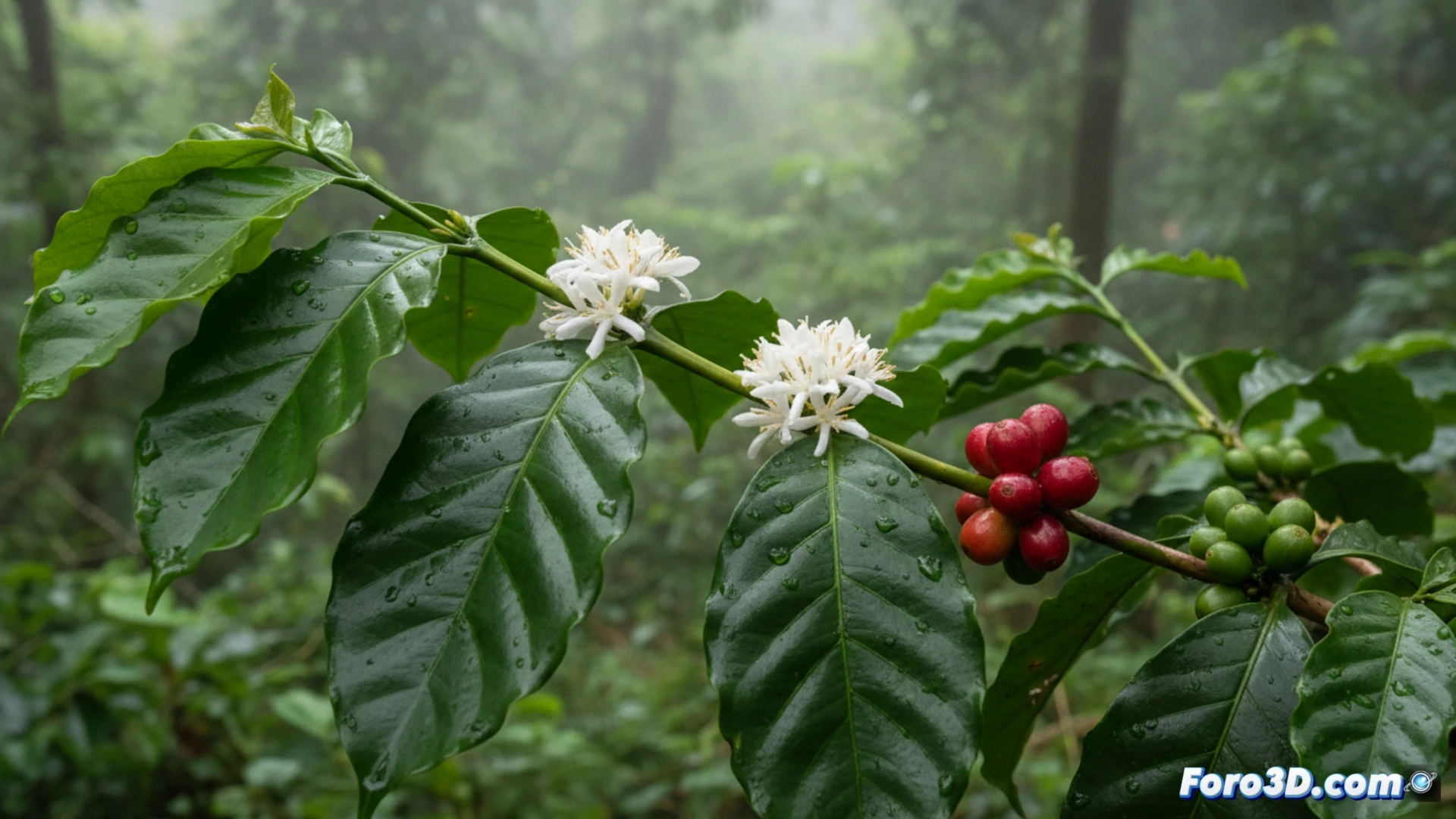
Virtual reconstruction of the ecosystem and detailed morphology 🌿
For 3D modeling, a multiscale approach is required. First, the reconstruction of the cloud forest ecosystem at 1,500 meters altitude, where constant fog and a closed canopy define diffuse lighting and ambient humidity. Second, the anatomical model of the plant: the stem exhibits sympodial branching with short internodes, ideal for animating its growth under low-light conditions. The leaves, with reticulate venation and wavy edges, must be textured with a low specular reflectance map to simulate their waxy cuticle. The fruit, a bilocular drupe, requires a subsurface scattering (SSS) model to replicate its translucent red-orange coloration. The visual comparison with Coffea arabica and Coffea canephora is achieved by overlaying polygon meshes and highlighting differences in endosperm size and stomatal density.
The value of biodiversity in a single render 🌍
Beyond aesthetics, this 3D model serves a critical function for scientific communication. By visualizing the root architecture of Coffea rizetiana, researchers can infer its adaptation to volcanic soils and steep slopes. Rendering its complete phenological cycle, from the white flower to fruit ripening, allows geneticists to identify pollination windows and potential hybridizations. At Foro3D, we believe that this type of digital asset is the ultimate tool for virtually preserving biodiversity before climate change alters these unique habitats.
Considering the challenges of preserving the unique morphology of a new botanical species like Coffea rizetiana, which scanning or photogrammetry technique would you recommend to accurately capture the microscopic details of its leaves or fruits in a tropical rainforest environment?
(PS: if your manta ray animation doesn't excite, you can always add documentary music from channel 2)