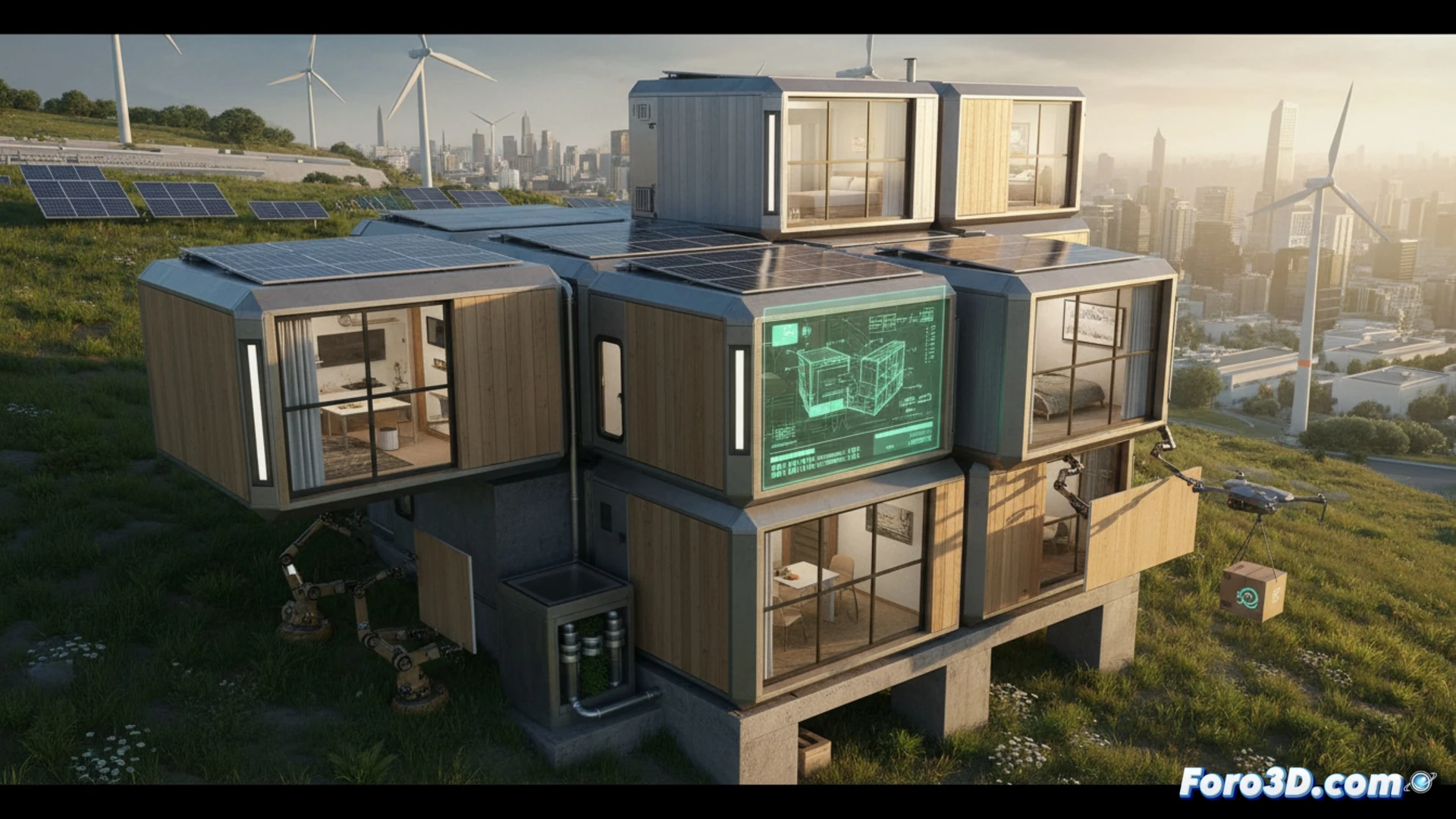
Open Source Ecology presents the MicroHouse project, an open-source modular construction system. This architectural core, designed for expansions, prioritizes the parallel manufacturing of plug-and-play components. It represents an ideal case study for analyzing the intersection between collaborative design, light industrialization, and the use of BIM and 3D visualization tools in open and sustainable architecture projects.
System Integration: Metallic, Digital, and Earth 🧱
The technical innovation of the MicroHouse lies in its hybrid integration. It combines a rapid spatial frame made of steel tube with compressed earth brick walls, allowing for the simultaneous construction of the roof and enclosure. Furthermore, it explores the use of digitally fabricated WikiHouse structures with wooden panels. This convergence of systems demands rigorous BIM modeling to coordinate modular components, simulate assemblies, and generate precise manufacturing drawings for all project collaborators.
BIM and 3D Visualization: Keys to Open Collaboration 🤝
The project's open-source philosophy depends entirely on accessible digital documentation. A centralized BIM model not only coordinates construction but also serves as a universal repository for the community. 3D visualization and virtual reality are essential tools for previewing assemblies, validating designs, and disseminating the project, demonstrating that digital technology is the pillar for scaling collaborative and modular architecture.
How can the integration of an open-source modular construction system, like MicroHouse, revolutionize BIM workflows and accessibility in architectural projects?
(PS: BIM is like having a building in Excel, but with pretty windows.)