A high-speed train suffered a catastrophic axle failure during operation. The failure, initially attributed to a manufacturing defect, was analyzed using a reverse engineering pipeline. 3D scanning with GOM ATOS revealed a microscopic ovalization in the wheel geometry, a deviation from ideal roundness of less than 50 microns. This imperfection, caused by incorrect turning in the maintenance workshop, generated high-frequency vibrations that broke the internal bearings of the axle.
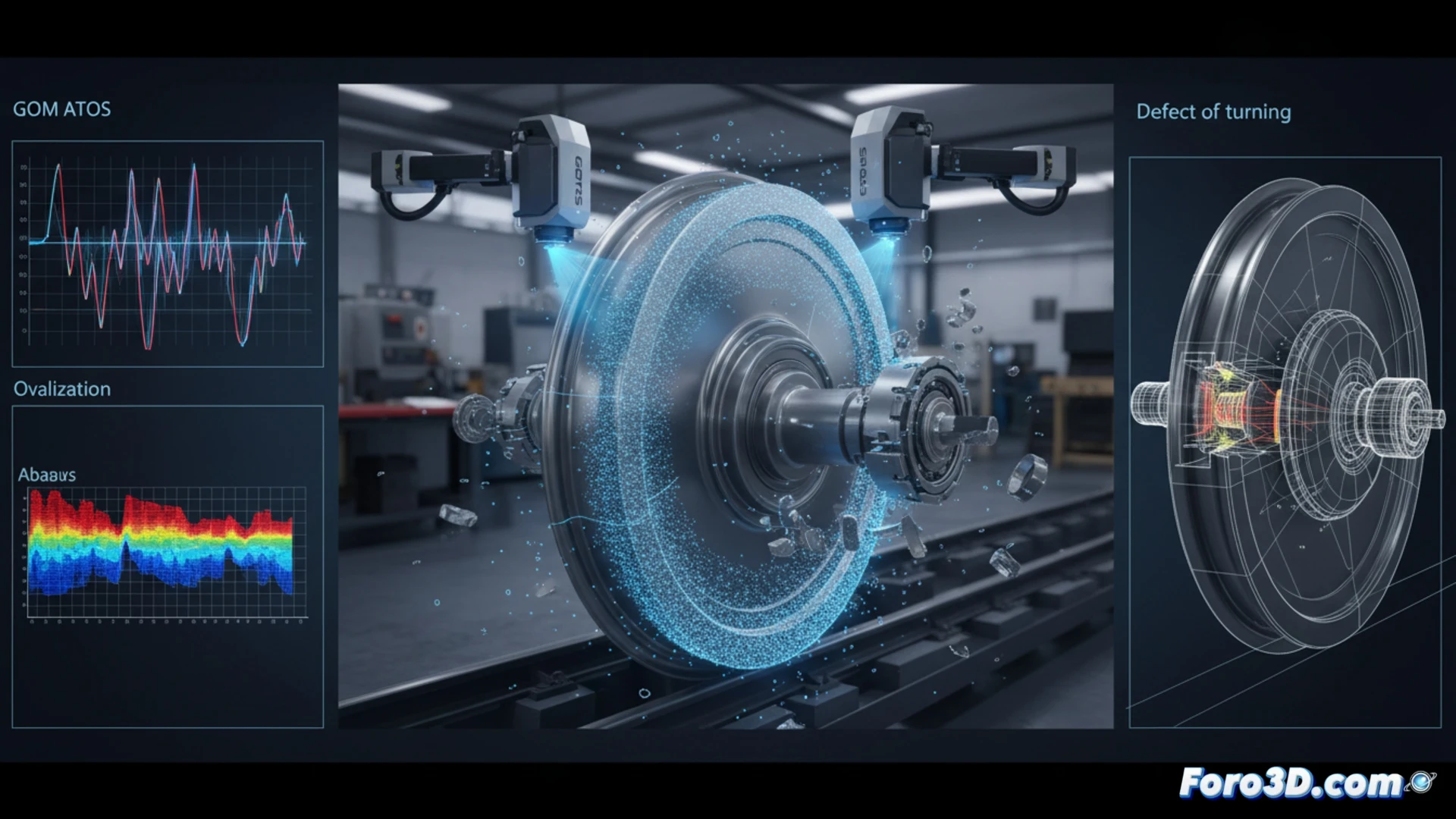
Inspection pipeline: From GOM ATOS to Abaqus 🚄
The process began with digitizing the wheel surface using GOM ATOS, a structured light system that captures point clouds with micrometric precision. The data was exported to MATLAB to perform a roundness analysis, where the radial deviation was quantified as a function of the rotation angle. This ovalization profile was imported into Abaqus to simulate wheel-rail contact under high-speed conditions. The finite element model revealed that, when rotating, the non-circular wheel generated acceleration peaks in the bearings, exceeding the material's fatigue limit. The simulation confirmed that the turning defect amplified the resonance frequencies of the assembly, causing progressive fracture of the bearing races and balls.
Lessons for railway maintenance 🔧
This case demonstrates that material fatigue does not always originate from extreme loads, but rather from minimal geometric imperfections that go unnoticed in visual inspections. The integration of 3D scanning (GOM ATOS) with fatigue simulations (Abaqus) allows predicting failures before they occur, establishing a new standard in predictive maintenance. For materials engineers, ovalization becomes a critical parameter to control in turning processes, where a poorly adjusted tolerance can trigger destructive harmonic vibrations. The final reflection is clear: in high-speed rail, geometric precision is not a luxury, but a safety requirement.
ANSYS or Abaqus for this analysis? 🤔