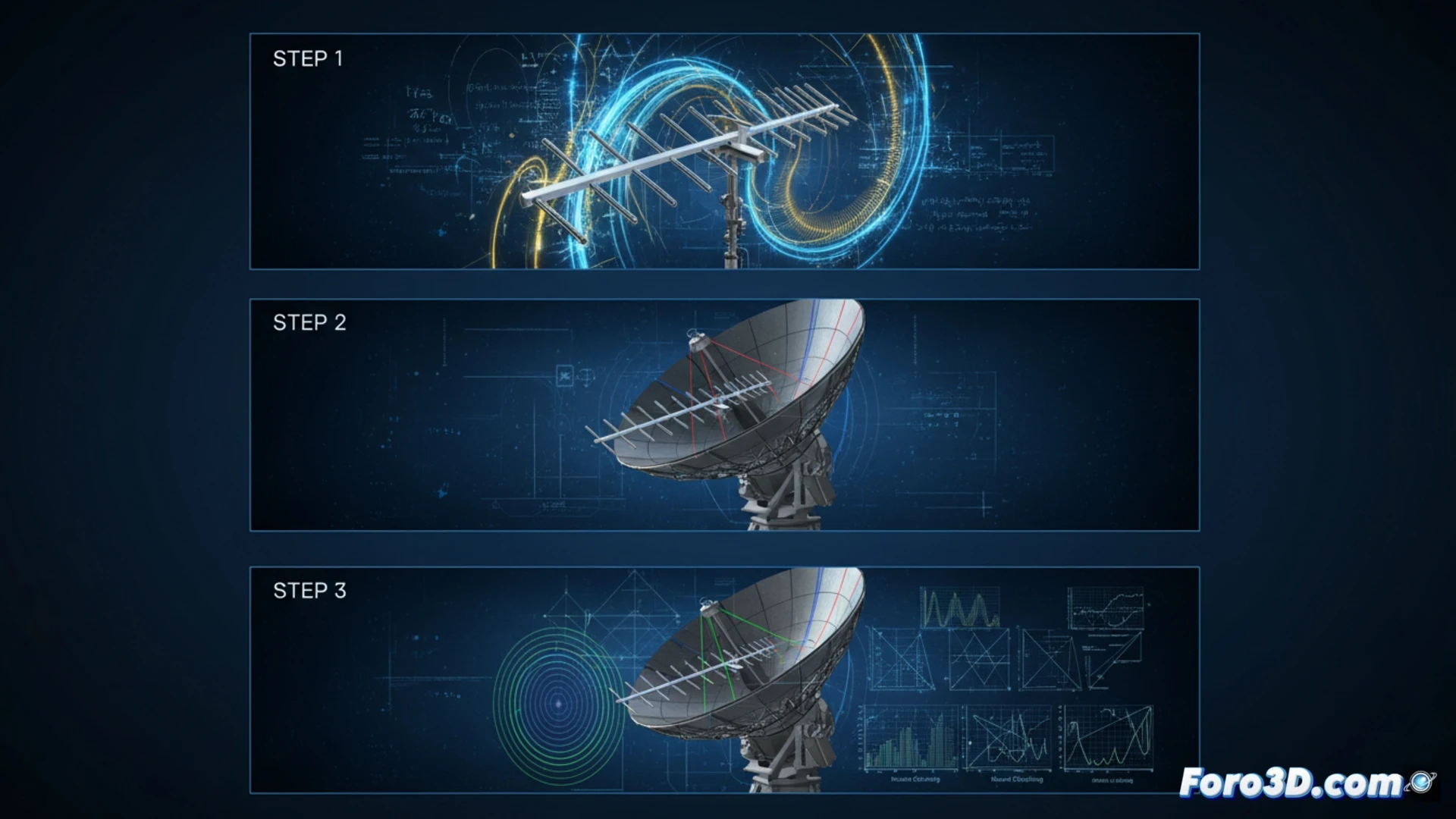
In critical applications such as satellite communications or radio astronomy, reflector antennas with broadband feeds are required. A recent document details a three-step methodology for designing reflectors fed by a log-periodic dipole array. The process addresses the independent optimization of the LPDA, its integration with the reflector, and the final joint tuning, effectively handling mutual coupling.
Pushing Limits with Advanced MoM and Systematic Optimization 🚀
The strategy overcomes the limitations of traditional simulations through advanced Method of Moments techniques. It employs high-order basis functions and exploits symmetries to model electrically large structures, such as reflectors up to 70 meters, on standard desktop hardware. This approach allows for a precise analysis of the coupling between the feed and the reflector, achieving compliance with gain and VSWR specifications over 10:1 bandwidths in a systematic manner.
When Your Parabolic Dish Asks for a Broadband Menu 🍽️
Sure, because designing an antenna for a single frequency is already fun enough. Now imagine doing it for a 10:1 range, where your feed decides to couple with the reflector in new and creative ways in each band. The presented methodology is like a marriage manual for antenna elements that don't get along, getting them to cooperate for the common good of the signal. At least in simulation, it's all in the family.