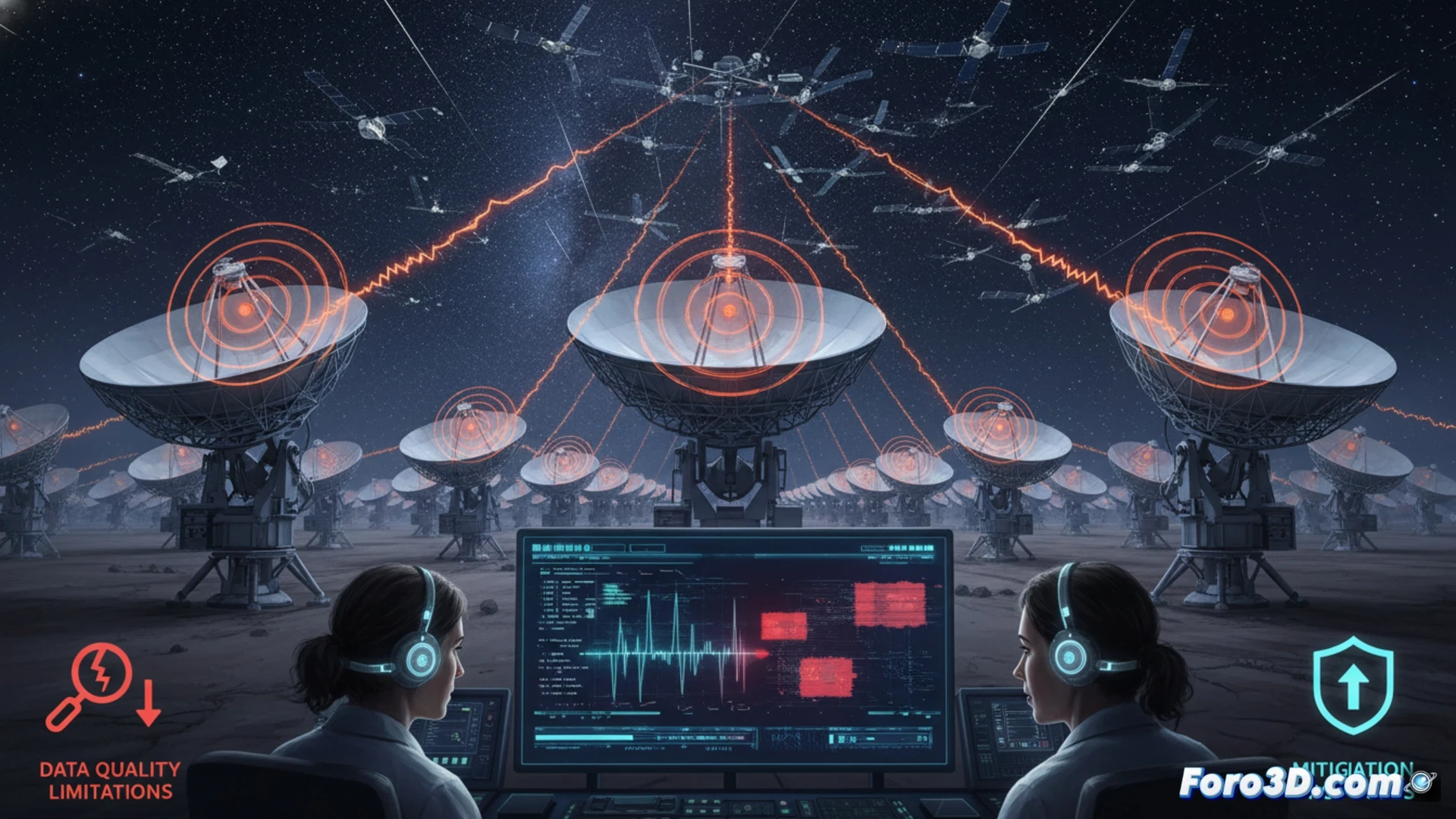
A new study warns that the increase in satellites, especially megaconstellations, will significantly affect observatories like the Square Kilometre Array. Simulations show that a relevant portion of observation time will be contaminated by radio frequency interference, particularly at low frequencies. This could complicate astronomical research and the quality of the data obtained.
Technical solutions against orbital pollution 🛰️
Faced with this threat, the scientific community seeks to develop more advanced mitigation systems. Strategies include dynamic filters that eliminate satellite signals in real time, noise cancellation algorithms, and agreements with operators to reduce unwanted emissions. Although pollution will be difficult to avoid, anticipating the problem allows for designing tools that preserve the integrity of observations. The challenge is technical, but not insurmountable if action is taken quickly.
The sky fills with antennas and astronomers cry 😭
Satellites no longer just give us internet; they also give us free interference. Astronomers will soon have to make an appointment to observe the sky without Elon Musk or Jeff Bezos messing up their signal. Perhaps the next step will be to rent a telescope on the far side of the Moon, although surely someone is already planning to put a 6G antenna there. The universe is big, but the radio spectrum is starting to look like a highway at rush hour.