The history of the scientific method often focuses on theoretical figures. However, its practical development owes much to 17th-century engineers like Cornelis Drebbel and Salomon de Caus. These inventors worked with a learning by doing approach, experimenting and building devices. Francis Bacon observed their work and sought to formalize that empirical process into a systematic framework, laying a fundamental foundation for modern science.
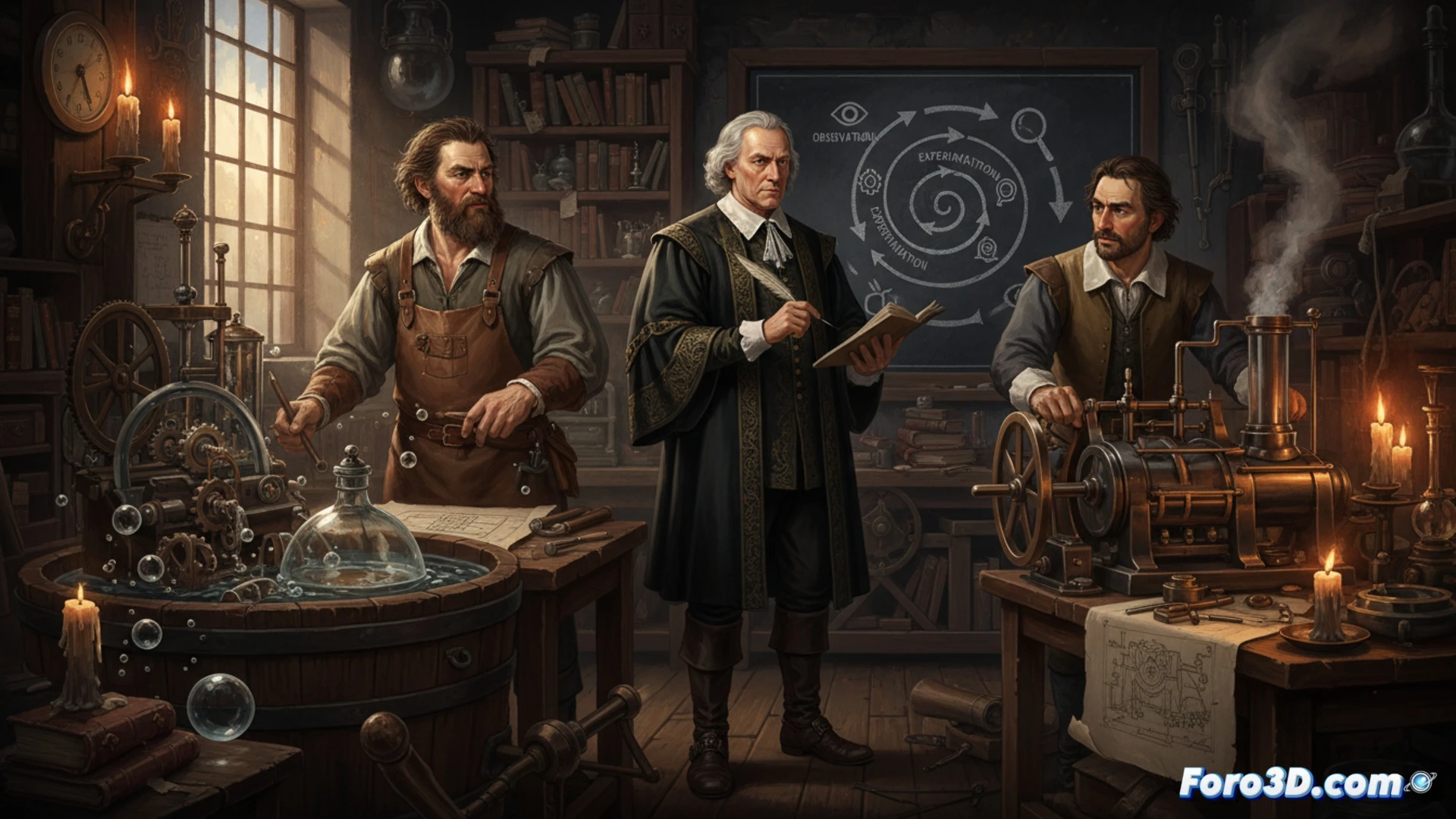
From the Hydraulic Machine to the Experimental Protocol 🔧
Drebbel, with his oar-powered submarine and a system of tubes to renew the air, or De Caus, with his automata and fountains powered by thermal energy, operated through controlled trial and error. They did not start from a pure theory, but from a concrete problem. Their iterative process of building, observing failure, and modification provided a tangible model. Bacon translated this approach into principles like methodical observation, deliberate experimentation, and induction from data, structuring what was a craft practice.
When the Invention Workshop Was the Best Laboratory 💥
It turns out that the founding fathers of modern science weren't just guys in lab coats thinking in Latin. They were, in part, observers of guys with grease-stained hands, burning their fingers on steam and noting which lever exploded this time. Bacon basically took the creative chaos of the workshop, gave it a fancy title and some rules, and sold it as the new method. Undoubtedly, a lesson that sometimes revolution comes not from the ivory tower, but from the flooded basement.