The discovery of the amphipod Lepidepecreum myla, named after a character from the Metroid saga, represents a milestone for marine biology. This crustacean, adapted to the total darkness of the ocean depths, presents a unique morphology that makes it an ideal subject for scientific visualization. Its detailed analysis allows us to understand how extreme pressure and the absence of light shape the anatomy of benthic organisms.
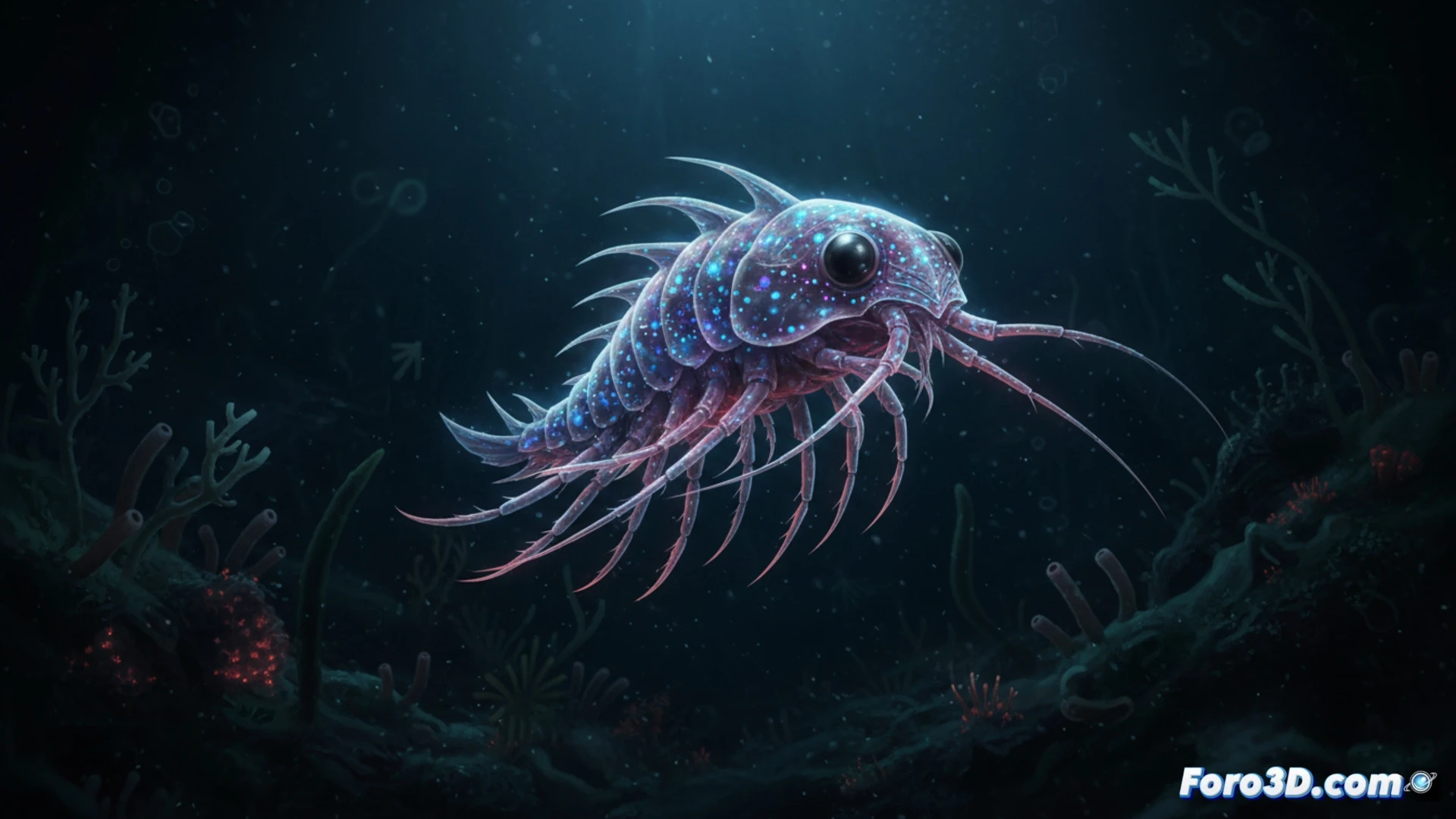
Anatomical modeling and adaptations to the aphotic zone 🦐
Our 3D model focuses on the three key adaptations of Lepidepecreum myla. First, the eyes: reduced to small non-functional ocelli, represented as smooth cuticular protuberances without retinal pigmentation. Second, the chelicerae and maxillipeds, hypertrophied and equipped with mechanoreceptor sensory setae, modeled with high polygon density to simulate their chitinous texture. Third, the semi-translucent cuticle devoid of chromatophores, a common trait in abyssal species that we have recreated using subsurface scattering (SSS) shading. The habitat animation includes a seafloor with pelagic sediment and dynamic lighting that simulates the bioluminescence of nearby organisms.
Scientific outreach as a driver of wonder 🌌
Naming a real creature Myla is not just a nod to popular culture; it is a bridge between science and emotion. By modeling this animal in 3D, we not only document its structure but invite the viewer to wonder what it is like to survive in a world without light. Interactive scientific visualization allows biologists and enthusiasts to rotate, virtually dissect, and compare this amphipod with more familiar ones, transforming a taxonomic fact into an immersive experience that celebrates the planet's hidden biodiversity.
As a 3D modeler, what is the main technical challenge when accurately recreating the translucent structures and articulated appendages of an abyssal amphipod like Lepidepecreum myla, and what scientific visualization techniques do you recommend for representing its bioluminescence in an extreme pressure environment?
(PS: modeling manta rays is easy; the hard part is making them not look like floating plastic bags)