A surprising discovery has bridged the gap between statistics and quantum physics. Scientists have found that the Tweedie distribution, a four-decade-old mathematical equation, accurately describes phase transition phenomena in quantum systems. This finding allows modeling how systems like a Bose gas in an optical lattice abruptly change between distinct states, opening new avenues for research in quantum matter and its technological applications.
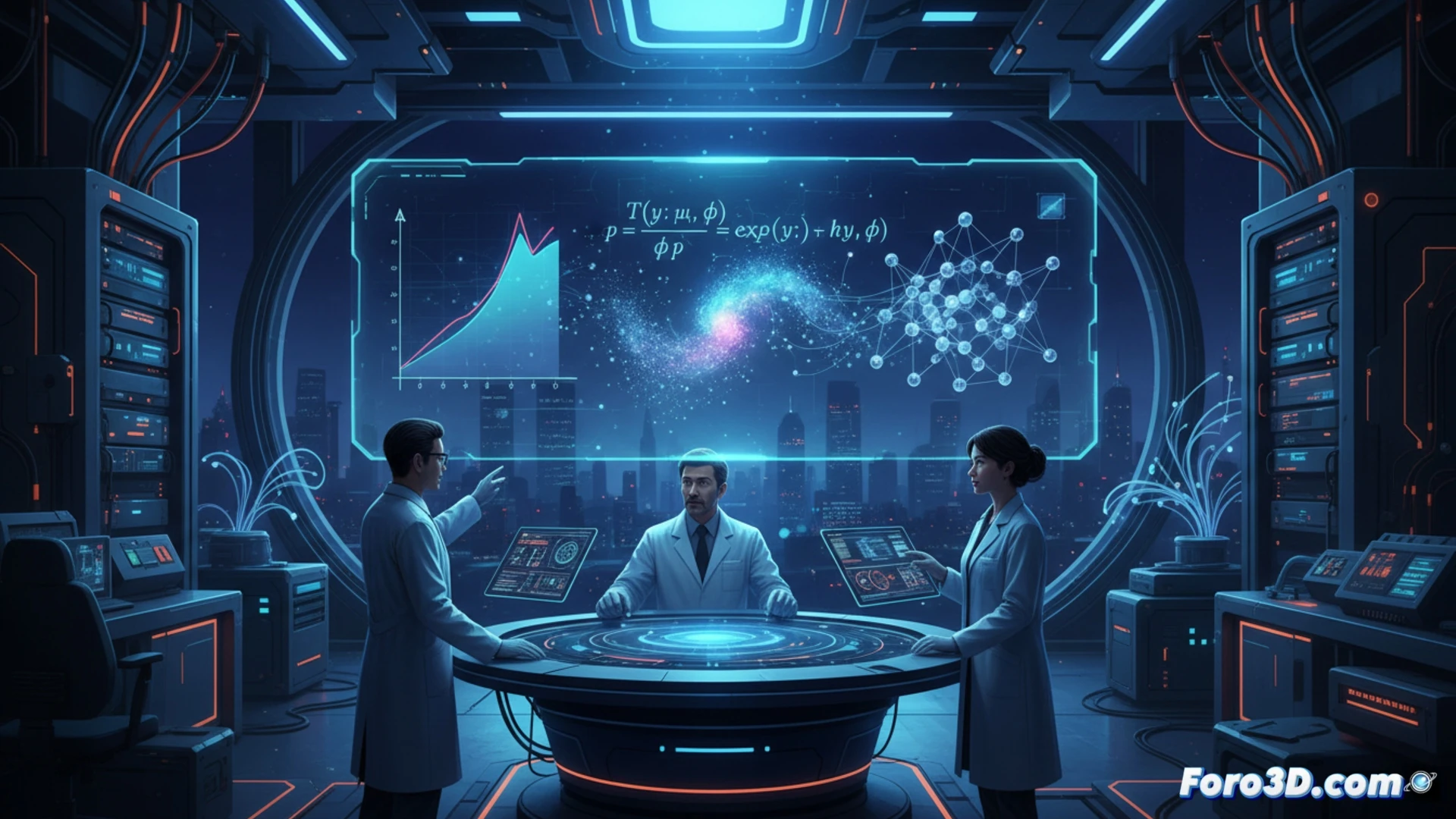
Visualizing the Transition: From the Statistical Model to the Quantum System 🔬
The power of this discovery lies in mathematical abstraction. The Tweedie distribution, originally used in fields like econometrics or biology, belongs to the exponential family and is known for modeling data with a specific relationship between variance and mean. Researchers have mapped this mathematical structure to the thermodynamic properties of a quantum system undergoing a phase transition. This is where scientific visualization becomes crucial. Representing in 3D a Bose gas trapped in an optical lattice, and animating how its density, correlations, or energy change drastically when crossing a critical point as predicted by the Tweedie equation, transforms an abstract concept into a comprehensible and analyzable image.
3D Tools for the Next Quantum Frontier 🚀
This case exemplifies how 3D modeling and visualization are indispensable allies of fundamental science. To explore the implications for quantum computing or material design, we need more than formulas. Interactive visual simulations are required that allow researchers to see the behavior of these systems under different parameters. Integrating this mathematical model into scientific visualization environments not only facilitates outreach but also offers a new diagnostic and exploration tool for one of the most complex and promising areas of modern physics.
How can a classical statistical equation accurately model transitions between quantum states, and what are the implications of this bridge between disciplines for the scientific visualization of quantum phenomena?
(PS: fluid physics for simulating the ocean is like the sea: unpredictable and you always run out of RAM)