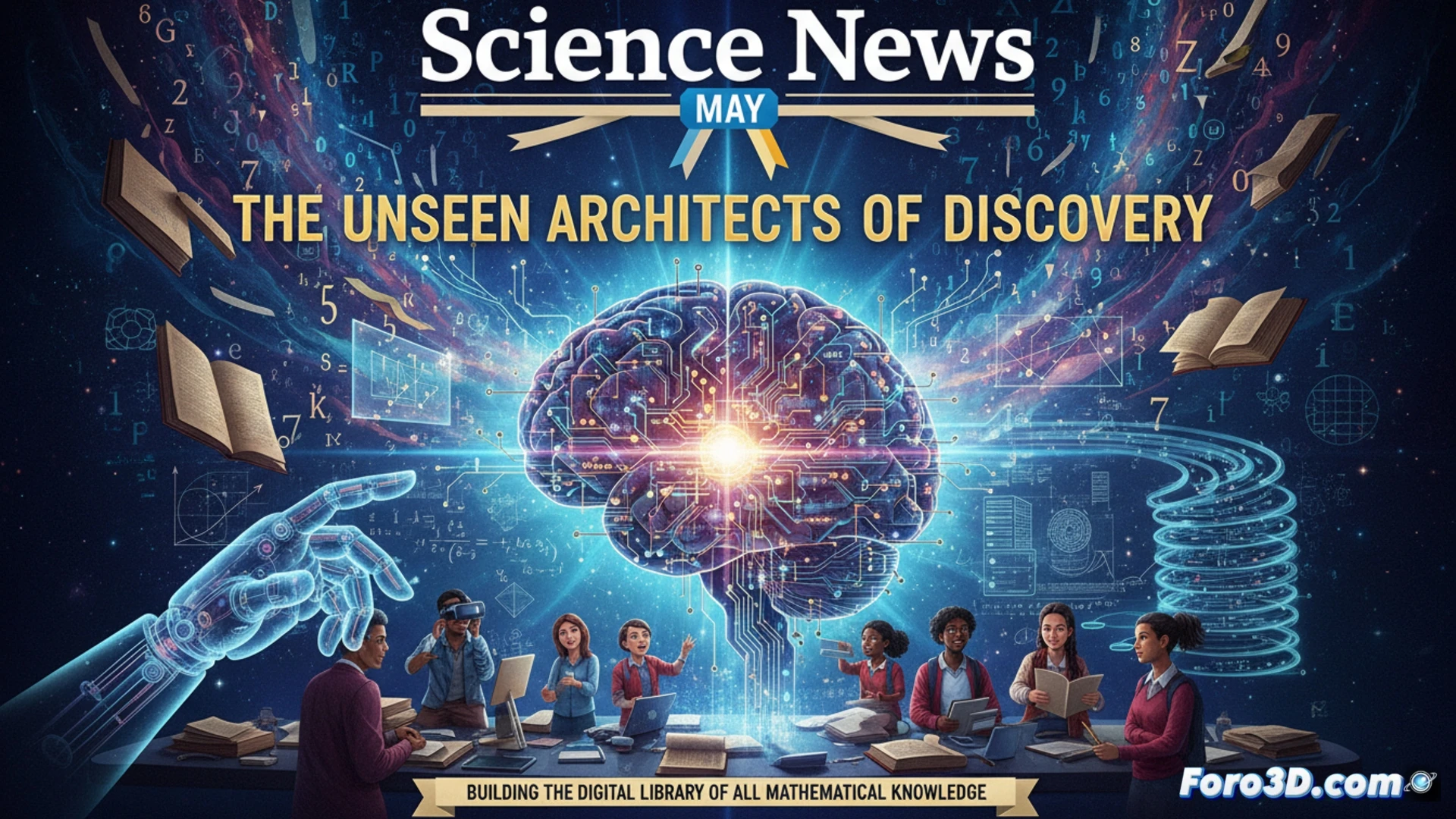
The May issue of Science News has a special audience: over sixteen hundred young people competing at the International Science and Engineering Fair. The magazine also dedicates space to reflect on the less visible work that underpins major discoveries. A clear example is in mathematics, where computers and artificial intelligence are helping to verify proofs and build a universal digital library of mathematical knowledge.
Formal Verification and the Dream of a Digital Mathematical Library 🤖
This effort is based on formal verification, a process where a proof is written in a logical language that a computer can check step by step. Projects like Lean or Isabelle are assistants that validate theorems with absolute precision. The long-term goal is to use these tools, powered by AI, to digitize and connect all existing mathematical knowledge. This would create an interactive and reliable database, where every result is rigorously linked to its premises.
Goodbye Pencil and Paper, Hello Robot Homework Grader 😅
Imagine submitting your proof and, instead of your teacher, it's an algorithm that points out an error in step 147 with relentless coldness. The future mathematician might spend more time debugging verification code than scribbling on a blackboard. There's a certain humor in thinking that, after centuries of human genius, our final legacy will be a database maintained by machines that constantly remind us of our small logical mistakes.