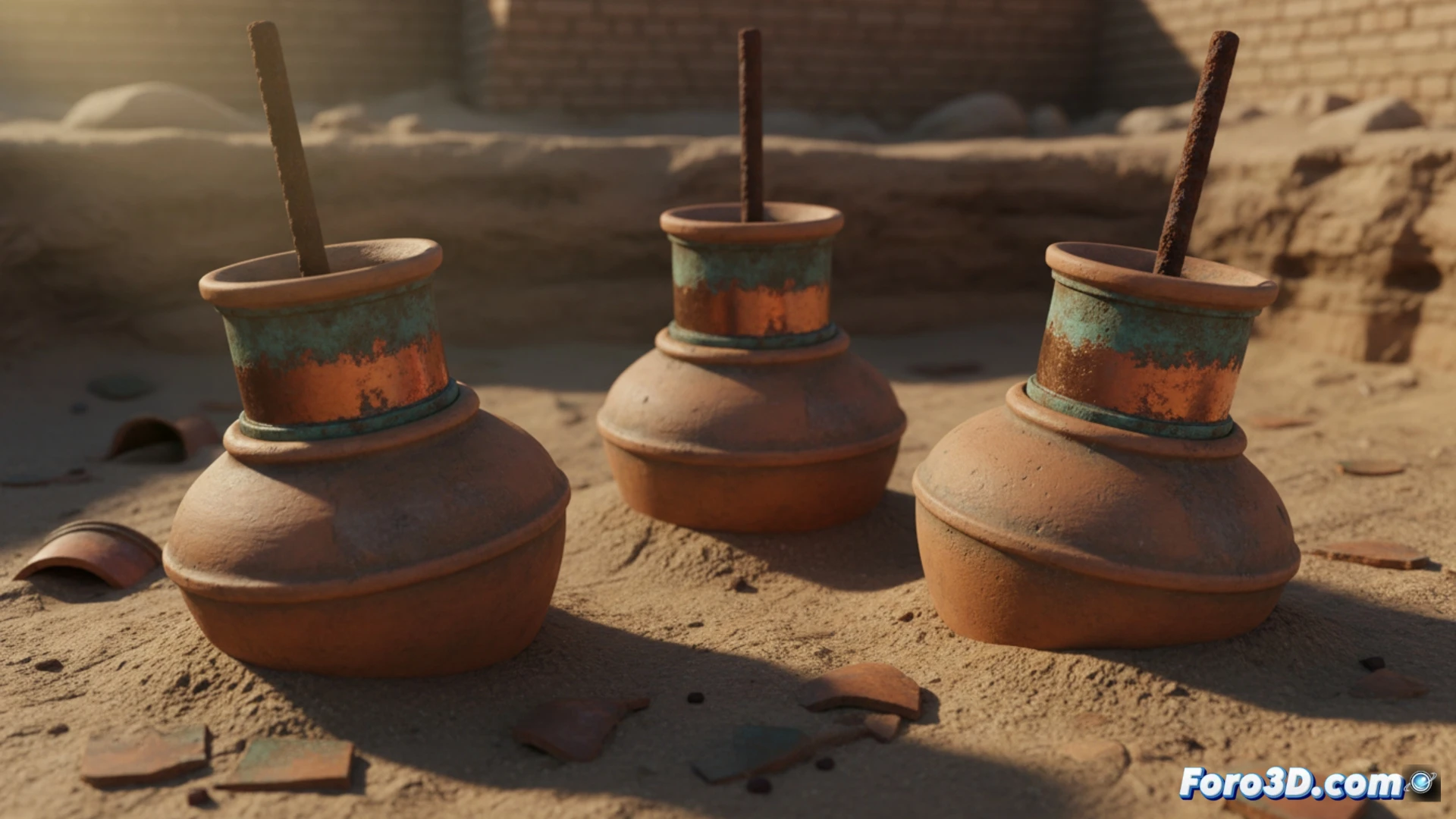
In 1936, on the outskirts of Baghdad, a puzzling artifact was discovered: a clay jar containing a copper cylinder and an iron rod, insulated with asphalt. Some researchers, like Wilhelm König, proposed that it could be a primitive galvanic cell, capable of generating a weak electric current. This object, dated between the 3rd century BC and the 3rd century AD, challenges conventional narratives about technological development and presents itself as an ideal case study for the methodologies of digital archaeology. 🧪
3D Documentation and Virtual Simulation of the Artifact 🖥️
Digital archaeology offers tools to study the Baghdad Battery without physically handling the fragile originals. Through photogrammetry or high-resolution laser scanning, a metrically precise 3D model of the jar, its internal components, and adhered sediments can be generated. This model allows for exhaustive structural analysis, exact measurements, and the visualization of hidden details. Subsequently, in a simulation environment, the hypothetical assembly with an electrolyte, such as vinegar or grape juice, can be recreated to calculate and visualize the generated electrical potentials, providing quantitative data to the debate about its functionality.
Digital Preservation and Interactive Dissemination 🌐
Beyond analysis, digitization ensures the perpetual preservation of the artifact in its current state. An interactive 3D model, accessible online or in virtual museums, allows anyone to explore the object from all angles, understand its complexity, and evaluate the proposed hypotheses. Thus, digital archaeology not only protects heritage but also democratizes its study, transforming an archaeological enigma into an open educational and research resource, fostering new interpretations and keeping the scientific discussion alive.
How could computer simulation and 3D modeling help validate or refute the electrochemical use hypothesis of the Baghdad Battery?
(PS: and remember: if you can't find a bone, you can always model it yourself)