The battle for the professional desktop is intensifying. HP has launched the Z2 Mini G1a, a workstation that directly challenges Apple's Mac Studio. Powered by an AMD Ryzen AI Max+ PRO 395 processor and the ability to house up to 128 GB of RAM, this machine promises brutal performance for 3D modeling, simulation, and rendering. But is it truly a viable alternative for the professional pipelines that dominate the market? We analyze its hardware in depth and compare it with the Cupertino giant. ⚔️
Rendering and simulation performance: CPU vs GPU 🔥
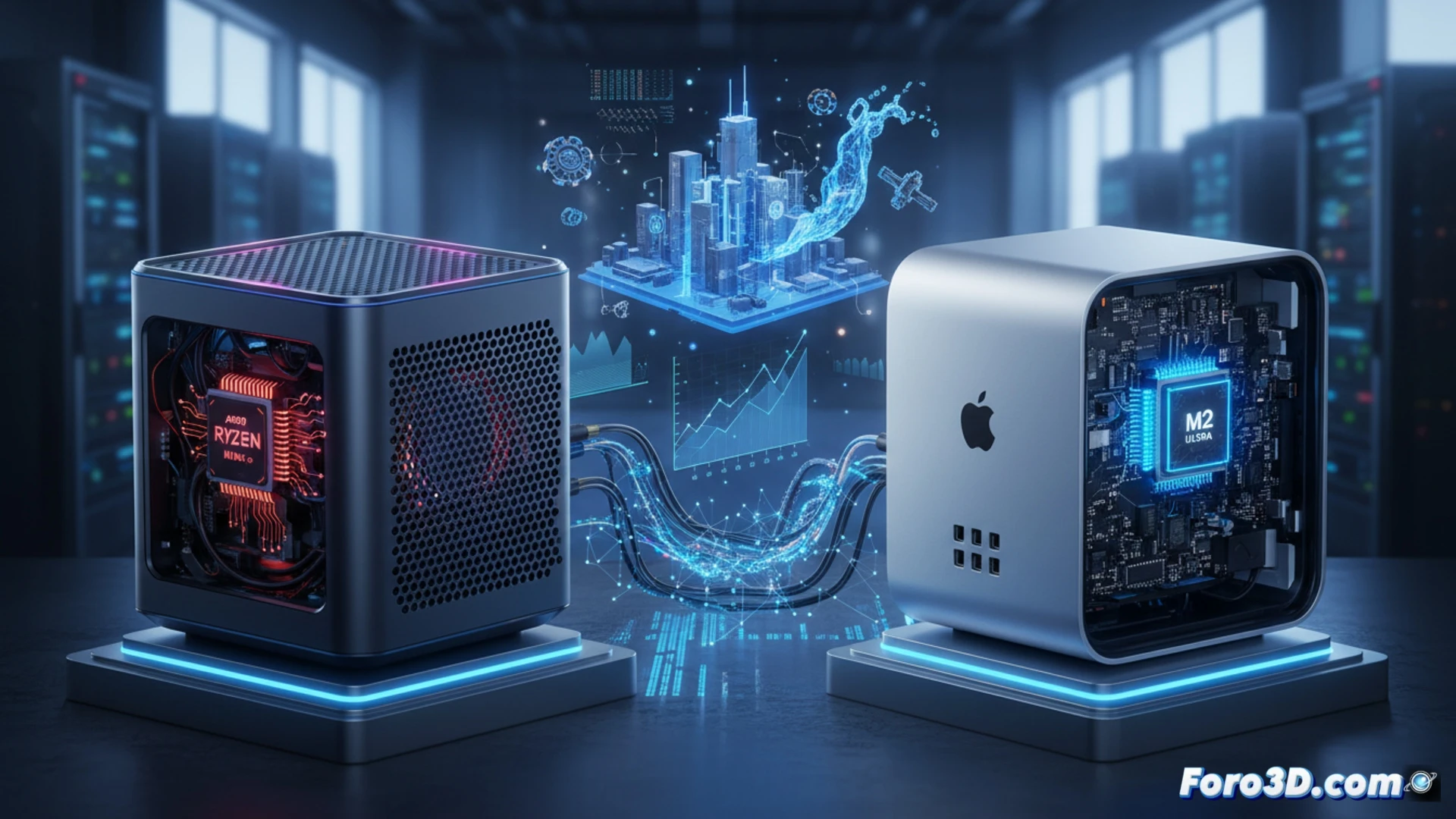
The key to the confrontation lies in the architecture. While the Mac Studio bets on the extreme integration of its M2 Ultra silicon, the HP Z2 Mini G1a uses an AMD processor with Zen 5 cores and an integrated Radeon 800M iGPU. In physical simulation tasks (such as those in Blender or Maya), the 16-core CPU of the Ryzen AI Max+ PRO 395 offers an advantage in pure logic calculations and particle simulation, outperforming the M2 Ultra in single-threaded tests. However, in final GPU rendering, AMD's iGPU falls short compared to Apple's unified GPU, which offers massive memory bandwidth. The 128 GB of unified RAM in the HP is a plus for handling extremely heavy scenes without swapping, exceeding the 96 GB limit of the Mac Studio, but the noise of its two fans under intense load can be a critical factor in a recording or silent editing studio.
Connectivity and scalability: The Thunderbolt 4 factor 🔌
For a professional 3D workflow, connectivity is as vital as the processor. The HP Z2 Mini G1a includes Thunderbolt 4 ports, allowing connection of multiple 8K monitors, external NVMe storage docks, and eGPUs to compensate for the weakness of its integrated graphics. Unlike the Mac Studio, which relies on soldered SSDs, the HP offers expandable internal storage via accessible M.2 slots, an advantage for those who need to quickly switch between projects. However, its compact chassis limits internal expansion to only two storage drives, while Apple's ecosystem allows configurations of up to 8 TB in a single volume. For the 3D artist who prioritizes modularity and hardware swapping, the HP wins; for those seeking a closed and silent ecosystem, the Mac Studio remains the queen of the desktop.
Considering the ecosystem gap between x86 and ARM, which factor is more decisive for a 3D animation studio looking to scale its rendering pipeline: native software compatibility on the Mac Studio or graphics configuration flexibility on the HP Z2 Mini G1a?
(PS: RAM is never enough, like coffees on a Monday morning)