The analysis of an aviation accident that occurred during a rainy landing revealed that the cause was not excessive speed, but a loss of friction on the runway. Through a 3D scan of the pavement's macrotexture, investigators discovered that rubber buildup from previous landings had sealed the drainage pores, facilitating hydroplaning. This article breaks down the technical workflow for calculating the actual friction coefficient and validating the forensic hypothesis. 🛩️
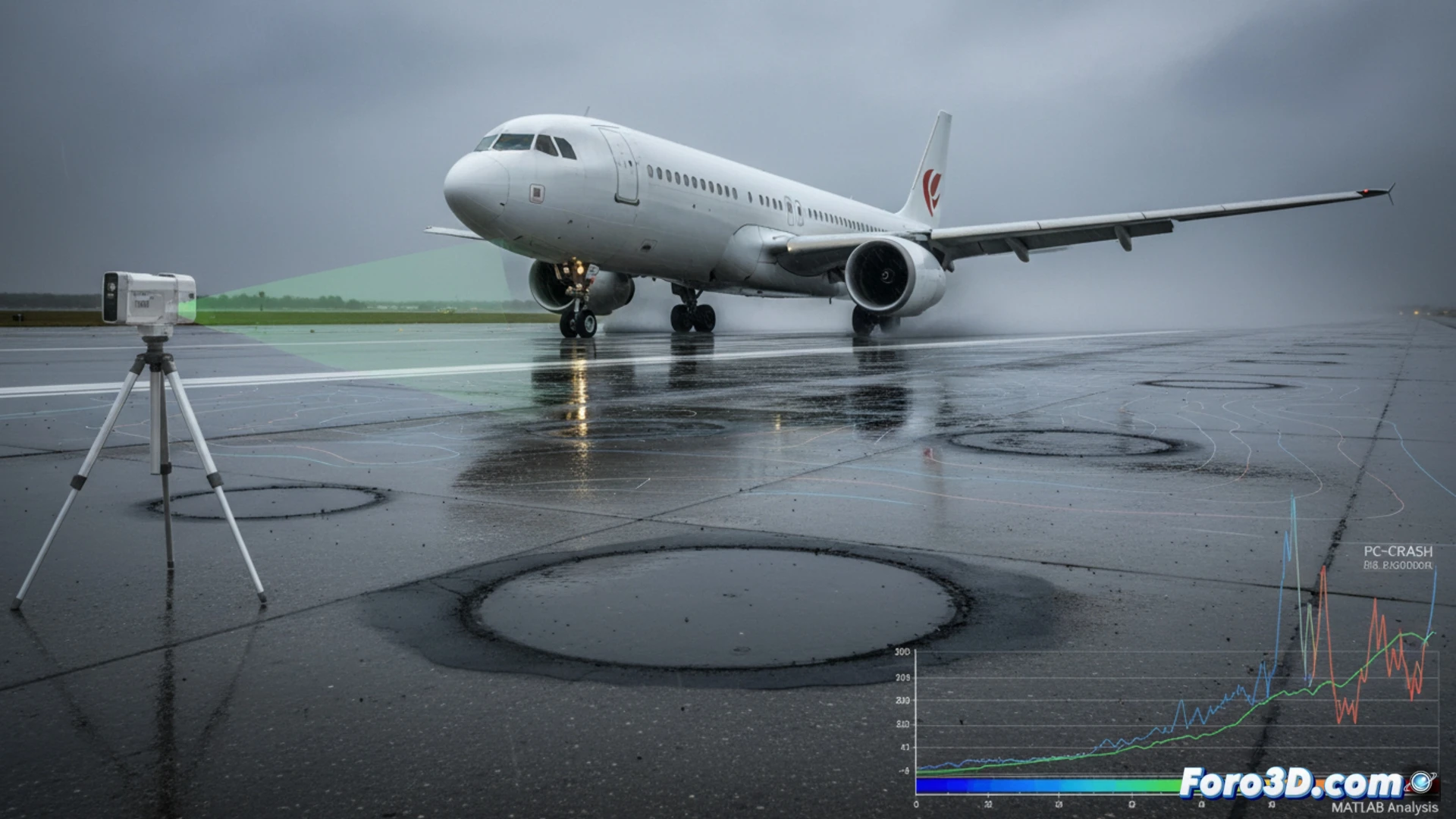
Forensic Workflow: From the Trimble SX12 Scanner to the Friction Coefficient 🔍
The process began with capturing the runway geometry using a Trimble SX12, functioning as a scanning total station. A high-density point cloud was generated to model surface roughness (macrotexture). This 3D model was exported to PC-Crash, where the impact dynamics and runway excursion trajectory were simulated. Simultaneously, the texture data was processed in MATLAB to calculate the actual friction coefficient, comparing it with standard dry runway values. The result revealed a critical reduction in grip in areas where accumulated rubber had obliterated the asphalt drainage.
The Invisible Lesson: How Accumulated Wear Alters Safety ⚙️
This case demonstrates that runway safety depends not only on current weather conditions but also on the pavement's wear history. 3D scanning allows for the detection of blind spots in visual inspection, such as micro-pore sealing by rubber. The combination of tools like the SX12 and MATLAB turns an accident into an engineering lesson, enabling airport managers to schedule corrective maintenance based on real friction data, not subjective estimates.
How is 3D scanning used to differentiate between hydroplaning marks and normal rubber wear in the reconstruction of an aircraft accident during a rainy landing?
(PS: In scene analysis, every scale witness is a small anonymous hero.)