Researchers at the Technical University of Denmark have broken the mold of solid oxide fuel cells. Using yttria-stabilized zirconia (8YSZ) and a Lithoz CeraFab printer, they have fabricated monolithic structures with a gyroid geometry. The result is a power-to-weight ratio of 1 W g⁻¹, five times higher than traditional planar cells. This breakthrough promises to transform hydrogen-powered transportation by drastically reducing the weight of energy systems. ⚡
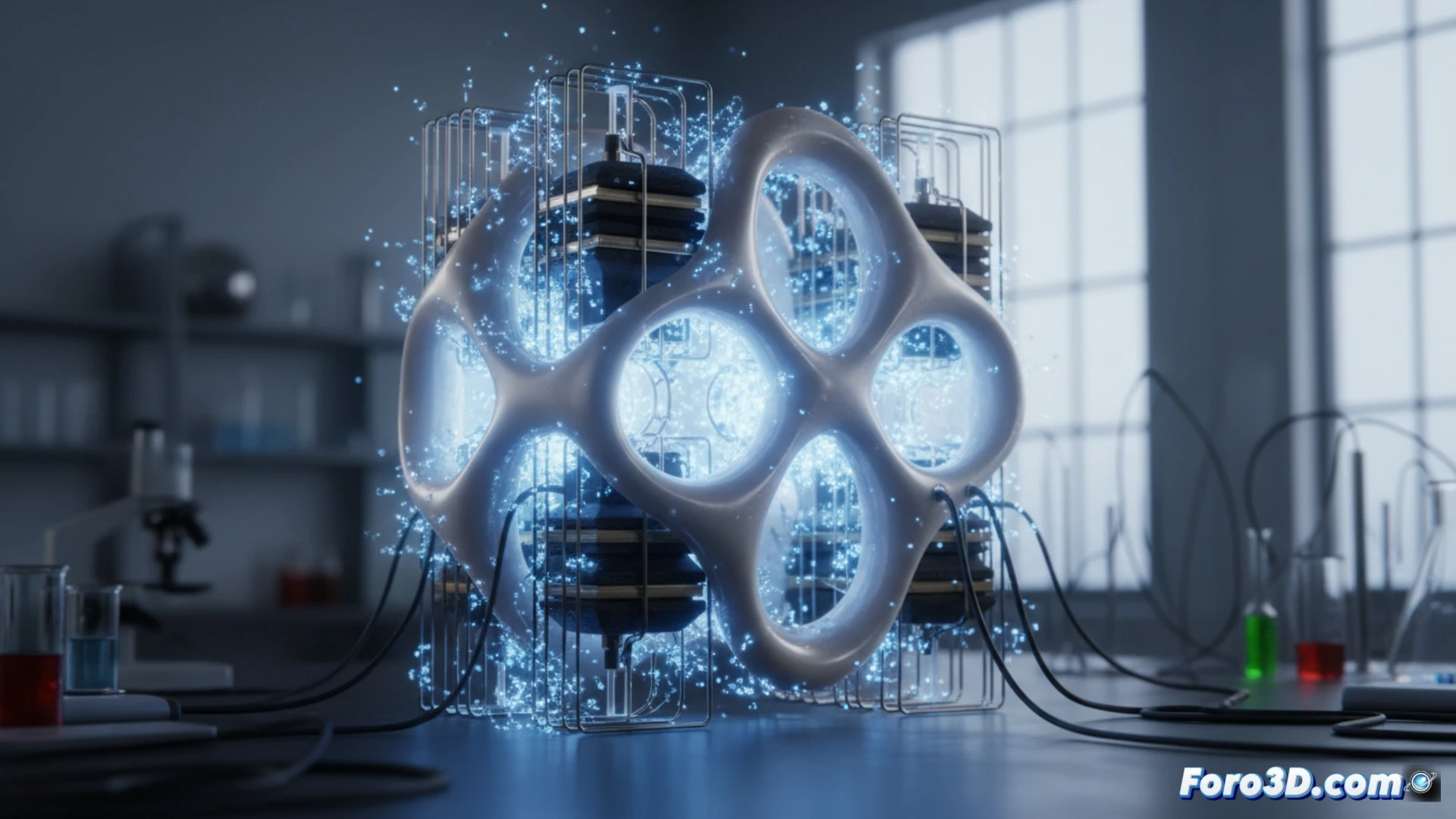
Gyroid microstructure: how geometry eliminates mechanical ballast 🧊
The key to success lies in the internal architecture. Instead of stacking planar cells with heavy interconnectors and sealants, Professor Vincenzo Esposito's team designed a single ceramic piece. The extremely thin internal walls form a gyroid network that maximizes the active surface area without compromising rigidity. 3D printing allows control over each pore and curvature, creating channels that distribute gas uniformly. Collaboration with DTU Construct validated that this structure withstands the thermal stresses of the operating cycle without fracturing. By integrating repeated gyroid units within a sealed frame, the necessary gas-tightness for cell operation is maintained.
3D simulation: visualizing the performance leap in complex ceramics 🔬
To understand the advancement, a comparative 3D simulation is revealing. By modeling heat flow and stress distribution in a planar cell versus the gyroid, it is observed how the curved geometry eliminates stress concentration points. The monolithic structure not only weighs less but also dissipates heat more homogeneously. Esposito describes the finding as a paradigm shift: 3D printing has overcome the barrier that prevented realizing this microarchitecture in conductive ceramics. The next step is to scale up production to integrate these cells into lightweight and efficient hydrogen vehicles.
How does the gyroid geometry of 3D-printed zirconia affect the ionic conductivity and thermal durability of solid oxide fuel cells compared to conventional structures?
(PS: Visualizing materials at the molecular level is like looking at a sandstorm with a magnifying glass.)