An anomaly in the cooling system of a nuclear power plant triggered all alarms. The area, highly radioactive, was inaccessible to human personnel. The solution came in the form of an ROV robot equipped with a Faro Focus scanner and 3D ultrasound sensors. After data capture, the volumetric model created in VGSTUDIO MAX revealed neutron-induced swelling in critical welds, identifying the exact point of a potential leak before it occurred.
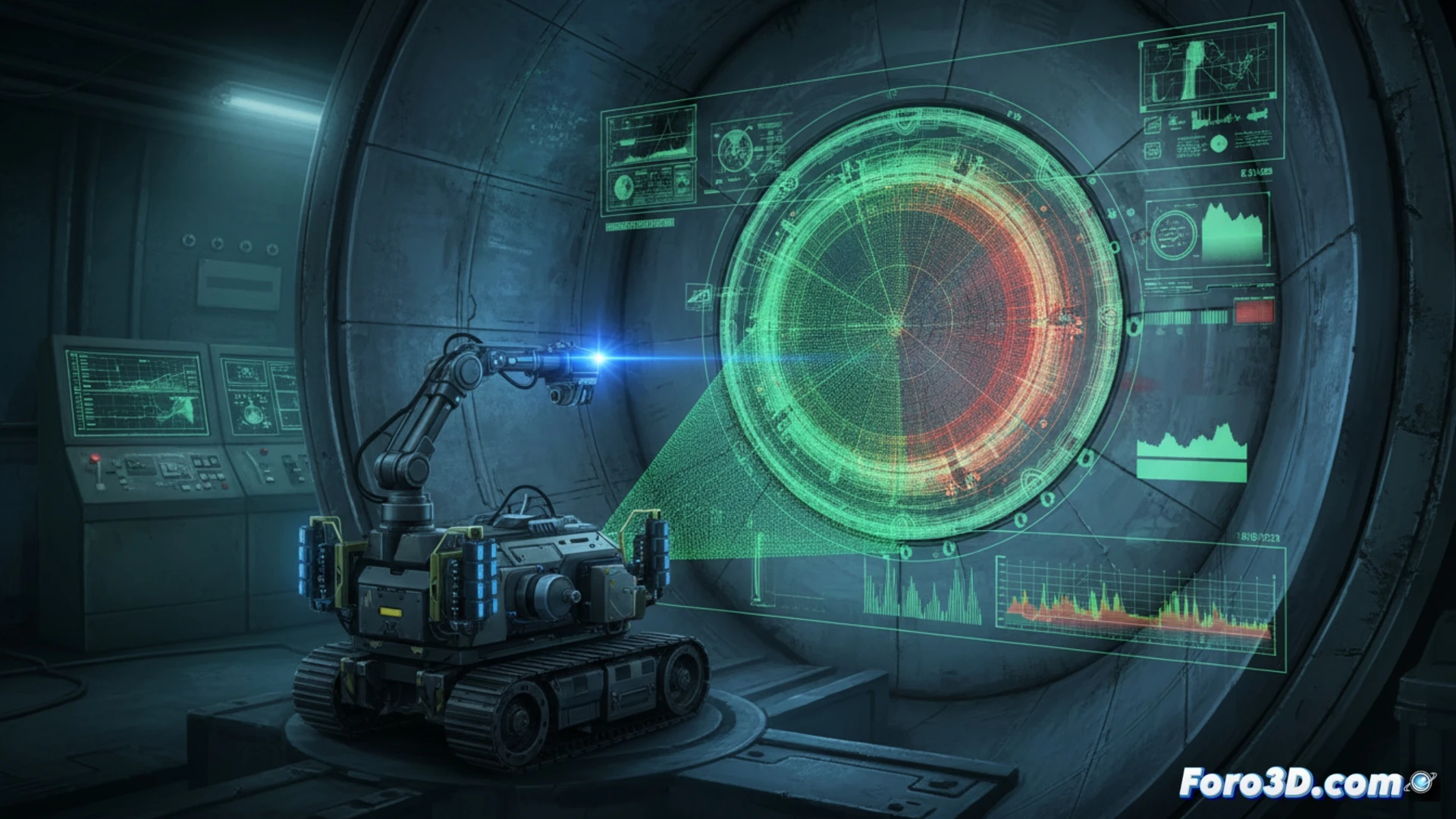
Technical workflow: from ROV to multiphysics simulation 🤖
The process begins with the ROV deployed inside the vessel. The Faro Focus performs a high-precision laser scan, generating a point cloud that is processed in VGSTUDIO MAX. Here, the software analyzes material density and detects micro-deformations caused by neutron irradiation, a phenomenon known as swelling. This data is exported to COMSOL Multiphysics, where thermal and pressure loads are applied. The simulation predicts fatigue in the affected welds, allowing maintenance shutdowns to be scheduled without risk of catastrophic failure.
The value of the digital twin in nuclear maintenance ⚛️
This case demonstrates that a digital twin is not just a visual replica, but a predictive model that saves lives. The combination of laser scanning, volumetric analysis, and multiphysics simulation allows engineers to anticipate failures in environments where human inspection is lethal. In the nuclear sector, where a leak can have global consequences, this technological synergy turns data into precise decisions, reducing unnecessary shutdowns and maximizing operational safety.
What type of sensor or 3D scanning technology is most effective for detecting micro-cracks in real-time inside a nuclear reactor vessel and how does it integrate with the digital twin to predict leaks before they occur?
(PS: My digital twin is currently in a meeting, while I am here modeling. So technically, I am in two places at once.)