A building with a concave glass facade concentrated sunlight onto a precise point on the sidewalk, melting parts of vehicles and causing burns to pedestrians. This phenomenon, colloquially known as the death ray, was not a random weather accident but the result of negligence in architectural design. To prove this, a digital twin of the building was constructed, replicating its exact geometry and simulating solar reflection at different times of the year.
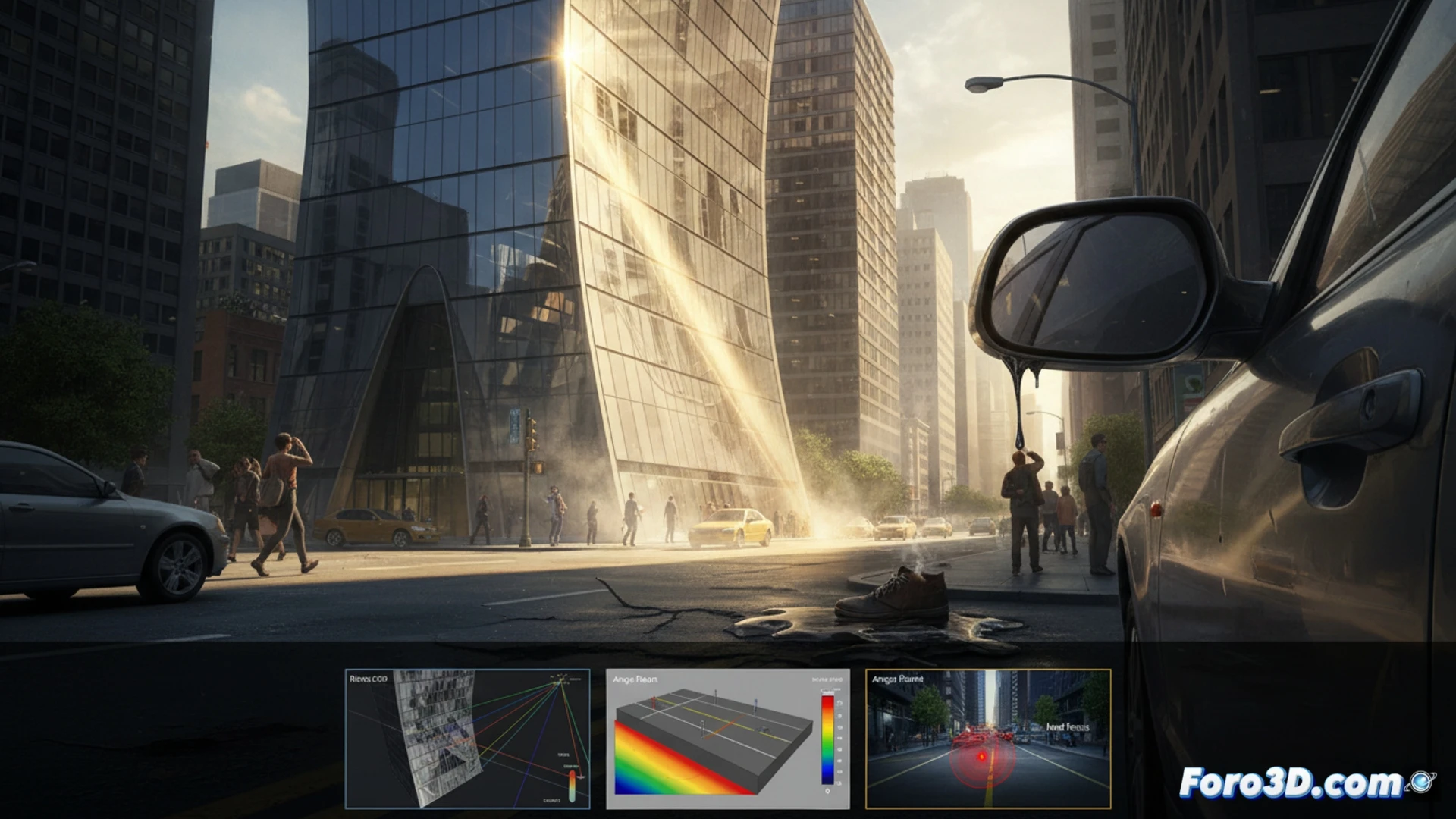
Technical pipeline: from Rhino to Unreal Engine for thermal simulation 🔥
The digital twin was modeled in Rhino 3D with Grasshopper, parameterizing the exact curvature of the facade. Ladybug was integrated for solar analysis, calculating the sun's path in each season and mapping the points of light concentration. This data was exported to Ansys Fluent, where heat transfer on the glass surface and the focal point on the pavement were simulated. Finally, Unreal Engine visualized the displacement of the heat focus in real time, showing how the energy intensified at noon in summer. This pipeline made it possible to accurately replicate the conditions that caused material damage and injuries.
The forensic value of the digital twin in architecture ⚖️
Beyond technical simulation, this case demonstrates that a digital twin is not only useful for optimizing a building's performance but also as expert evidence in negligence litigation. The ability to virtually recreate the exact solar conditions of a specific day allows forensic experts to prove that the original design violated basic safety standards. In an industry where aesthetics often take precedence over physics, this technology stands as an objective and irrefutable witness.
Unreal or Unity for visualizing this twin?