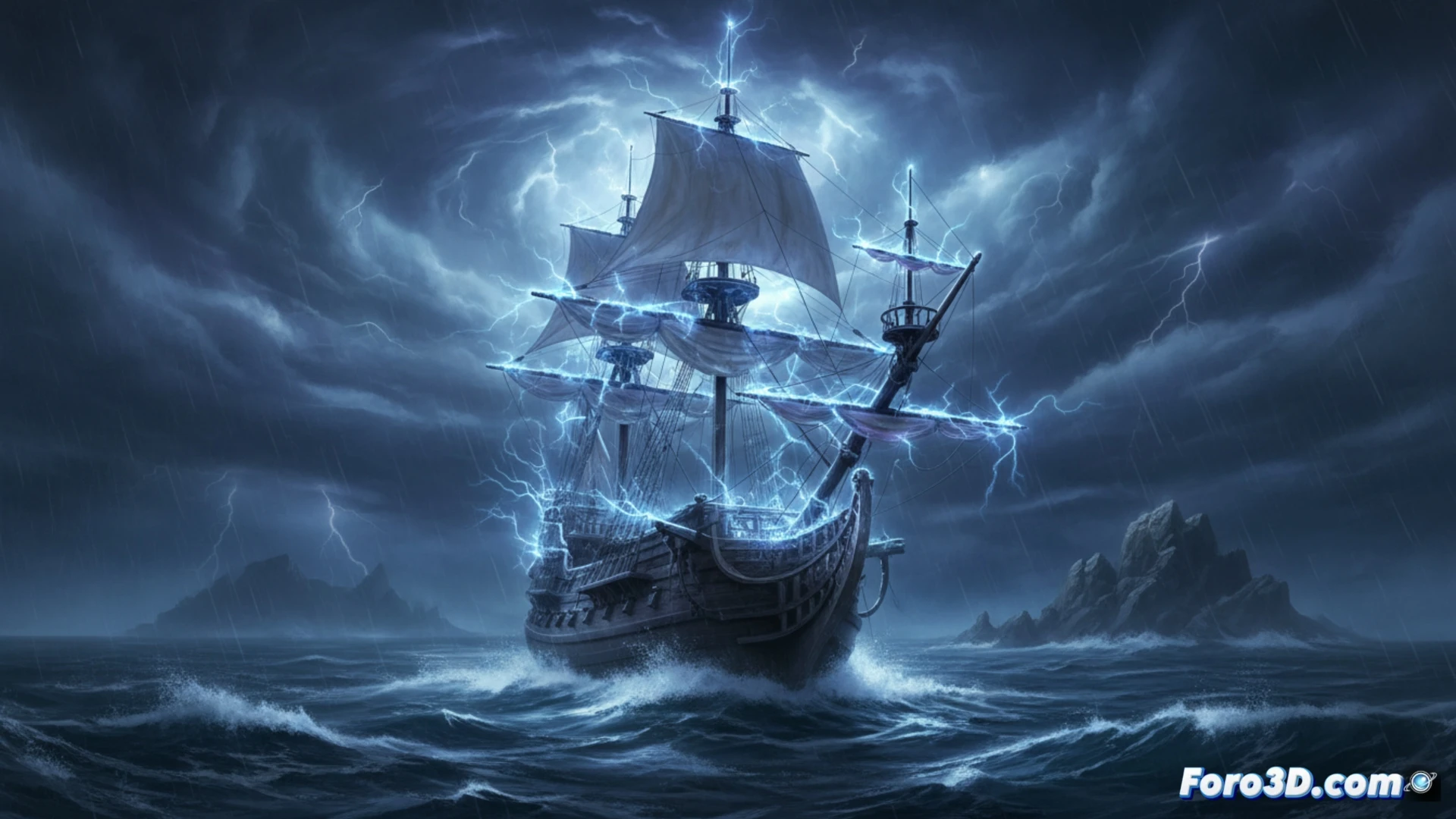
For centuries, sailors watched with terror and fascination as a bluish glow danced on the masts of their ships during storms. Known as St. Elmo's Fire, this phenomenon ceased to be a mystical omen to become an object of scientific study: a luminous discharge caused by the ionization of air on pointed objects. Today, 3D visualization tools allow us to precisely break down and recreate this electrical beauty, fusing physics and digital graphics. ⚡
From Plasma Physics to Digital Particles 🔬
The scientific basis is a weak plasma, an ionized gas where excited air molecules emit light as they return to their stable state. To simulate it in 3D, the process begins with researching references and the physics of corona discharges. Then, in software like Blender or Houdini, the main geometry, such as a mast, is modeled. The key lies in particle systems: they are emitted from points of highest charge (sharp vertices) and controlled with force fields that simulate wind and the erratic movement of the phenomenon. The materials, with self-emission (Emission Shader) and a scattering volume, give that ethereal, bluish glow.
Scientific Visualization as an Educational Tool 🧠
Recreating St. Elmo's Fire in 3D transcends the artistic. It is an exercise in scientific visualization that allows isolating variables, showing the intimate process of ionization, and freezing a fleeting event for analysis. These photorealistic representations, validated by science, are powerful for outreach, demystifying the somber and explaining the complex through a clear and attractive image that anyone can understand and appreciate.
How can the light emission and filamentous structure of St. Elmo's Fire be realistically recreated in 3D using particle simulations and volume shaders?
(PS: at Foro3D we know that even manta rays have better social connections than our polygons)