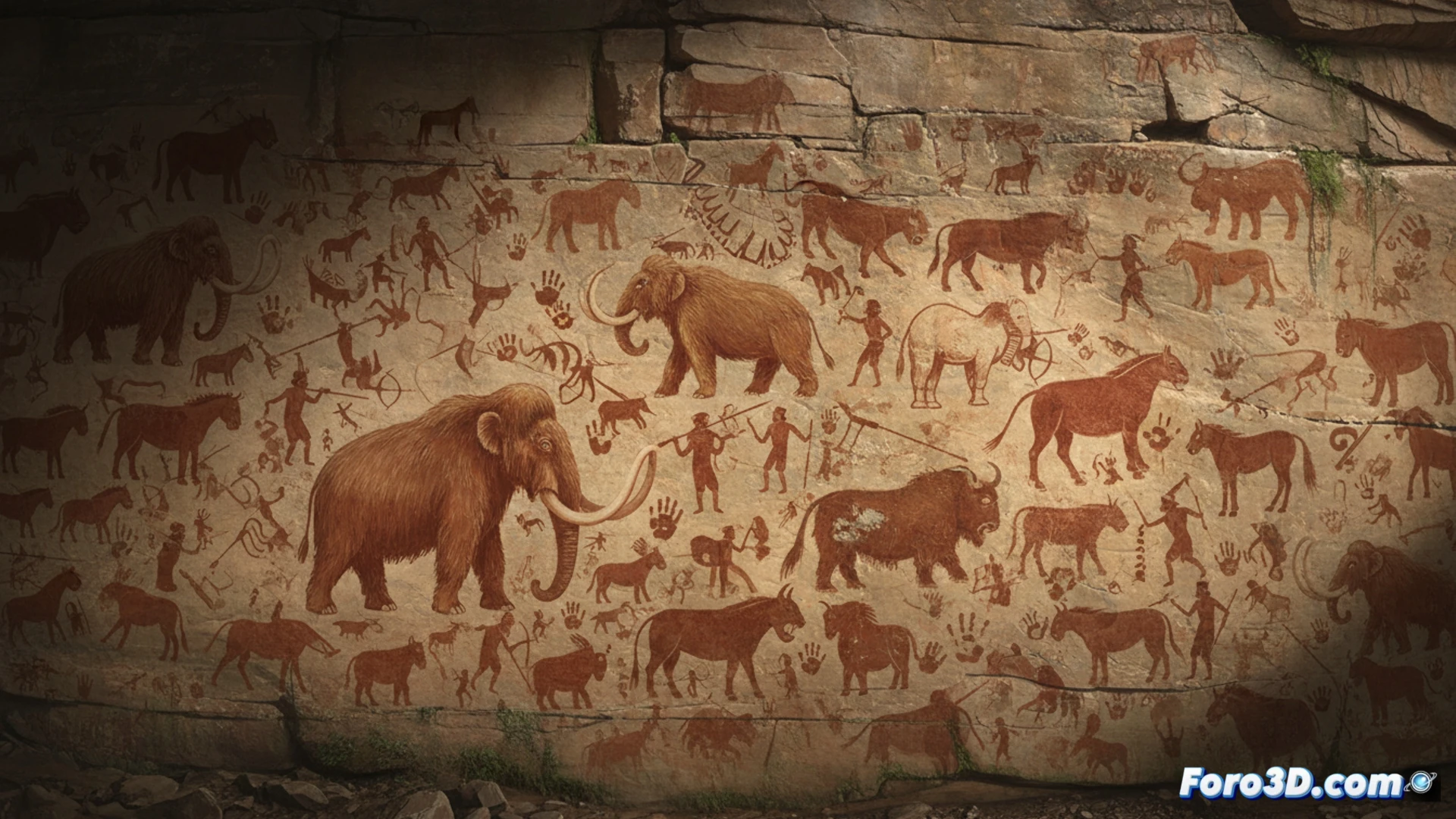
In the Serranía de la Lindosa, Colombia, a vast 12-kilometer-long rock art mural has been discovered, featuring thousands of paintings dated to around 12,000 years ago. This archaeological treasure, which includes depictions of already extinct Ice Age megafauna, faces natural and human threats. Digital archaeology emerges as the key tool for its preservation and study, employing 3D technologies to capture this legacy in detail before it degrades.
Digital documentation techniques: drones, laser, and point clouds 🚁
Documenting this colossal site requires non-invasive methods. Drone photogrammetry allows capturing high-resolution images of inaccessible panels, generating textured 3D models and precise orthomosaics. Complementarily, terrestrial laser scanning (LiDAR) captures the exact geometry of rock shelters, even under dense vegetation. These techniques merge data to create a comprehensive digital replica, a millimeter-precise point cloud that allows researchers to measure, analyze, and study the strokes and figures of giant animals, such as mastodons, without setting foot on the fragile site.
Virtual preservation and immersive heritage outreach 🕶️
The resulting 3D model transcends mere documentation. It becomes a permanent archive for virtual preservation, enabling remote and multidisciplinary analysis. Furthermore, it facilitates the creation of immersive experiences, such as virtual tours or augmented reality reconstructions, which democratize access to this discovery. Thus, technology not only protects the art of the past but projects it into the future, connecting a global audience with a unique testimony of human prehistory.
How can 3D photogrammetry overcome the challenges of scale and environment to accurately and accessibly document a 12-kilometer-long rock art mural?
(PS: If you dig at a site and find a USB drive, don't plug it in: it could be Roman malware.)